Square Meter to Hectare Converter
Convert square meters to hectares, acres, square feet, and practical farm blocks while accounting for plot dimensions, usable percentage, crop block size, and irrigation zone size.
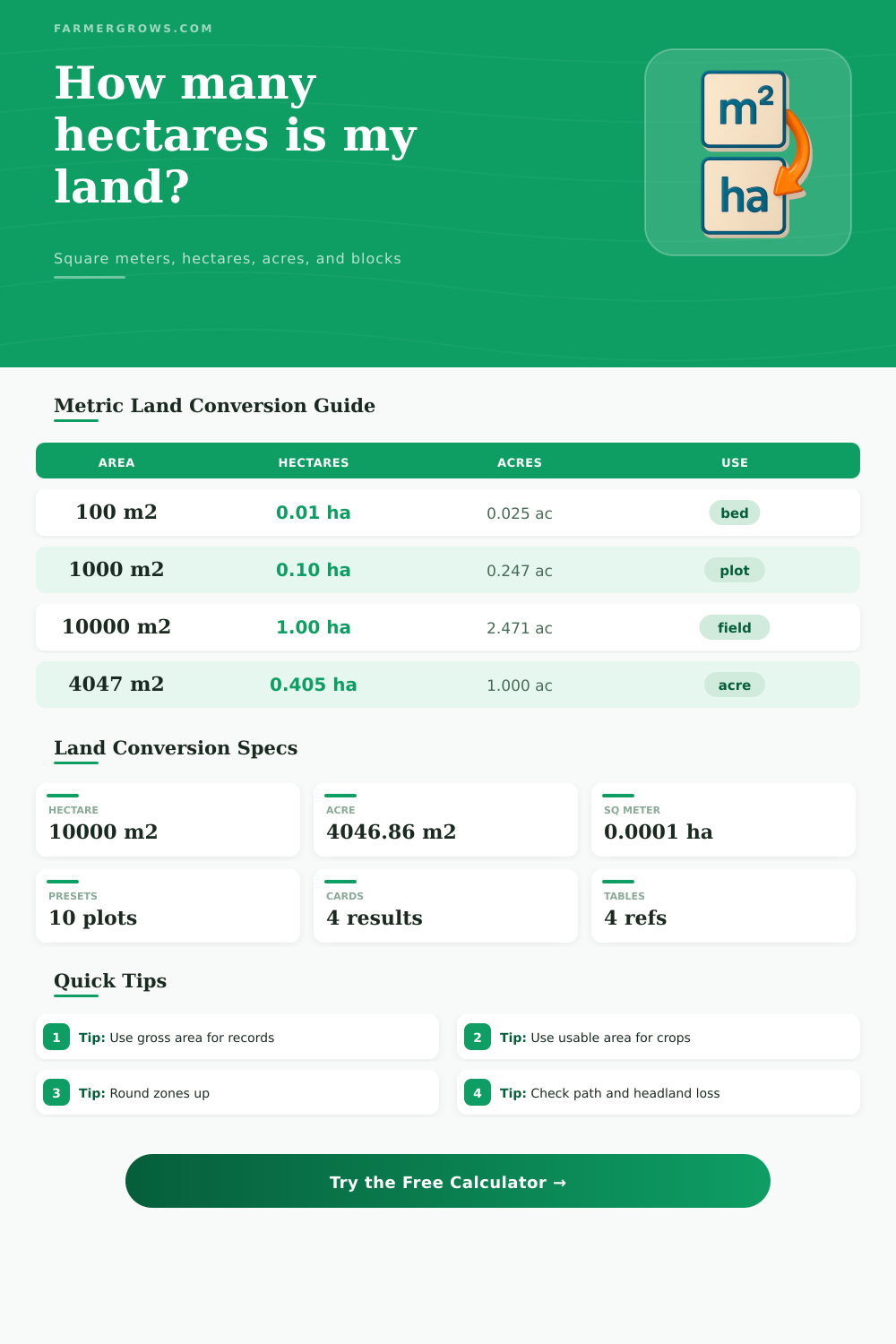
Use direct square meters or enter plot dimensions. The calculator keeps the official conversion simple: 1 hectare equals 10,000 square meters. Usable area, crop blocks, and irrigation zones are planning helpers, not changes to the legal land area.
Land Conversion Results
Enter an area to convert square meters into hectares, acres, and planning blocks.
| Square meters | Hectares | Acres | Field note |
|---|---|---|---|
| 50 m2 | 0.005 ha | 0.012 ac | Small bed, nursery, or greenhouse bench area. |
| 100 m2 | 0.010 ha | 0.025 ac | Compact garden or trial planting block. |
| 500 m2 | 0.050 ha | 0.124 ac | Large home plot or small market block. |
| 1,000 m2 | 0.100 ha | 0.247 ac | One tenth hectare for simple field planning. |
| 10,000 m2 | 1.000 ha | 2.471 ac | One full hectare. |
| Unit | Equals | Formula from m2 | Use case |
|---|---|---|---|
| Hectare | 10,000 m2 | m2 / 10,000 | Metric land records, farm maps, crop reporting. |
| Acre | 4,046.856 m2 | m2 / 4,046.856 | US field notes and mixed-unit parcel comparisons. |
| Square foot | 0.092903 m2 | m2 x 10.7639 | Building pads, sheds, and small plot materials. |
| Square yard | 0.836127 m2 | m2 x 1.19599 | Sod, fabric, netting, and surface cover estimates. |
| Are | 100 m2 | m2 / 100 | Garden and small parcel references in some records. |
| Rectangle size | Square meters | Hectares | Planning note |
|---|---|---|---|
| 10 m x 10 m | 100 m2 | 0.010 ha | Good for a small intensive bed block. |
| 25 m x 40 m | 1,000 m2 | 0.100 ha | Easy tenth-hectare layout. |
| 50 m x 80 m | 4,000 m2 | 0.400 ha | Comparable to just under one acre. |
| 100 m x 100 m | 10,000 m2 | 1.000 ha | Square one-hectare reference block. |
| 120 m x 200 m | 24,000 m2 | 2.400 ha | Useful for paddock or orchard planning. |
| Usable percent | Typical reason | 1 hectare usable | Field note |
|---|---|---|---|
| 95% | Minor paths and clean edges | 9,500 m2 | Good for simple rectangular crop ground. |
| 85% | Headlands, paths, and irrigation lines | 8,500 m2 | Common for market gardens and mixed crops. |
| 75% | Access lanes, slopes, drains, shade | 7,500 m2 | Useful for irregular plots or tree crops. |
| 60% | Buildings, wide roads, wet corners | 6,000 m2 | Use for mixed farmyards and constrained land. |
Keep legal and working area separate: use the gross square meter and hectare result for land records, then use the usable result for crop planning, seed, irrigation, and labor estimates.
Round practical systems upward: crop blocks may round down to avoid overpromising space, but irrigation zones usually round up so every part of the usable area can be watered.
Land is rarely shape in the form of a perfect rectangle. Land plots are irregular as they may contain ditch or slopes in them. A person may own land that exists in the form of a long strip of land or land that has an irregular slope.
In order to manage the land efficient, the land must be measured to determine how many seed of crops to order, as well as the size of the irrigation valve for that land plot. Land measurements must be converted from one unit to another as official records use hectares instead of the units that most individuals are used to utilizing for area measurements. Ten thousand square meters are equivalent to one hectare.
Measure and Plan Your Farm Land
Within a land plot, there is a difference between the gross area of the land and the usable area of the land. The gross area of the land is the total area of the land plot that is listed on the deed for the land. However, the usable area of the land is that portion of the land plot that can be used to planting crops.
Much of the gross area may be occupied by feature of the land plot that are not utilizable for farming activities. A square meter to hectare converter allow for individuals to include the percentage of the land that is usable for farming activities. The percentage can help individuals to determine how many seed to order for example, as purchasing too many seed will result in unnecessary work to sow the seeds on the land.
The usable area of the land can be divided into crop blocks. Many farm plots include crop blocks that the farmer is to be used in repeating way. The size of the crop block can impact the number of individual that are required to manage the land.
For instance, an individual that performs the activities by hand can manage a small area. However, the area is too small for a tractor to efficient perform work on the land. A hectare to square meter converter can allow individuals to decide how many of these crop block can be created within the usable area of the land plot.
Any remaining area after dividing the usable area into crop blocks can be used as an access lane for farming equipment to travel along the land. Within the usable area, the land can be divided into irrigation zone. Individually, many drip lines and sprinklers within the usable area may be grouped into these irrigation zones.
By knowing the area of each irrigation zone that can be created with the land’s resources, such as pump and valve limits, individuals can use that information to determine the number of irrigation zone that will be created. The hectare to square meter converter can round up the number of irrigation zones as it is better to have a zone with slightly less water than the needed amount rather than having a zone that is without water altogether. Hectares can be converted to acres to help individuals who are more familiar with imperial unit and measurements.
One hectare is equal to 2.5 acres. Thus, 20 hectare would be 50 acres. Individuals should ensure that both hectare and acre measurements are visible to ensure that they do not make an error in the land management plan.
An error in measurement will result in an impossible workload to be completed by the individual farmer. The legal area of the land is different than the planned area of the land. The legal area is the area of the land that is listed on the deed for the land plot and is used for tax and rental rate determinations.
The planned area is the area that the farmer will be to be seeded, watered, and harvested. The planned area will have less area than that of the legal area due to the exclusion of areas of the land that will not be used for farming activities. Both of these area should be separately accounted for by the land owner.
Reference tables can help individuals to understand the area of the land. For instance, 50 by 50 meter squares is half of a hectare in size. Additionally, one acre is slightly more than 4,000 square meters.
These reference tables can help individuals understand small change in land dimensions and how that can have an impact upon the total area that can be managed. For instance, increasing the length and width of a 50 by 80 meter square by only ten meters will increase the area by over 1,000 square meters. These square meters is equivalent to an entire additional crop block that can be planted with crops.
Individuals can calculate how much of the land will be required for access by farming equipment. For instance, four meter headlands may be required around each block of land for access. However, four meter headlands may eliminate fifteen percent of the total gross area of the land plot.
The usable percentage of land that is usable for farming activities can be entered into a converter to determine how much land may be lost to these access requirement. Additionally, individuals may want to leave some percentage of the usable area of the land unallocated for future use, such as land for future drainage work. Reserving a percentage of the land will allow the land owner to have a more stable land plot throughout the year that may experience changes in usability of portions of the land plot.
The hectare to square meter converter can help individuals with calculations. However, it does not make the land management and planning decision for the individual. For instance, an individual must decide how much of the land will be productive ground as compared to infrastructure.
Additionally, an individual must decide how many crop block will be created based off the number of individuals that are available to manage each block of land. Additionally, an individual must decide if the irrigation system for the land has enough pump to provide water to each irrigation zone that is created. An individual will use the numbers that are calculated and displayed with the hectare to square meter converter to make these management and planning decisions.