Square Feet to Acreage Calculator
Convert square feet to acres, hectares, and square meters while accounting for multiple parcels, length-width measurements, usable percent, setbacks, slope, and optional area-based cost or seed estimates.
Use measured land area for planning only. Surveys, deeds, easements, waterways, drives, and local zoning rules can change the legal or buildable acreage.
Acreage Conversion Results
Enter square feet or dimensions to calculate acreage.
| Square feet | Acres | Hectares | Square meters | Typical planning use |
|---|---|---|---|---|
| 1,000 sq ft | 0.02296 ac | 0.00929 ha | 92.90 sq m | Small garden, greenhouse pad, animal pen |
| 2,500 sq ft | 0.05739 ac | 0.02323 ha | 232.26 sq m | Market garden bed block or compact yard |
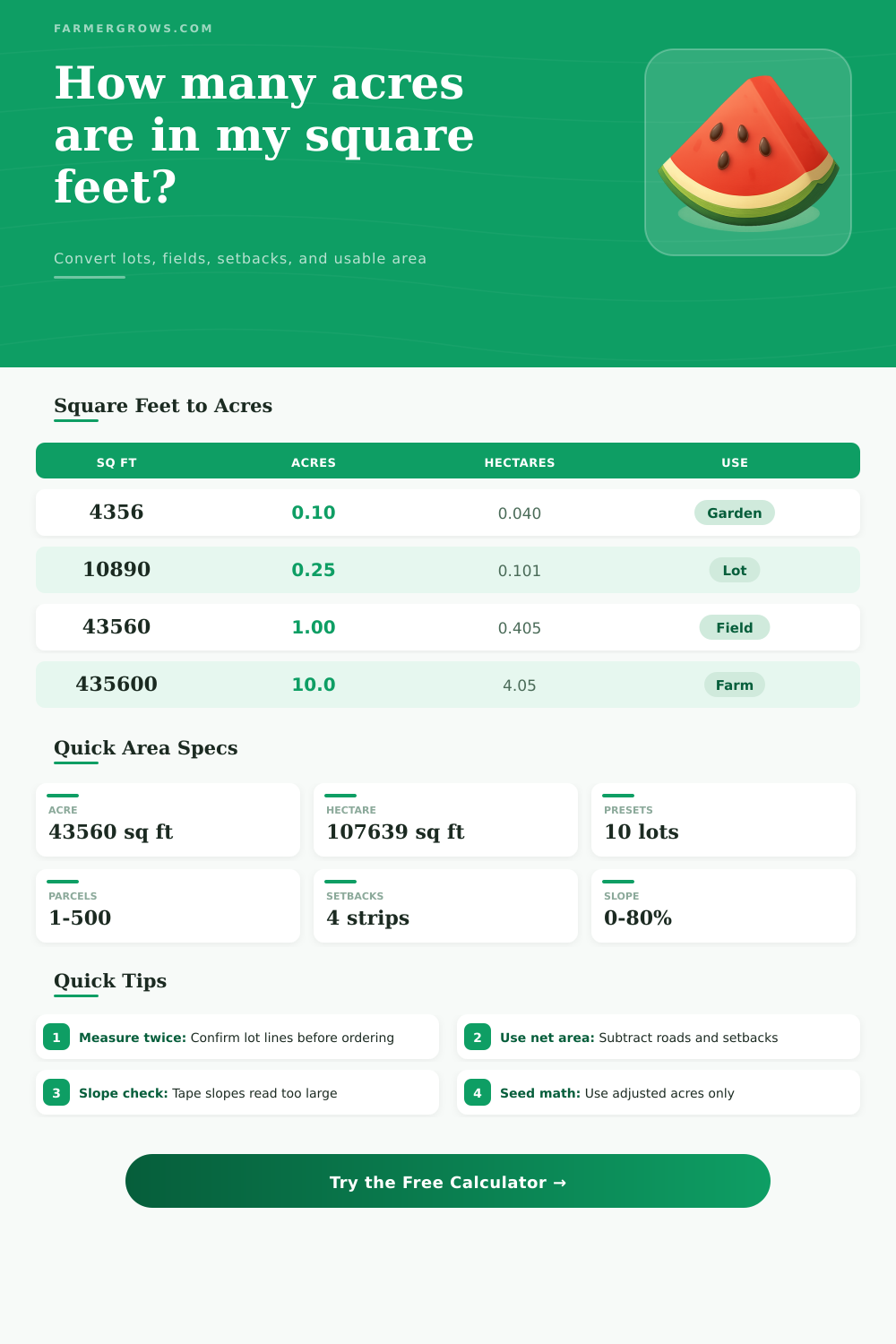
| 4,356 sq ft | 0.10000 ac | 0.04047 ha | 404.69 sq m | One-tenth acre lot or intensive garden |
| 5,000 sq ft | 0.11478 ac | 0.04645 ha | 464.52 sq m | Common city lot size |
| 10,890 sq ft | 0.25000 ac | 0.10117 ha | 1,011.71 sq m | Quarter-acre home parcel |
| 21,780 sq ft | 0.50000 ac | 0.20234 ha | 2,023.43 sq m | Half-acre homestead or paddock |
| 43,560 sq ft | 1.00000 ac | 0.40469 ha | 4,046.86 sq m | One acre field, pasture, or lot |
| 435,600 sq ft | 10.000 ac | 4.0469 ha | 40,468.6 sq m | Small farm block or crop field |
| Preset | Area or dimensions | Acres | Hectares | Planning note |
|---|---|---|---|---|
| 0.10 acre backyard | 4,356 sq ft | 0.100 ac | 0.040 ha | Small food plot, garden, or play yard |
| City lot | 5,000 sq ft | 0.115 ac | 0.046 ha | Urban parcel with access and setback limits |
| 60 x 121 ft home lot | 7,260 sq ft | 0.167 ac | 0.067 ha | Typical suburban rectangle before setbacks |
| Quarter-acre parcel | 10,890 sq ft | 0.250 ac | 0.101 ha | Common residential acreage listing |
| Half-acre homestead | 21,780 sq ft | 0.500 ac | 0.202 ha | Room for house, garden, access, and small livestock |
| One-acre field | 43,560 sq ft | 1.000 ac | 0.405 ha | Base unit for seed, spray, and mowing rates |
| 2.5 acre paddock | 108,900 sq ft | 2.500 ac | 1.012 ha | Rotational grazing or horse turnout estimate |
| 10 acre crop field | 435,600 sq ft | 10.000 ac | 4.047 ha | Small farm block for input planning |
| Parcel rectangle | Setback strips | Gross area | Remaining rectangle | Remaining acres |
|---|---|---|---|---|
| 50 x 100 ft | 10 ft front, 5 ft back, 5 ft sides | 5,000 sq ft | 40 x 85 ft = 3,400 sq ft | 0.0781 ac |
| 60 x 121 ft | 20 ft front, 10 ft back, 5 ft sides | 7,260 sq ft | 50 x 91 ft = 4,550 sq ft | 0.1045 ac |
| 100 x 150 ft | 25 ft front, 15 ft back, 10 ft sides | 15,000 sq ft | 80 x 110 ft = 8,800 sq ft | 0.2020 ac |
| 208.71 x 208.71 ft | 30 ft front, 20 ft back, 15 ft sides | 43,560 sq ft | 178.71 x 158.71 ft = 28,367 sq ft | 0.6512 ac |
| 660 x 660 ft | 40 ft field edge buffer on all sides | 435,600 sq ft | 580 x 580 ft = 336,400 sq ft | 7.7227 ac |
| Average slope | Horizontal factor from ground measurement | Surface sq ft equal to 1 acre horizontal | Approx difference | Use note |
|---|---|---|---|---|
| 0% | 1.0000 | 43,560 sq ft | 0.0% | Flat ground or map area |
| 5% | 0.9988 | 43,614 sq ft | 0.1% | Usually small enough to ignore for rough planning |
| 10% | 0.9950 | 43,777 sq ft | 0.5% | Useful for taped pasture or hillside beds |
| 20% | 0.9806 | 44,423 sq ft | 1.9% | Noticeable on rolling ground |
| 30% | 0.9578 | 45,478 sq ft | 4.2% | Correct ground-surface measurements |
| 50% | 0.8944 | 48,696 sq ft | 10.6% | Steep site; survey methods matter |
Keep gross and usable acreage separate. Deeds, tax records, maps, seed rates, and mowing quotes may all use different versions of "area," so label whether your number is gross, buildable, planted, or maintained.
Use setbacks before percent reductions. Strip setbacks remove a fixed rectangle first; then apply usable percent for irregular losses such as ditches, trees, lanes, shaded corners, or wet ground.
When planning a project on a piece of land, determining the acreage that is usable for the project is essential. While it is true that a person can measure the square footage of a tract of land with ease with a tape measure or a map, the decisions that is made regarding that land will usualy refer to the acreage of that tract of land. A square foot to acreage calculator will help to convert the square footage of a tract of land to acres, and also allow the user to account for difference between the total area of the land and the usable area of that land.
The total area of the land may not be the same as the area that can be used for the project due to various reasons. For example, the total area of the land may need to have setbacks for roads, setbacks for neighbors land, or even setbacks for drainage areas that are removed from the usable area. A square feet to acreage calculator allow for the area of these setbacks to be accounted for first, and then allows the user to account for any other losses that may occur due to features of the land (like trees or wet corner) by allowing the user to enter a usable percent.
How to Find Usable Acres of Land
The slope of the land may also impact how the acreage is measured; if the land feature a slope, a tape measure will measure a different distance along that slope then horizontally. Both mode may be accounted for within the acreage calculator; selecting the correct mode prevents any over-ordering of material for projects that are to be performed on that rolling ground. In addition to determining the usable acreage of a tract of land, the calculator may also allow the user to account for the number of parcels of land that are to be managed.
For instance, if identical paddock are to be formed within a tract of land, the acreage calculator will allow the user to input the number of paddocks that are to be formed; the acreage calculator will automatically divide the acreage by that number for each paddock. Additionally, the acreage calculator may allow the user to account for the cost of the land per acre or the rate of the seed that the user is to be plant on that land per acre. By entering these two variables, the acreage calculator will provide an estimate of the total cost of the land and the cost of the seed that is to be planted on that land.
This information can help potential users to compare the cost of the land to quotes that may come from contractors for the land. Understanding the difference between gross acreage and usable acreage is another important aspect of managing land. Gross acreage is the total amount of land that is owned by an individual (as listed on the deed), while usable acreage is that amount minus any deductions for features of the land that impact the project that is to be completed on that land.
Each of these two values should be calculated and account for separately; the gross acreage may be provided to lenders for example, but the usable acreage may be provided to suppliers of seed that is to be planted on that land. Another feature of the acreage calculator is the inclusion of reference tables for converting between the various unit of area; acres, hectares, square meters, and square feet can be compared with ease with these tables. Due to the inability of the acreage calculator to consider some aspects of the land that may impact its usability for the project, it is also important for the user of that acreage calculator to be aware of aspect of that land.
For instance, while the acreage calculator can account for setbacks of land for neighbors or roads, it cannot account for easements for utilities, flood zones, or the types of soil that contains the land. For example, if the land contain a 10-acre field, it is possible that local ordinance state that there must be a 50-foot buffer area for a creek that runs through the field; that 50-foot buffer area will reduce the usable area of that field. The same is true of the slope; even if the slope of the land appears relatively gentle on a map, it may be difficult to implement certain equipment onto that slope.
Thus, the acreage calculator will provide a user with a reliable estimate of the area of the land, but walking the land itself and reviewing its records is essential to determining the true acreage of the land. To save time in calculating the acreage that will be usable for a project, it is beneficial for the user to measure the land twice prior to inputting any value into the acreage calculator. The user should confirm the lot lines for the land by measuring it with the survey of the land and the GIS map of the county.
Additionally, the user should determine any setbacks that may be applied to the land prior to using the acreage calculator. By entering these parameter into the acreage calculator, the acreage calculator can perform the calculations and the percentage reduction to the usable area of the land; the user can then use that number to determine if the land is sufficient for the project that is to be performed on the land, or if additional land need to be added to the project to provide sufficient acreage for the project. You should of measured the land first to avoid errors.