Square Bale of Hay Weight Calculator
Estimate small square bale and large square bale weight from bale dimensions, density, hay type, moisture, flake tightness, compression, storage dryness, and bale count.
Choose a familiar bale package, then fine-tune density, moisture, and handling class for your own hay lot. Presets use outside bale dimensions and typical field density ranges.
Square Bale Weight Estimate
Results combine measured bale volume, entered density, hay type, moisture, flake tightness, compression, storage dryness, and bale count.
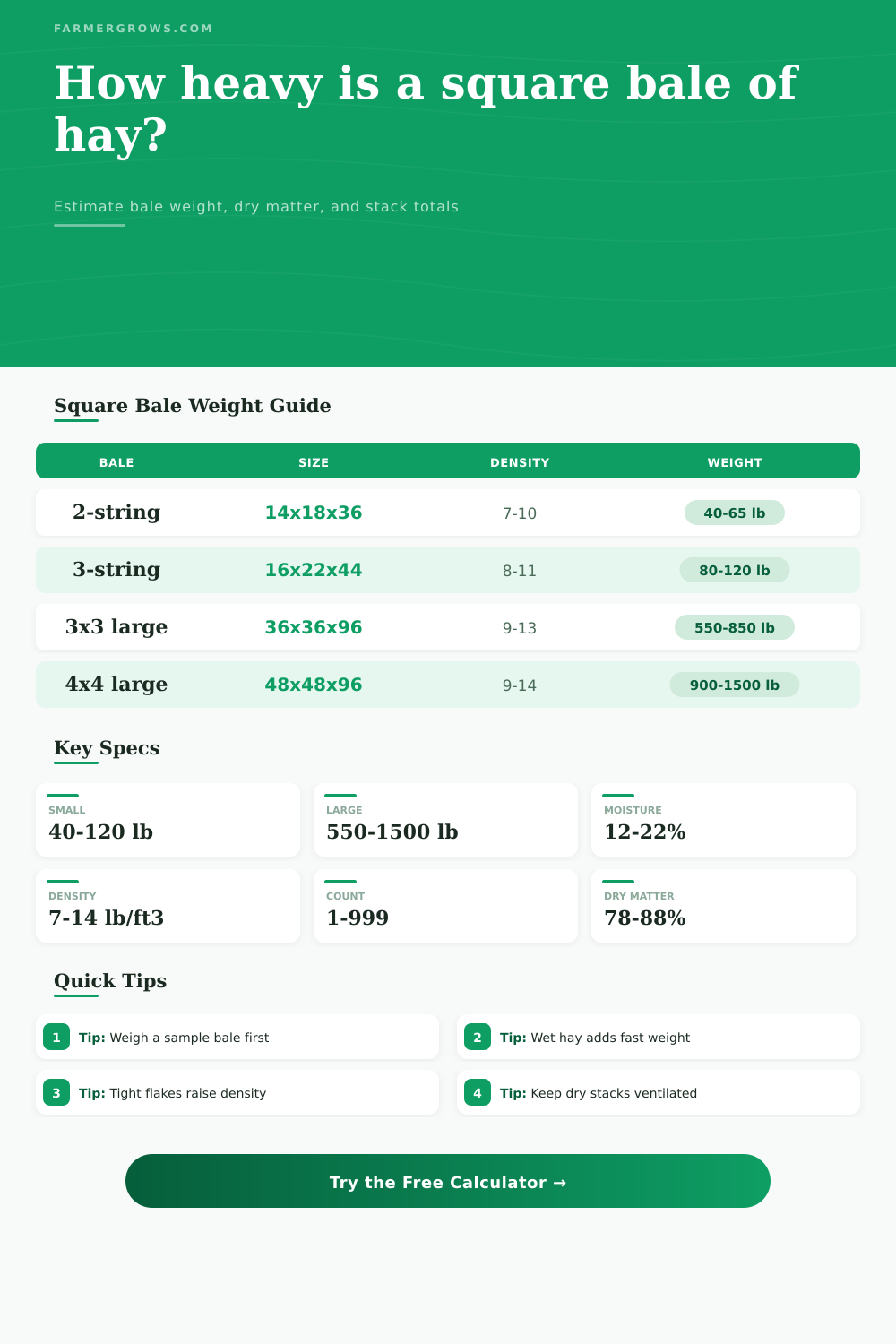
Common 14 x 18 x 36 inch package. Often 40 to 65 lb when cured grass or mixed hay is baled at normal density.
Common 16 x 22 x 44 inch western package. Often 80 to 120 lb, depending on crop, chamber tension, and moisture.
A 36 x 36 x 96 inch bale can land near 550 to 850 lb for dry hay when density and flakes are moderate.
Larger square bales can exceed 1,000 lb. Use actual dimensions and moisture before planning wagons, trailers, or loft limits.
| Bale package | Common dimensions | Typical volume | Typical dry hay weight |
|---|---|---|---|
| Small 2-string square | 14 x 18 x 36 in | 5.25 ft³ | 40 to 65 lb |
| Compact 2-string square | 15 x 18 x 36 in | 5.63 ft³ | 45 to 70 lb |
| Western 3-string square | 16 x 22 x 44 in | 8.96 ft³ | 80 to 120 lb |
| Large square 3x3 | 36 x 36 x 96 in | 72.00 ft³ | 550 to 850 lb |
| Large square 3x4 | 36 x 48 x 96 in | 96.00 ft³ | 750 to 1,200 lb |
| Large square 4x4 | 48 x 48 x 96 in | 128.00 ft³ | 900 to 1,500 lb |
| Moisture reading | Dry matter share | Handling note | Weight effect |
|---|---|---|---|
| 10 to 12% | 88 to 90% | Very dry hay or long storage | Lower scale weight |
| 13 to 16% | 84 to 87% | Common cured small-square range | Normal sale weight |
| 17 to 20% | 80 to 83% | Watch heating in tight stacks | Noticeably heavier |
| 21 to 25% | 75 to 79% | Risk rises unless preservative or airflow is used | Heavy for dry hay |
| 35 to 55% | 45 to 65% | Wrapped baleage or high-moisture forage | Much heavier package |
| Class | Multiplier | Common use | What it changes |
|---|---|---|---|
| Light twine, low compression | 0.96 | Soft small squares and light straw | Reduces packed weight |
| Standard twine compression | 1.00 | Most farm small squares | Baseline estimate |
| Heavy twine, firm chamber | 1.05 | Dense horse hay and export lots | Adds modest density |
| High density baler | 1.12 | Large square balers and tight packages | Adds significant density |
| Planning item | Example bales | Typical total weight | Use this result for |
|---|---|---|---|
| Pickup load of small squares | 35 to 60 | 1,500 to 3,600 lb | Payload and tie-down planning |
| Small wagon stack | 90 to 140 | 4,000 to 8,400 lb | Wagon rating and field lanes |
| Horse barn delivery | 100 to 300 | 2.5 to 9 tons | Loft floor and unloading labor |
| Large square trailer | 18 to 28 | 12 to 34 tons | Trailer axle and loader capacity |
Weigh a sample bale: The best density input comes from weighing two or three representative bales, then dividing each weight by its measured cubic feet.
Watch moisture drift: A few moisture points can change stack weight quickly, especially in tight alfalfa, dense export hay, or large square baleage packages.
With your conditions and dimensions plugged into the calculator above (which does the math for you), you’re saving time calculating volumes and messing with coefficients. You think that bale is going to weigh what’s listed on the tag; probably about what it should according to a standard density which never reflects what you have on your farm.
On a small square, that two-string can be a fluffy bale of fescue at forty pounds if it was baled on a humid morning, or it might be a bale of dense alfalfa that was cured in perfect sun weighing sixty-five pounds. And this is not even based off the crop type. This is based upon its water content and how tight the flake got squeezed by the machine.
Why Hay Bales Weigh Different Amounts
The hidden factor in all of this is moisture. The higher the moisture content (18 vs 12 percent), the heavier your hay will weigh, a weight you cannot see. More moisture adds more dead weight to your haystack. It also increase the chance of spontaneous heating if your bales are stacked too closely together.
This is where the tool comes into play. It allows you to account for current moisture and storage dryness. There’s no need to take out the lab meter. Your best guess can come from a fast visual inspection and a feel for how crunchy the stems are. If they’re soft and fold easily without snapping, then you might want to bump your estimated moisture up a few percentage points. It’s not much but it makes a difference when you’re calculating your axle rating.
The other half of the equation is compression. A bagger full of older bales made with loose twine and worn-out springs tends to be soft, taking up more room (though lighter). On the other hand, a brand-new high-density baler make tighter packs, sometimes eliminating air pockets that might have lightened its load.
So if your buddy down the road recently bought a new baler, those new bales will hit the scale harder then the old ones, even if they look the same size. His bales from last year will be heavier; so will yours if you use the same baler he did. This explains why, when you purchase hay from someone with a new machine, it will weigh much more on your scale, even though your eyes tell you both bale hold equal amounts. The chart below compares very tight bales to loose ones, explaining how the multiplier for density affects overall weight:
Square bales present an entirely new set of considerations. Depending on the crop and degree of compression, we’re talking fifteen-hundred-pound-plus packages here. You don’t pick these things up off the ground with your hands. You need a trailer capable of handling a heavy payload and a loader strong enough to handle it.
To move them, the calculator lets you adjust to include multiple bales, because a stack of bales weighs far more than “a pile of hay.” Thirty big squares isn’t something you toss in the back seat; it’s a multi-ton shipment worthy of careful consideration when thinking about tying down and weight distribution.
Another output that farmers don’t talk about enough is a dry matter weight. You aren’t paying for water when you pay for your hay by nutritional value; you’re paying for the dry matter in it. Moisture-rich bales are just water that you didn’t buy. Knowing how much of the bale is dry matter allows you to make a more accurate comparison between different lots. This removes the variable of rainfall from the equation so you can judge the true forage quality.
It’s really more about knowing what you’re measuring. If it’s a volume, just get out your tape measure. If it’s a density, you’ll need to estimate that. The best way would be to weigh one bale and divide its weight by its cubic feet. This becomes your basis of density for the entire stack. Short of weighing each individual bale, this is the most accurate.
So when those bales do come, and it’s time to plan out your storage area, you need to know how much they weigh. If you have a loft floor intended to hold small squares, a big stack of squares will concentrate too much weight in one place and cause issues. That pickup you got away with twenty bales of small stuff in last summer could be sagging too close to the ground with just ten bales of large stuff this year. Before you make that commitment to transport, the calculator can help you see what all those numbers add up to. Concrete numbers from vague intuition.
Weight is everything in hay farming. A pound here, a pound there adds up. Whether you’re selling by the ton or feeding livestock, every pound matters. An accurate estimate results in safe lifts, no busted axles, and fair transactions.
Don’t simply look at a stack of square bales as uniform blocks. Moisture and compression are hiding beneath the surface. Measure them, calculate them, move them confidently. The weight’s always there, it’s just waiting to be counted.