💧 Sprayer Calibration Calculator
Match nozzle output, travel speed, tank coverage, and pressure so every pass lands on rate.
Full breakdown
Catch cups
Collect nozzle output for the same time window on each tip, then average the readings.
Stopwatch
Time the run on level ground so speed stays steady from start to finish.
Measured course
Mark a fixed distance first. A clean course makes the speed test repeatable.
Graduated jug
Use a jug with clear marks to compare the catch volume against the target flow.
| Imperial rate | Metric rate | Flow note | Use |
|---|---|---|---|
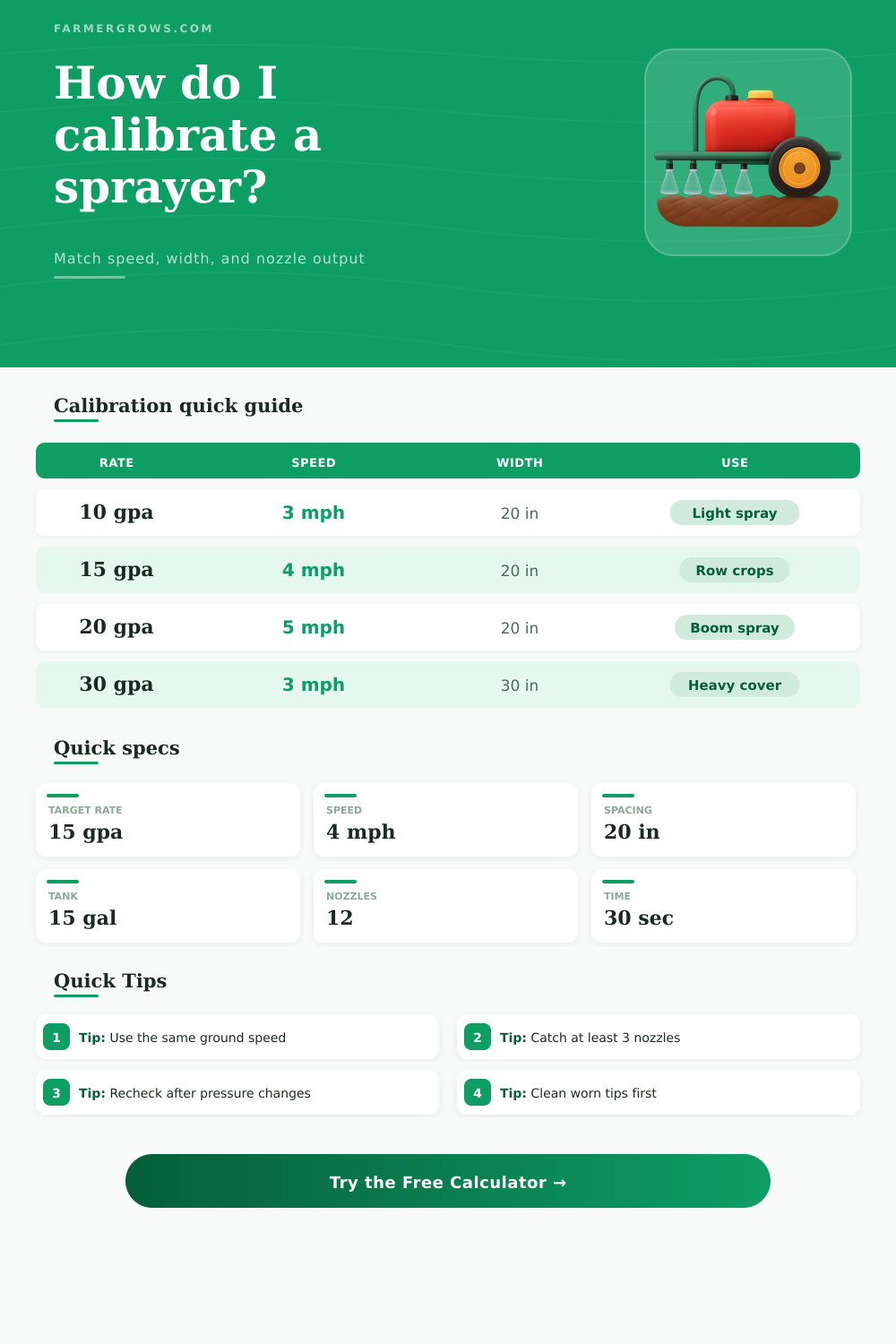
| 10 gpa | 93.5 L/ha | Low output | Light spray |
| 15 gpa | 140.3 L/ha | Mid output | General use |
| 20 gpa | 187.1 L/ha | Mid-high | Boom spray |
| 30 gpa | 280.6 L/ha | High output | Heavy cover |
| Speed | 100 ft | 50 m | 100 m |
|---|---|---|---|
| 3 mph | 22.7 sec | 37.3 sec | 74.6 sec |
| 4 mph | 17.0 sec | 28.0 sec | 55.9 sec |
| 5 mph | 13.6 sec | 22.4 sec | 44.7 sec |
| 6 mph | 11.4 sec | 18.6 sec | 37.3 sec |
| Nozzles | 20 in boom | 50 cm boom | Use |
|---|---|---|---|
| 8 | 13.3 ft | 4.0 m | Small rig |
| 10 | 16.7 ft | 5.0 m | Compact boom |
| 12 | 20.0 ft | 6.0 m | Common boom |
| 15 | 25.0 ft | 7.5 m | Wide boom |
| Tank | 10 gpa | 15 gpa | 20 gpa |
|---|---|---|---|
| 5 gal / 19 L | 0.5 ac | 0.3 ac | 0.25 ac |
| 15 gal / 57 L | 1.5 ac | 1.0 ac | 0.75 ac |
| 25 gal / 95 L | 2.5 ac | 1.7 ac | 1.25 ac |
| 50 gal / 189 L | 5.0 ac | 3.3 ac | 2.5 ac |
Tip: Catch output from three or more nozzles, then average the readings before changing pressure.
Tip: Recheck calibration after nozzle wear, speed changes, or tip swaps because every one of them shifts rate.
Sprayer calibration is the process to ensure that the sprayer device gives the right amount of liquid carrier according to the wanted spray pattern for the field that you treat. It seems difficult but calibrate sprayer is not as hard as you think. Every dose of fertilizer, insecticide or herbicide on crops has its target, and to reach it well, calibration is key.
The first step for calibration of sprayer is choose the right type and size of nozzle according to the flow rate. You use flat-fan nozzles for spraying most herbicides and some insecticides where you want medium drops. Before calibration, check the output of every nozzle against the catalog value at same pressure.
How to Calibrate a Sprayer
Replace all nozzles that differ more than 10 percent with new nozzle. After that the sprayer is ready for calibration.
For calibrate you need a tape, stopwatch and graduating liquid cup. Set the right calibration course according to the spacing of nozzle. The course be on same soil as the sprayed area, because speeds differ on roads and on fields, which alters the apply amount.
Calibrate the sprayer for the environment in that it will operate.
Drive the course in the pace, gear and RPM that you will use during actual spraying. Note the time in seconds. Repeat twice for average.
Later park and keep the RPM. Switch the sprayer and gather water from one nozzle while exactly the same time as you needed for the coures. The measured amount from nozzle match to gallons for acre.
If the output coincides in 5 percent with the intended for minute, the sprayer calibrated well. Otherwise repeat the steps until mistake under 5 percent.
Over time nozzles, pumps and other parts wear out and need refill. Fill the tank with water and start the pump. Keep the RPM of pump same during calibration as during field usage.
Backpack sprayers are cheap, light, easy use and ideal for little tasks in garden or landscape. Knowing how to use, take care and calibrate backpack sprayer matters for efficiency, economy and safety. Without prior calibration the right product dose happens by means of trial and mistake, and first tankfull mistake costs alot.