
If you’ve seen the videos of people eating realy hot peppers, you’ve probably noticed that it’s always somebody who take a wrinkly red pepper in their mouth, and then reacts to extreme heat. There are plenty of such moments on the web, but as cooks and gardeners, we might be more interested in the science behind all that heat.
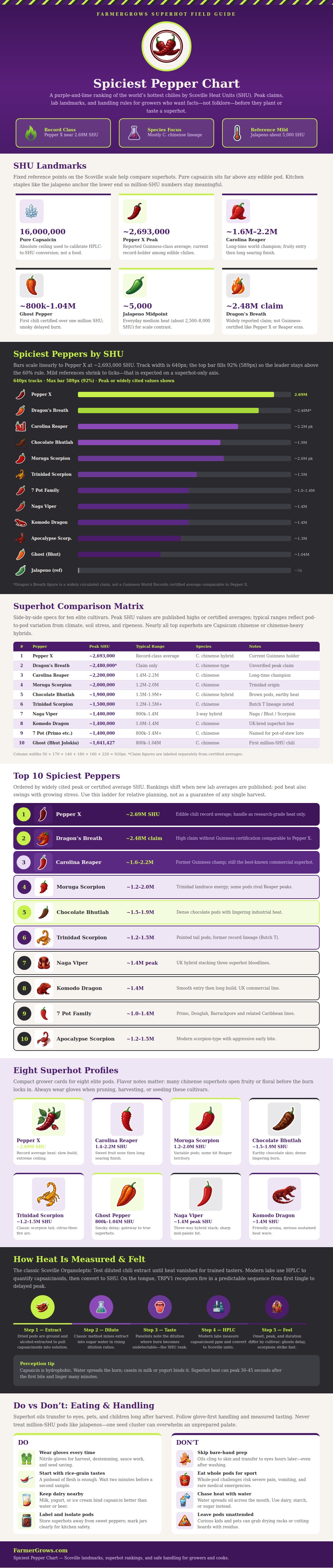
Here’s the chart, which put the peppers on a linear scale. This doesn’t just order the peppers; it also show that the difference between a mild jalapeno and the hottest ones is massive. That makes a big difference in what you’ll do with the plant.
Understanding Hot Peppers
All those numbers are big ones, though. Without some perspective it’s easy to get lost in the digits. Take a jalapeño (roughly 5,000 Scoville Heat Units) as an example. That’s your jumping-off point. Now turn up to the extreme end. Pepper X has been measured at nearly two point seven million SHUs. This isn’t just hotter; it’s another level entirely. Think about it: Do you use a two-thousand-unit pepper the same way you do a two-million-unit one? Of course not. There’s more difference between them then there is between room temperature and boiling water.
Having this perspective gives you a sense of what direction to head when choosing which peppers to grow: Are you looking for something hot? Or are you focused on taste? Most so-called record-breaking pepper are hybrids made from Capsicum chinense. This species contain the genes necessary for heat. The Carolina Reaper, the Ghost Pepper, and Pepper X is all ancestors to these record-busting varieties. They’re all cousins in a fiery family.
Measuring heat has become more sophisticated. Once upon a time, pepper extracts were diluted into sugar water and tasted by people till they couldn’t feel it burning anymore. It was subjective and something of an art form. Today’s labs use High-Performance Liquid Chromatography, measuring the capsaicinoids that exist in the plant. They gives us a precise number. That’s why the chart includes precise peaks instead of vague guesses.
Why? Because it’s good for the grower. If you know you have a pepper close to two million SHU, you’ll be wearing gloves. If you assume it’s just a jalapeno and go ahead without thinking, well…you won’t touch your eyes. And you would of wish you’d thought before you did.
Superhot peppers is tough to work with unless you know what you’re doing. The oils they contain repel water… Meaning the oil will literally push away water. When you touch one of these peppers and then attempt to wash your hands with soap and water, all you do is spread the oil around more. To bind the capsaicin, you require something containing fat (like an oil) or casein (such as milk). A little yogurt or milk work. You could also use some oil.
Most folks mess up here. They encounter a hot challenge and immediately go for water, which only serves to spread the burn throughout their mouth. Have the dairy at hand. This isn’t a nicety, it’s a safety item.
A good part of it is psychological with eating superhots as well. Not all are going to kick in right away. Some have what’s called a delayed onset, such as with the Ghost Pepper. You’ll think it tastes fruity or smoky and then the heat kicks in a half-minute later. Others; the scorpion types, is quick and stay put. Understanding when the punch comes will allow you to appreciate the taste rather than prepare yourself only for suffering. With time, you can taste notes of citrus or chocolate in these pods.
And yes, these are the contenders. The infographic lists the ones to try, but keep in mind there can be great variation between pod from the same plant (the same crop). Final heat level depends on factors like climate, soil stress, and even ripeness. Often a stressed-out pepper will be hotter then one grown in ideal conditions. Treat the ranking as a guideline, not a promise.
Grow your Ghost Peppers for hot sauce, or your Pepper X for bragging rights, but either way, treat them with respect. The gloves? Don’t forget those. Is there dairy nearby? Yes. And then recall that the heat’s only half the story. It’s the flavor that keeps you coming back.