Space for Fruit Trees Calculator
Estimate how many fruit trees fit in an orchard block from species, rootstock, row spacing, in-row spacing, canopy training, alleys, pollinizers, slope allowance, mature canopy spread, and a target tree count.
Use net plantable orchard dimensions after excluding buildings, ponds, windbreak bases, setbacks, and fixed service yards. Equipment alleys are subtracted before tree spaces are counted.
The calculator counts whole rows after subtracting equipment alleys and checks how many tree stations fit along each row.
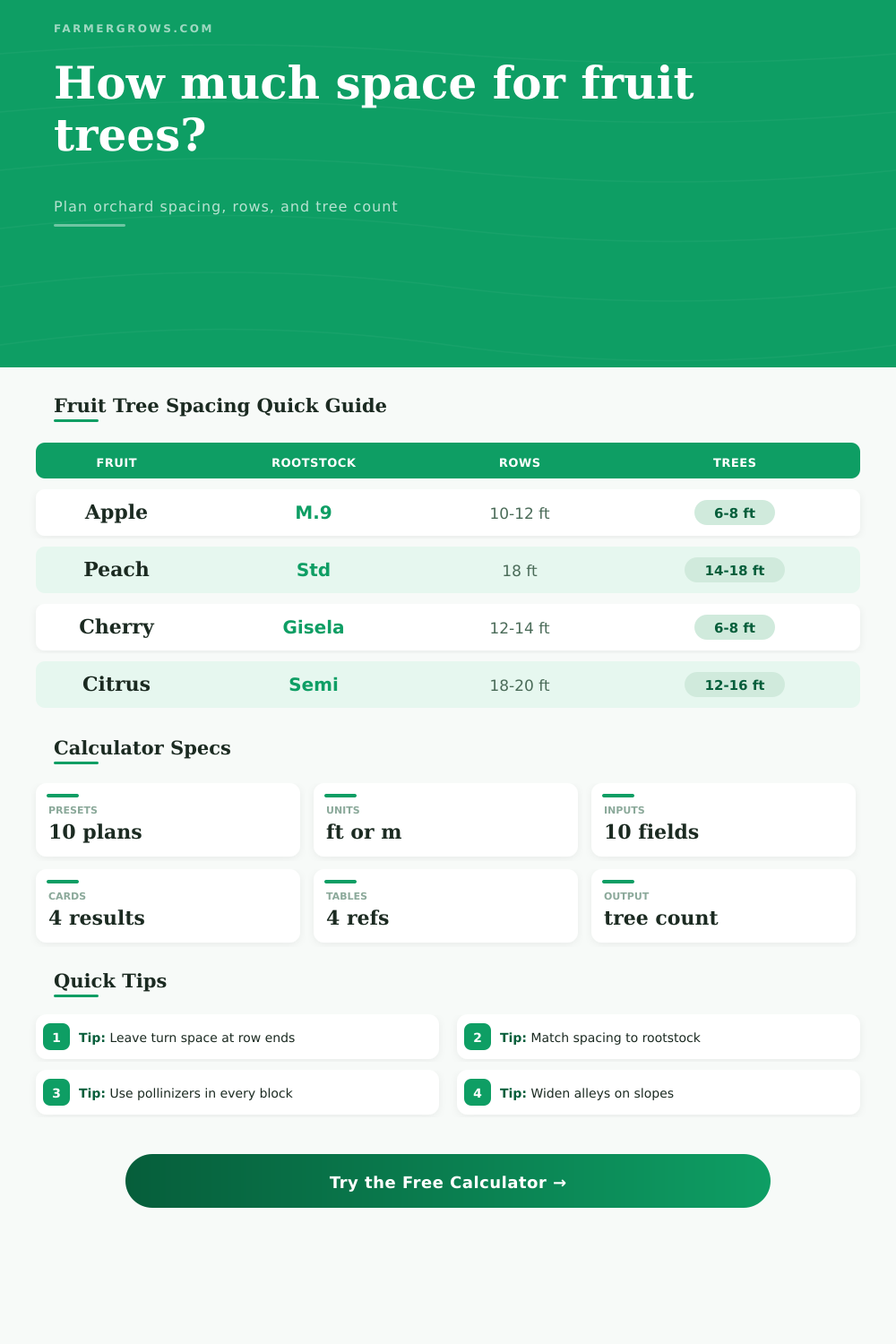
Dwarf apple and Gisela cherry blocks can run tighter than standard peach, citrus, avocado, or mango plantings.
Mature canopy diameter is compared with row and in-row spacing so crowded plans are flagged before planting.
The pollinizer ratio estimates compatible trees to include in the total count for crops that need cross-pollination.
Fruit Tree Spacing Results
The cards show whole-row capacity, pollinizer planning, estimated land need for your target, and canopy clearance for mature trees.
Best for tall spindle or trellis blocks with support, drip irrigation, and careful pruning.
Useful for lower-density home orchards where wider machinery or mower access is needed.
Pairs well with vertical leader or trellis systems; keep enough alley room for bird netting.
Open-center peach trees need more canopy diameter and good airflow than dwarf apples.
Central leader pear blocks often need compatible pollinizers and moderate row spacing.
Allow sprayer access, skirt pruning space, and enough sun around mature canopy edges.
Wide spacing helps with light interception, harvest lanes, and future canopy management.
Plan wider rows unless you commit to regular canopy size control and topping.
| Fruit and rootstock | Typical row spacing | Typical in-row spacing | Approx trees per acre | Notes |
|---|---|---|---|---|
| Apple M.9 dwarf | 10 to 12 ft | 3 to 8 ft | 454 to 1,452 | High-density systems usually need posts, wire, and irrigation. |
| Apple M.26 semi-dwarf | 14 to 18 ft | 8 to 14 ft | 173 to 389 | A common home orchard compromise between size and access. |
| Sweet cherry Gisela | 12 to 14 ft | 6 to 10 ft | 311 to 605 | Training system strongly affects final canopy width. |
| Peach standard | 18 to 22 ft | 14 to 18 ft | 110 to 173 | Open center canopies need airflow and spray coverage. |
| Citrus semi-dwarf | 18 to 22 ft | 12 to 18 ft | 110 to 202 | Leave room for skirt management and picking lanes. |
| Avocado | 24 to 30 ft | 18 to 25 ft | 58 to 101 | Tree size varies widely with climate and pruning. |
| Training system | Best fit | Spacing effect | Canopy note | Access note |
|---|---|---|---|---|
| Central leader | Apple, pear, plum | Baseline | Narrower than natural form | Good mower and sprayer lanes |
| Tall spindle | Dwarf apple | Tighter in row | Needs support and renewal pruning | High density harvest lanes |
| Trellis wall | Apple, cherry, pear | Tighter tree spacing | Flat canopy, fast light capture | Keep posts outside turn paths |
| Open center | Peach, nectarine, plum | Wider row clearance | Broad vase canopy | Better airflow and spray angle |
| Espalier | Small orchard edges | Very tight depth | Flat trained fruiting wood | Works along fences or walls |
| Natural canopy | Fig, mango, avocado | Wider spacing | Large shade footprint | Allow equipment and picking room |
| Crop group | Common pollinizer need | Typical ratio | Layout approach | Spacing reminder |
|---|---|---|---|---|
| Apple | Usually cross-pollinated | 5% to 15% | Every third or fourth tree in rows, or dedicated pollinizer rows | Do not crowd pollinizers into leftover corners. |
| Pear | Often needs compatible cultivar | 8% to 15% | Mix cultivars through the block for bee movement | Flower overlap matters as much as spacing. |
| Sweet cherry | Variety dependent | 10% to 20% | Use compatible pollen groups across rows | Keep netting and sprayer access open. |
| Peach and nectarine | Often self-fruitful | 0% to 5% | Pollinizers may be optional for many cultivars | Still keep room for open-center canopy. |
| Citrus | Usually self-fruitful | 0% to 5% | Use mixed cultivars for harvest season, not always pollination | Some mandarins have special pollen rules. |
| Avocado | A and B flower types help | 10% to 20% | Include compatible flower type rows or scattered trees | Leave enough mature canopy space. |
| Example block | Block size | Spacing used | Approx capacity | Good for |
|---|---|---|---|---|
| Small backyard | 80 x 60 ft | 18 x 14 ft | 18 trees | Peach, plum, pear, semi-dwarf apple |
| Quarter acre net | 120 x 90 ft | 14 x 8 ft | 84 trees | Semi-dwarf apples or trained pears |
| High-density strip | 300 x 80 ft | 11 x 4 ft | 459 trees | Dwarf apple spindle or trellis |
| One-acre rectangle | 330 x 132 ft | 18 x 12 ft | 198 trees | Citrus, pear, plum, peach adjustments |
| Wide tropical grove | 300 x 300 ft | 25 x 20 ft | 180 trees | Avocado, mango, large citrus |
Canopy check: If mature canopy diameter is larger than in-row spacing, expect branch overlap and higher pruning pressure. That can be fine for trained walls, but it should be deliberate.
Alley check: Reserve turn lanes before counting trees. A tidy spreadsheet layout that ignores tractor turning radius often loses rows after the ground is marked.
A block of trees isn’t just a group of trees: it’s a grid of equipment access, air, and light. For me, the two factors that most determine whether I have a money-maker or a hell of a pruning nightmare aren’t the variety selection or even quality of soil. They’re the spacing.
Get the geometry wrong and you’ll be wrestling with canopies for the rest of the decade, or watching your tractor get stuck in between the rows. Those rows might appear adequate on paper but they don’t leave enough room to maneuver the turn radius of your sprayer. Use the calculator; it does math for you. But know why it highlights some combination of numbers so as to prevent your project from buckling under its own shade.
Why Tree Spacing Matters
The next thing is to begin with the rootstock, because that sets scale for all the rest. For example, if I put my 9 rootstock trees six feet apart in a row, they’re going to behave like a vertical column of fruiting wood and accommodate me. By contrast, a mango or a peach on its own roots, what we call a standard tree, is a living thing that sprawls around demanding a space of eighteen to twenty feet just to get air.
But if you try to plant those standard trees only six feet apart? You are not planting an orchard. You are planting a thicket that will never see sun in its center again.
The tool allows you to adjust the tree capacity, based off the strength of the rootstock you select. And you’ll see how the tool helps you visualize the tradeoff between putting less vigorous trees in so they has room to develop a good skeleton before the canopy shuts down, but then leaving fewer total trees on acre. It is not just about having more trees per acre, but about making sure each one have the volume it requires.
The training system acts as the blueprint for that canopy. Because a central leader system keeps the tree narrow and manageable, it work well with tight in-row spacing. Open center-vase shapes, like those found on plums and peaches, grow out laterally in all directions very aggressively. In order to allow for that kind of lateral growth without a solid wall of foliage between plant (which would also trap humidity), you’ll want wider rows. Wider spacing in an open system isn’t just aesthetic; it’s a money-saving health investment. Humidity is the enemy of fungal diseases, remember?
The table on the page break down these common configurations to help you see how different styles of training change the effective footprint of the individual plant. Don’t overlook the alleys. Amateurs count the overall acreage then divide by tree size, ignoring that they’ll require space to maneuver tractors, mowers and harvesters. Until you attempt backing a three-point sprayer into an alley only 12 feet wide, a 20-foot buffer strip for turning lanes and equipment paths may feel extravagant.
The calculator factors out all such unproductive space before tallying up your trees. This provide a more realistic picture of how densely you’re really planted. It forces you to consider what kind of machinery you’ll possess in five years, not merely today’s seedling number. This helps you avoid the mistake of planting one block too densely, making it impractical to manage when the canopies close.
Another wrinkle pure geometry doesn’t account for is importance of pollinators. For apples (and pears and other fruit), planting one variety won’t do; you also need about 5-15 percent of all your trees to be compatible varieties in bee-flight distance, which will do the job of cross-pollinating. Again, the tool calculates how many extra trees this requires. This way, you aren’t basing your yield projection on only half the story of what is happening biologically in the block. It is a small difference, but it’s enough to change the overall pattern and the amount invested. Half your trees could of gone to waste if you forget about it.
Lastly, think about the slope. Water behaves different on a slight incline (a three percent grade is considered quite mild), and machines do too. The spacing allowance I entered takes into account the slope and gives you some wiggle room. This is because if it’s sloping or terraced, you need extra margin to be safe and minimize erosion. It’s another tiny tweak, but one that keeps the land healthy over time.
Step back again from the calculations and know this: An orchard is a living, moving machine. The spacing of those trees is like the gear ratio of that machine: does it run smoothly or slowly wear itself out? Space with the mature tree in mind, not the sapling, and the math will play out in your favor.