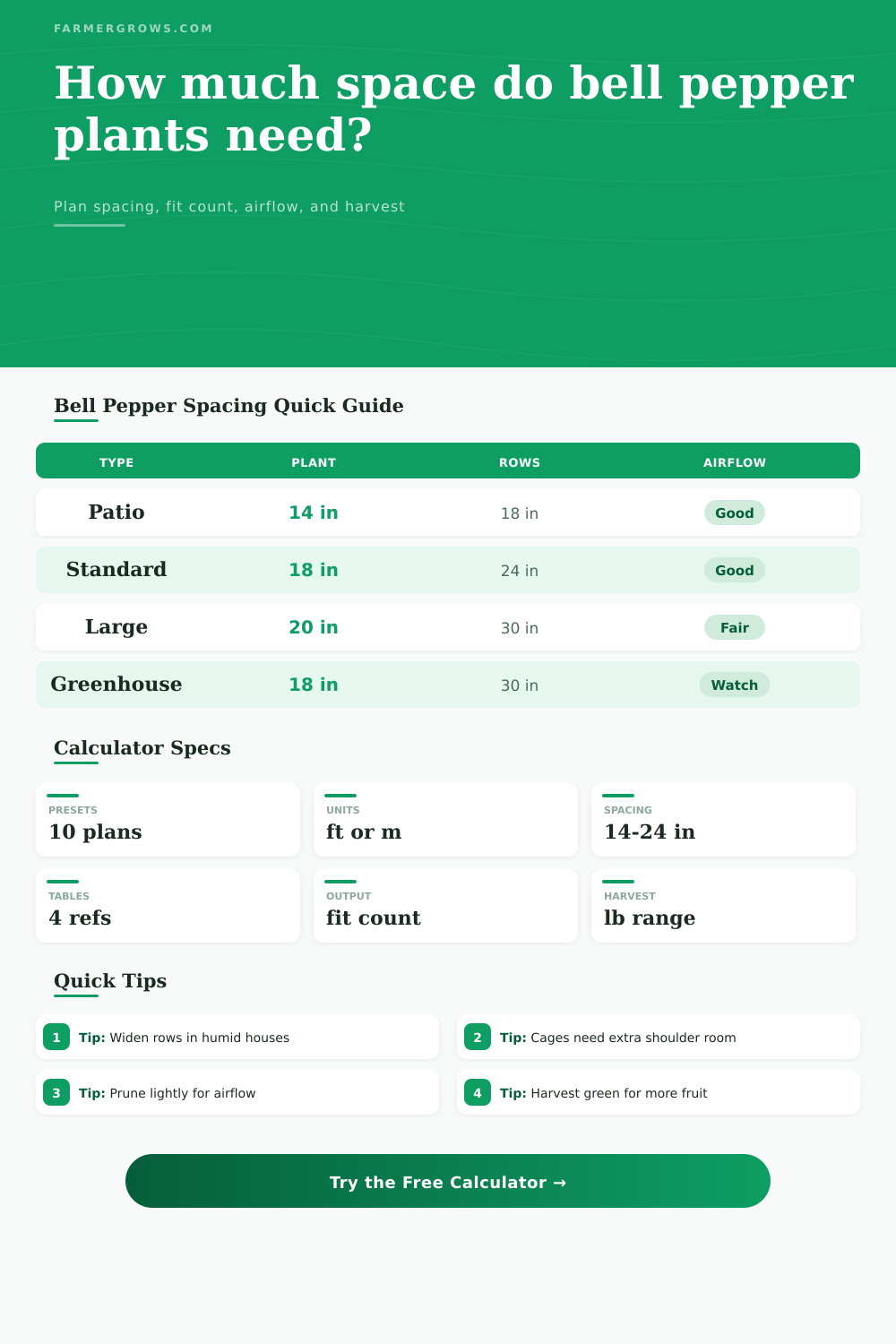
Space For Bell Pepper Plant Calculator
Plan bell pepper spacing for raised beds, in-ground rows, greenhouse benches, or containers using variety size, support choice, humidity, pruning, harvest stage, and your target plant count.
Use the actual planted footprint, excluding aisles outside the bed or bench. For containers, enter the inside length and width of the tub or planter box.
Shorter plants can work at 14 to 16 inches in containers when light and feeding stay steady.
Most bell peppers settle best around 18 inches in-row with 24 inch row spacing.
Heavy-fruiting plants need shoulder room, especially with cages or humid late-summer canopy.
Protected crops can be efficient, but humidity and pruning decide how tight the layout can be.
Bell Pepper Spacing Results
Recommended layout and harvest estimate for this pepper bed.
| Variety size | Recommended in-row | Recommended rows | Best support | Expected harvest per plant |
|---|---|---|---|---|
| Mini bell or lunchbox bell | 14 to 16 in | 18 to 24 in | Stake in containers | 2.5 to 4 lb |
| Compact patio bell | 15 to 18 in | 20 to 24 in | Small cage or stake | 3 to 5 lb |
| Standard bell pepper | 18 in | 24 in | Stake or weave | 4 to 7 lb |
| Early northern bell | 18 in | 24 to 30 in | Stake in windy sites | 3.5 to 6 lb |
| Colored sweet bell | 18 to 20 in | 24 to 30 in | Stake or cage | 3.5 to 6.5 lb |
| Large-fruited bell | 20 to 22 in | 30 in | Cage or strong weave | 5 to 8 lb |
| Giant bell pepper | 22 to 24 in | 30 to 36 in | Cage | 5 to 9 lb |
| Greenhouse blocky bell | 16 to 20 in | 28 to 34 in | Trellis or string | 6 to 10 lb |
| Bed or planter | Usable area | 18 x 24 in spacing | 20 x 30 in spacing | Best use |
|---|---|---|---|---|
| 2 x 4 ft planter | 8 sq ft | 2 plants | 1 plant | Patio mini or compact bells |
| 3 x 6 ft trough | 18 sq ft | 4 plants | 3 plants | Container crop with stakes |
| 4 x 8 ft raised bed | 32 sq ft | 8 plants | 4 plants | Standard home bell peppers |
| 4 x 12 ft raised bed | 48 sq ft | 12 plants | 6 plants | Mixed color harvest |
| 30 x 4 ft bed | 120 sq ft | 30 plants | 18 plants | Market or preservation crop |
| Condition | Spacing adjustment | Canopy reason | Practical note |
|---|---|---|---|
| Dry outdoor garden | Base spacing is usually fine | Leaves dry faster after watering | Mulch to stabilize soil moisture |
| Moderate humidity | Add 0 to 2 inches if unpruned | Interior leaves may overlap by midsummer | Remove lowest leaves that touch soil |
| Humid outdoor or tunnel | Add 2 to 4 inches | Still air raises disease pressure | Keep rows open for hand access |
| Very humid greenhouse | Add 4 to 6 inches unless trained | Dense canopies hold condensation | Use pruning and horizontal airflow |
| Support setup | Minimum plant spacing | Container fit note | When to widen |
|---|---|---|---|
| No support | 18 to 22 in | Use one sturdy plant per 5 gal pot | Windy sites or heavy fruit load |
| Single stake | 16 to 20 in | Works in tubs and raised beds | Humid canopy or large bells |
| Individual cage | 20 to 24 in | Allow room for cage shoulders | Cages touch or block picking |
| Greenhouse trellis | 16 to 20 in | Efficient with pruning and clips | Humidity stays high overnight |
Airflow tip: If the bed feels crowded before flowering, remove low interior leaves and keep irrigation off the foliage. Humid bell pepper canopies need dry leaf surfaces more than extra plants.
Harvest tip: Green peppers usually give the highest total weight because plants reset faster. Fully colored fruit improves flavor but lowers the season total, so the calculator narrows yield when colored harvest is selected.
In july many bell pepper plants is running out of room; they’re taking over. Perhaps you started with little seedlings… But then the plant got big and sprawled around, smothering things. Now they’re creating a humid microclimate, inviting mildew.
The culprit in most such situations isn’t actualy the bell peppers; it’s how they was planted, where in the garden. Most people grow from gut, but airflow counts (as does sun). If there’s no room for air circulation, your yield will be reduced, and so will the resistance to disease spreading. Even if you fertilize heavy.
Why Bell Peppers Need Space
It’s an easy-to-use calculator (above). There are no calculation for you to make: Just input types and sizes of peppers you want to grow in whatever containers or beds they will fit, and the calculator figure out the rest. It makes you visualize what will actualy go into the ground.
You pick from varieties of bells (a Patio Mini is different than a Giant bell, right?). Then it calculates how much space that plant need, based off part on the size it will eventually reach. Without accounting for these distinctions, the plants can wither on the vine. “People screw up on the input side. They say they want to grow a certain number of plant in there, but that’s based on how many will actually fit. It will tell you whether you’re dreaming of more then can be achieved, or that the space is simply too small.
Another key variable is the support option. Cages require more space than no support, while staking means closer spacing (though not so close that the stakes touch each other). If you choose a cage, the calculator expand the spacing between plants so they don’t crowd one another. Obstructing air flow and light. “A lot of people assume support is just for supporting the fruit, but it also affects how much space you need.”
The recommended spacings is adjusted for humidity and type of pruning. Tighter rows work well in a breezy, dry location. But add inches to spacing if it’s a humid greenhouse. More moisture = higher risk of fungal problems. Less foliage mean less shade and drier conditions (if you’ll do some light pruning). The tool takes that into account too.
Finally, what are you hoping for? A heavier yield of green peppers gets you there faster because the plant will reset itself sooner. Colored peppers take longer and thus lower total yield. The calculator adjust the predicted yield accordingly. See the detail in the table of references.
Plant mini bells fourteen to sixteen inches apart, and plant the large kinds twenty-two inches or more apart. These are not arbitrary; they are facts based on leaf spread and root competition that block the sun. More space means easier care. When picking your peppers, do not damage the stem. Better irrigation means water goes into soil instead of onto the leaves.
Wider row spacing seems counterintuitive because you get less fit. Fewer plant with more room are often better because they gets better access to air, light, and nutrients. That’s what the Airflow score in the results is helping you see. A good score means the canopy dries fast after a rainfall. A fair or poor score means you should of prune more or change your layout.
The best thing about planning is that it’s easier then replanting. You’ll get better-quality fruit, less disease, if you measure and space things before planting. The calculator gives you a framework, but you still have to balance health and density. The secret is giving each plant its space.
By respecting their need for space, you won’t have to thin your row in midsummer. The idea is getting to know what you’re measuring. It’s not so much square footage; it’s making an environment where the plants can breathe. Give them room and they will give you back a better harvest. The bottom line is a healthier, tidier garden that makes good peppers.