Space Between Garden Rows Calculator
Plan mixed vegetable row spacing from garden size, crop family, plant spacing, walkway width, bed system, equipment access, canopy height, sun orientation, and interplanting intensity.
Choose a real mixed-garden layout, then adjust row spacing, walkways, crop family, canopy height, equipment access, and interplanting factor to match your beds.
Garden Row Spacing Results
Your mixed garden row spacing plan will appear here.
Lettuce, spinach, arugula, and cut greens work well in tight rows, especially in wide beds harvested by hand.
Carrots, beets, radishes, and turnips prefer narrow rows with steady access for thinning, weeding, and irrigation.
Cabbage, broccoli, kale, and cauliflower need extra leaf spread and airflow as heads or large leaves fill out.
Staked tomatoes can be closer than sprawling tomatoes, but harvest lanes and airflow still matter.
Peppers and eggplant usually fit medium rows, with more space in humid gardens where foliage stays wet.
Bush beans can be moderate, pole beans need room for trellis work, picking, and shade management.
Garden corn performs best in blocks of several rows, with enough spacing for pollination and walking.
Vining crops need wide gaps or border rows so leaves do not smother neighboring vegetables.
| Crop family | Typical row spacing | Typical plant spacing | Canopy note | Best bed use |
|---|---|---|---|---|
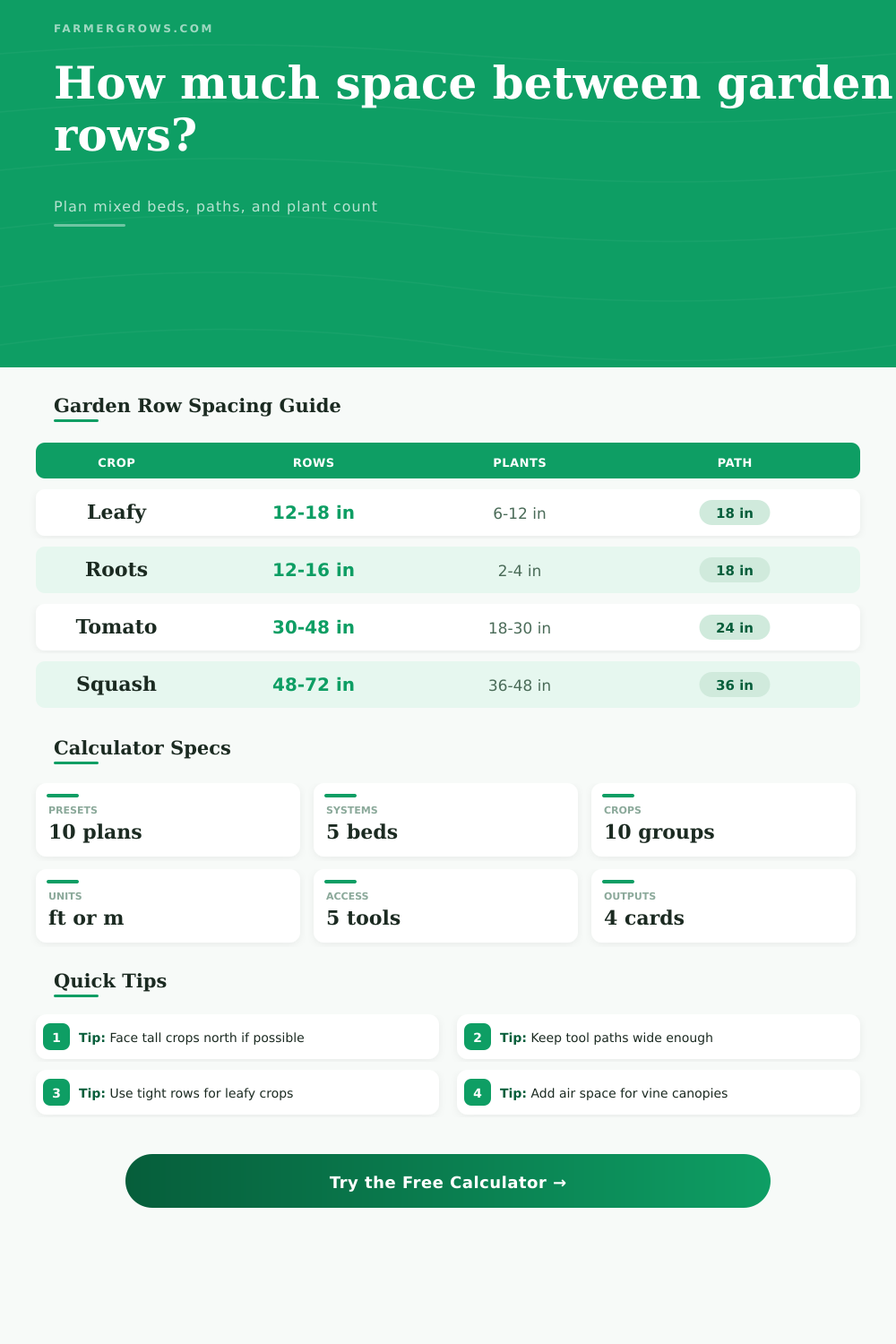
| Leafy greens | 12 to 18 in | 6 to 12 in | Low canopy, fast turnover | Wide beds or tight hand rows |
| Root crops | 12 to 16 in | 2 to 4 in | Low leaves, easy to shade | Dense rows with narrow access |
| Brassicas | 24 to 36 in | 18 to 24 in | Broad leaves need airflow | Single or paired rows |
| Tomatoes | 36 to 48 in | 18 to 30 in | Tall canopy, disease sensitive | Trellis rows with picking lanes |
| Peppers and eggplant | 24 to 36 in | 14 to 20 in | Medium canopy, branching habit | Block beds or double rows |
| Beans and peas | 18 to 30 in | 3 to 8 in | Trellis rows shade one side | Rows with picking access |
| Corn block | 30 to 36 in | 8 to 12 in | Tall and wind pollinated | Short block rows |
| Squash and melons | 48 to 72 in | 24 to 48 in | Sprawling vine canopy | Edges, borders, or wide hills |
| Access type | Minimum clear path | Comfort path | Where it fits | Spacing effect |
|---|---|---|---|---|
| Hand tools only | 12 to 18 in | 18 to 20 in | Small beds, low crops | Maximizes planted width |
| Wheelbarrow | 20 to 24 in | 24 to 30 in | Compost, mulch, harvest totes | Removes one narrow row in small beds |
| Garden cart | 28 to 32 in | 32 to 36 in | Market gardens and long paths | Improves repeated harvest movement |
| Walk-behind tiller | 30 to 36 in | 36 to 42 in | Annual row crops and stale beds | Needs wider bed breaks |
| Compact tractor | 48 to 60 in | 60 to 72 in | Large gardens, mower access | Fewer rows, easier turning |
| Bed system | Typical planted bed | Rows per bed | Path rhythm | Best use |
|---|---|---|---|---|
| Single rows with paths | One row width | 1 | Path after each row | Large crops and simple cultivation |
| Raised beds | 3 to 4 ft wide | 2 to 4 | Path after each bed | Home gardens with permanent paths |
| Wide intensive beds | 4 to 5 ft wide | 3 to 6 | Path after each wide bed | Leafy greens, roots, herbs, cut flowers |
| Market garden beds | 30 in planted top | 1 to 4 | Standardized harvest lanes | Repeat crop blocks and quick rotations |
| Contour or slope rows | Varies by grade | 1 to 3 | Extra access on contour | Erosion control and hillside gardens |
| Condition | Spacing adjustment | Why it matters | Planning response |
|---|---|---|---|
| Rows north to south | Standard | Light reaches both sides through the day | Use crop-family spacing unless canopy is very tall. |
| Rows east to west | Add 5 to 10% | Tall rows cast longer side shade | Place tall crops on the north side when possible. |
| Canopy under 18 in | No extra | Low leaves dry quickly and shade less | Good for dense greens and roots. |
| Canopy 18 to 48 in | Add 5 to 15% | Branching crops need airflow | Use wider rows in humid or disease-prone gardens. |
| Canopy over 48 in | Add 15 to 30% | Tall crops shade neighbors and slow drying | Widen lanes or separate tall crops from low crops. |
Tip: Put the widest walkway where you actually carry compost, water, trellis supplies, and harvest containers; skinny paths are only efficient when they remain usable.
Tip: When mixing tall and short crops, keep tall rows north of low crops or widen the row gap so leaves get morning and afternoon light.
It’s the garden you want: A full, fruitful place to grow things. But then: Oops. What happened? You planted it all real close so nothing gets lost. You squeeze in there like a contortionist, row after row and you ruin your crop just by looking at it.
No, no. Between-row space isn’t “empty.” It is infrastructure and crop survival equipment. It is also how we get what we planted out alive and into our mouths without fighting.
How to Space Your Garden Plants
Tackling the task mean figuring out balance between people and plant. Why do most gardeners begin with the plant itself? Because it’s forgiving: You can pack a narrow row of leafy greens such as spinach or lettuce without much penalty. Root crops works too, if you have enough soil depth. But throw in some bigger structures, and that’s when problems begins. Aggressive plants with aggressive canopies. Tomatoes, peppers, and particularly vining ones such as squash (want to touch).
And if they touch, their foliage create an environment where humidity is trapped, and fungal diseases such as blight or powdery mildew comes in for free. So row spacing needs to accommodate the eventual width of the plant… Not their seedling size.
Once you determine your bed width and the type of crop you’re growing, the calculator at the top do the math for you… So there is no guesswork when it’s time to design your mixed beds. It accounts for factors many beginner overlook, such as equipment access. If you’ll be using a small tiller or wheelbarrow, a narrow pathway is a bottleneck that will slow down all of your gardening tasks. About eighteen inches of clearance is plenty for hand tools; haul-out bins of harvest or bring-in compost bags demand more.
Early in the process, figure out what you’re willing to sacrifice. With a wider path comes loss of planting space; with one that’s too narrow you have obstacle courses different than simple chores.
Now, there’s another wrinkle to consider: which way the sun come from. In general, north-south rows is a safer bet; they get full exposure on each side all day, encouraging good light distribution and drying. East-west rows may cast a long shadow onto their neighbors (particularly in the afternoons). Ideally, tall things such as tomatoes should of grow north-facing. This protects short thing during the few hours a day when the light is weakest, which is in the mornings. Otherwise, you’ll have to increase your spacing so no one gets shaded and loses the energy required to do its job.
One other thing: how intense will your interplanting be? Are you more of a regimented grid person, or do you like to plant things all mixed together to conserve space? You can deal with this with “tightness” factor that will make the whole pattern tighter or looser. A tighter factor gives you a couple more plants here and there, but means those plants will be competing harder for their light and nutrients. Vigor v. Density. A tradeoff.
And if you live in a humid climate, you’re almost always better off erring on the larger side: More air movement = best pesticide, and it’s free.
The other thing: What’s the shape of your garden, raised beds or in-ground rows? Each has its own challenges. With raised beds, typically you have access to the middle from both sides, so you could go wider and have fewer pathways, changing the equation a lot. An in-ground garden the same width as a three-foot-wide raised bed might be only wide enough to have a path in-between every other row for access, while that 3-foot-wide raised bed may accommodate four rows plus one walkway.
Know your bed system first; then do the math. For general guidelines, I’ve got some handy reference tables on the page; they’re quick benchmarks for certain crops. But as always, locality counts. Is it a breezy or dry year? That may mean wider gaps. Humid summer weather may call for wider spaces than a hot, bone-dry season. Is there a hill involved, with its steepness forcing you to change up the effective width by contouring your rows?
The numbers you get back will be your starting point, then tweak according to what’s realy happening in your own climate. After a month, if things feel crowded in your garden, they’re probably too close together. Things want to breathe, and so do you!
Save yourself hours of frustration (and crop losses) by planning ahead for the space. Turn your jumble of a plot into a connected system that helps you, rather than fights you.