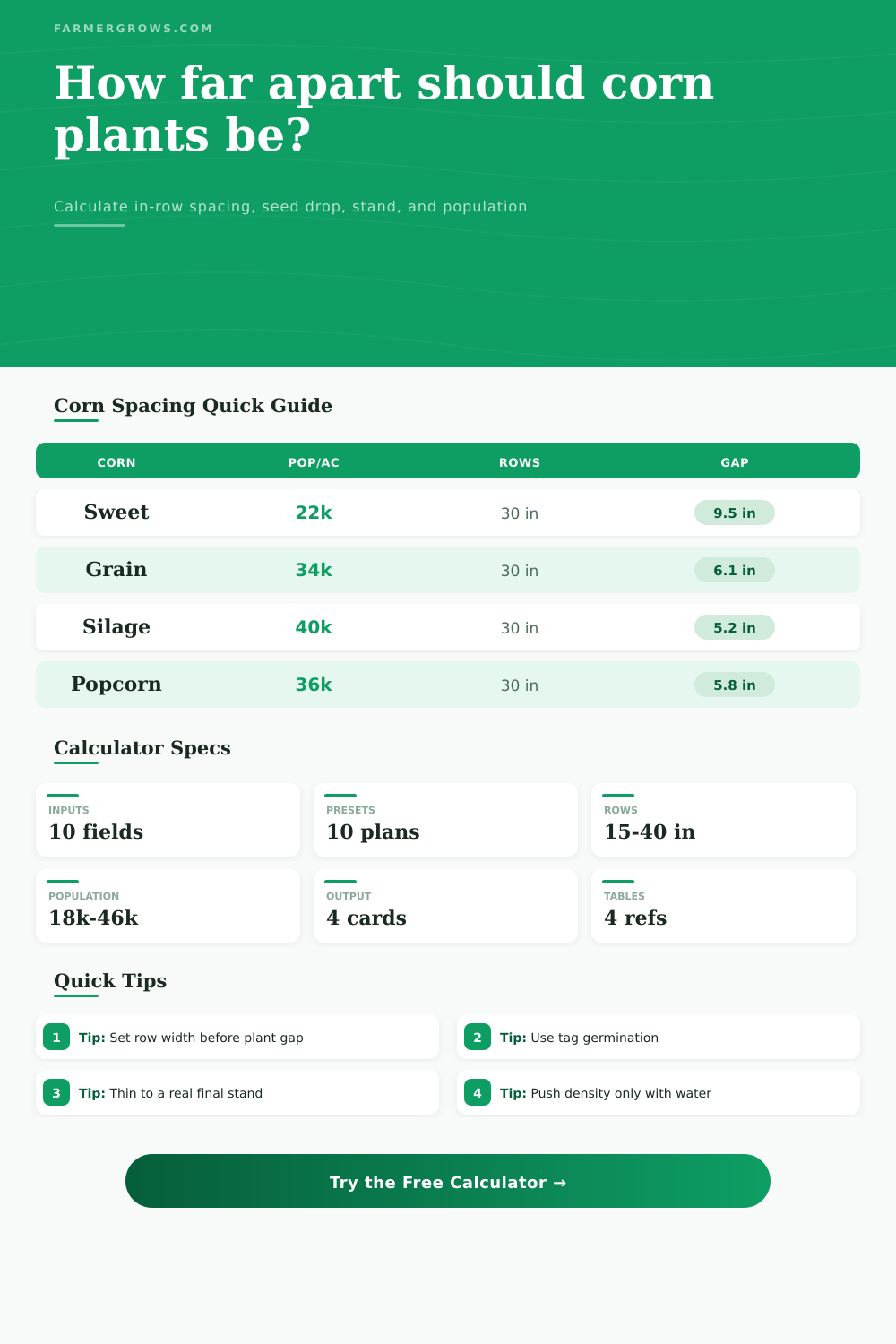
Space Between Corn Plants Calculator
Calculate corn in-row plant spacing from target population, row width, row length, row count, seed-drop spacing, germination, thinning loss, corn type, ear-size goal, and water-fertility support.
Choose a named corn spacing setup, then adjust the target population, row geometry, germination, thinning, and entered seed-drop spacing to match your planter, seeder, or hand-planted row.
Spacing and Stand Result
Results update from row spacing, target population, seed drop, germination, thinning loss, corn type, ear target, and irrigation-fertility level.
Usually spaced wider for full ears, airflow, and hand harvest. Gardens often use blocks instead of one long row.
Balanced hybrids use moderate in-row spacing where stand uniformity, water, and nitrogen are dependable.
Often planted tighter for canopy closure and biomass, especially with strong fertility and timely irrigation.
Popcorn can run denser; flour and dent corn often need more stalk room for ear fill and lodging resistance.
Use these references to compare your result with common row widths and population goals. In-row spacing equals row feet per acre times 12, divided by target plants per acre.
| Row spacing | Row feet per acre | 28,000 plants/ac | 34,000 plants/ac | 40,000 plants/ac |
|---|---|---|---|---|
| 15 inches | 34,848 ft | 14.9 in | 12.3 in | 10.5 in |
| 20 inches | 26,136 ft | 11.2 in | 9.2 in | 7.8 in |
| 22 inches | 23,760 ft | 10.2 in | 8.4 in | 7.1 in |
| 30 inches | 17,424 ft | 7.5 in | 6.1 in | 5.2 in |
| 36 inches | 14,520 ft | 6.2 in | 5.1 in | 4.4 in |
| 38 inches | 13,755 ft | 5.9 in | 4.9 in | 4.1 in |
| Corn type | Common population range | Typical in-row gap on 30 in rows | Spacing note |
|---|---|---|---|
| Sweet corn for full ears | 18,000 to 26,000 plants/ac | 8.0 to 11.6 in | Wider spacing protects ear size and picking access. |
| Balanced grain corn | 30,000 to 36,000 plants/ac | 5.8 to 7.0 in | Common field-corn range with even emergence. |
| Irrigated fixed-ear grain | 36,000 to 42,000 plants/ac | 5.0 to 5.8 in | Dense stand needs fertility, water, and lodging tolerance. |
| Silage corn | 38,000 to 46,000 plants/ac | 4.5 to 5.5 in | Canopy and biomass goals often justify tighter spacing. |
| Popcorn | 30,000 to 38,000 plants/ac | 5.5 to 7.0 in | Use variety guidance because ear size and stalk strength vary. |
| Baby corn | 44,000 to 70,000 plants/ac | 3.0 to 4.8 in | Harvest happens young, so full ear fill is not the goal. |
| Germination and thinning | Stand factor | Seed needed for 200 final plants | Use when |
|---|---|---|---|
| 95% germ, 3% thin | 92.2% | 217 seeds | Fresh seed, warm soil, careful planter setup. |
| 90% germ, 8% thin | 82.8% | 242 seeds | Typical garden or small field planning value. |
| 85% germ, 12% thin | 74.8% | 268 seeds | Cool planting, older seed, or uneven emergence risk. |
| 80% germ, 20% thin | 64.0% | 313 seeds | Rough stand conditions where extra seed is expected. |
| Example layout | Rows and row length | Target spacing | Approx final stand |
|---|---|---|---|
| Four garden rows | 4 rows x 40 ft | 9.5 in | 202 plants |
| Small market block | 8 rows x 100 ft | 7.0 in | 1,371 plants |
| 30 in field acre | 17,424 row ft | 6.1 in | 34,000 plants |
| Silage acre block | 17,424 row ft | 5.2 in | 40,000 plants |
Calibrate by row width first. A 34,000 plant target is about 6.1 inches apart on 30 inch rows, but about 9.2 inches apart on 20 inch rows. Confirm the planter row spacing before judging the seed drop.
Use ear goal and resources to set density. Large sweet-corn ears usually need more room, while silage or irrigated grain can tolerate tighter spacing when water and fertility are steady.
You should space corn at a specific distance. If plants is too close together, they will be weaker; if they are too far apart, the yield will be lower. The calculator (above) takes in the desired number of rows and width of each one, then translates that into inches between plants, leaving you to think about biology instead of geometry.
It’s a simple idea (that can be easily botched). To figure out how far apart to plant, you have to know exactly how many plants per acre you want…and then convert that into feet or inches between plants within your row. With all sweet corn, you’re likely aiming to grow about twenty-two thousand plants per acre. For standard row spacing of thirty inches apart, that means about nine and a half inches between each plant.
How to Space Corn Plants
As a newbie, that sounds like so much wasted space…yet those inches allow the plant time to spread it canopy. It also help ensure that the plant doesn’t compete with other plants for sunlight as it fills out a big ear. That’s not how field corn for grain works: Instead of big ears being the target, it can be all about total biomass and kernel count. You may go with as many as 30,000, or even 40,000, plants per acre. That make for tight quarters, with a space of roughly six inches or smaller between plant. Competition for available nutrients like nitrogen, and water, is intense. This is why the tool questions you about fertility and irrigation practices.
Simply cranking the population way up isn’t something you can do without consequences. Or at least without stunting. There has to be soil to sustain such numbers. Germination is another cause of death. Not all seeds sprout; in fact, most don’t sprout perfect. Even good seeds sometimes go bad, get eaten by bugs, or fail to make contact with the soil. For instance, if you’re sowing something with 90 percent germination according to its seed tag, you’ve already lost one in ten seeds before ever breaking ground. The calculator takes that into account, allowing you to enter both your seed’s expected germination rate and percentage of thinning you plan on doing.
Thinning is when you pluck out the weaker-seeming seedling (or sometimes pull them right up!) to allow each survivor more room to stretch. Sounds wasteful, but it’s an insurance policy. Nine times out of ten, a stand of strong plant will outperform a stand of weaker plants, even if there are many more of the latter then the former.
Consider your planter setup. Where it gets real: the seed drop spacing. You might want to plant at nine and a half inch intervals to hit your population targets. However, if your planter is set to drop one seed every eight inches, you’re planting too thick. You may end up with more plants than you has soil to feed them. This reference table on the page makes that clear.
How wide the rows are matter for the whole equation. The math looks different between twenty- and thirty-inch rows. It’s not just about how many plant are in a line; it is also about how those lines relate to each other across an acre.
Many gardeners make a common error by lumping all corn together. Popcorn needs tighter spacing then sweet corn because the ears is smaller. For silage corn, high density help form a closed canopy, keeping out weeds. The key is this. Get the type correct. Then, everything else slots in. There’s not as much guesswork. You follow the numbers more and figure out how to set it up physically.
So in the end, it’s a question of scale versus quantity. Not too little (the plant will be lonely), but not too much (it’ll starve). Find the right amount so it looks good, and the tool does just that. It converts vague intentions into real numbers you can put on paper (or measure out with a tape, or mark in your planter). Know what you’re trying for first, then consider how much you’ve got to work with based off soil and water, and go from there. Good planning yields better growing, as they say about corn, but really applies to everything else.