Fertilizer Per Acre For Soybeans Calculator
Estimate soybean fertilizer rate from yield goal, soil P and K class, soybean removal rates, no-routine-N flag, inoculation status, N-P-K product analysis, efficiency, acreage, and total product needed.
Pick a soybean fertility scenario, then fine tune the yield goal, soil-test classes, inoculation note, N-P-K product, efficiency, acreage, and removal rates for your field.
Often fits low phosphorus fields when the product rate is sized from the P2O5 recommendation.
Useful for replacing soybean potassium removal where soil-test K is low or yield goals are high.
A common soybean blend that contributes some N but is usually sized by P or K, not routine N.
Good for plans that intentionally avoid added nitrogen while supplying phosphate and potash together.
N-P-K product analysis
Soybean Fertilizer Results
Results update as you change field inputs.
| Yield goal | Routine N target | P2O5 removal | K2O removal | Planning fit |
|---|---|---|---|---|
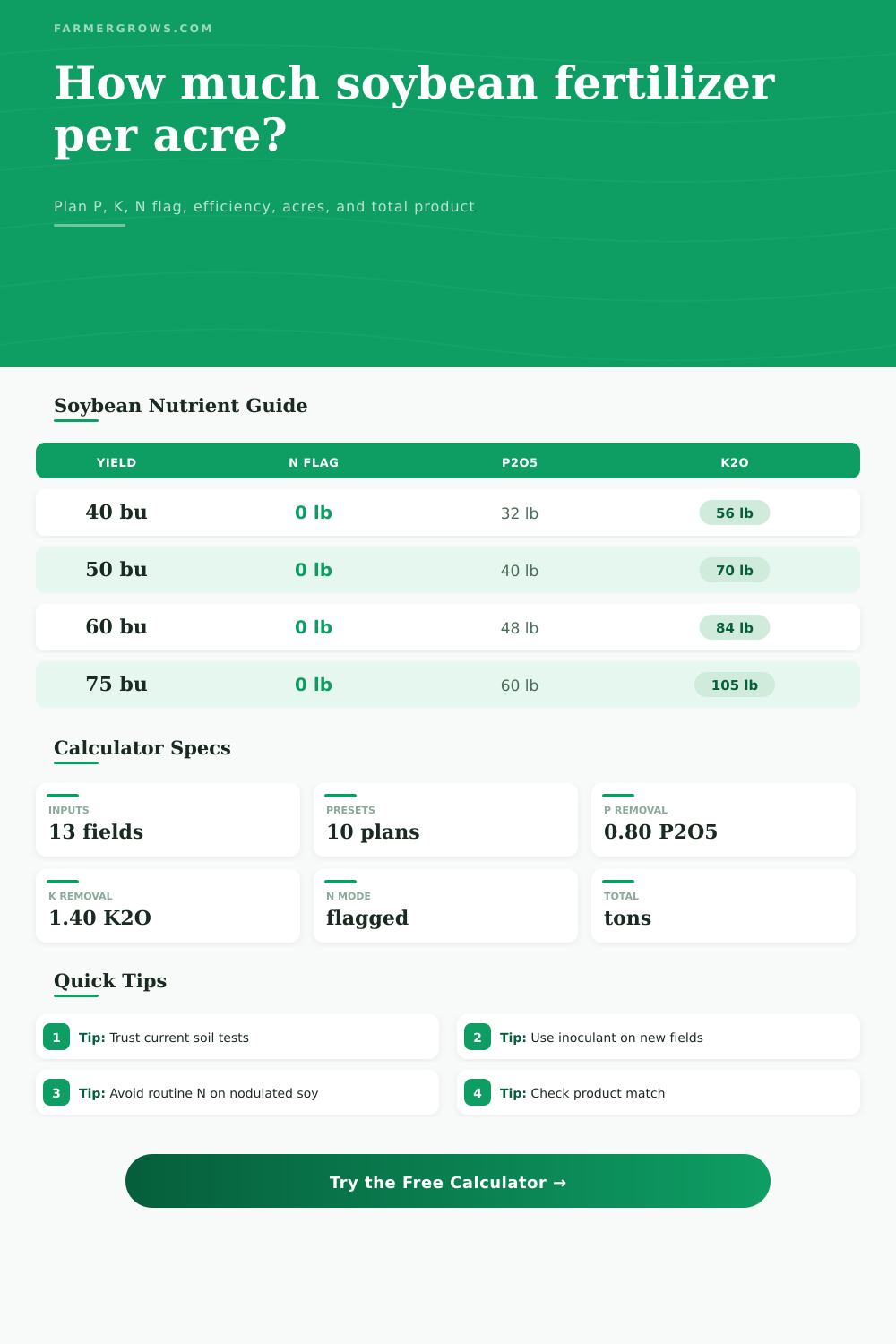
| 35 bu/ac | 0 lb/ac when nodulated | 28 lb/ac | 49 lb/ac | Low-yield dryland or stress-prone field |
| 45 bu/ac | 0 lb/ac when nodulated | 36 lb/ac | 63 lb/ac | Moderate rainfed field with maintenance fertility |
| 55 bu/ac | 0 lb/ac when nodulated | 44 lb/ac | 77 lb/ac | Common soybean planning target |
| 65 bu/ac | 0 lb/ac when nodulated | 52 lb/ac | 91 lb/ac | Strong field history or food-grade program |
| 75 bu/ac | 0 lb/ac when nodulated | 60 lb/ac | 105 lb/ac | High-yield environment with careful K replacement |
| Soil class | P2O5 adjustment | K2O adjustment | Planning intent | Calculator behavior |
|---|---|---|---|---|
| Very low | 1.40 x removal plus 25 | 1.50 x removal plus 35 | Build depleted soil | Raises recommendation above crop removal |
| Low | 1.20 x removal plus 15 | 1.25 x removal plus 20 | Build toward optimum | Adds build-up fertilizer to maintenance |
| Medium | 1.00 x removal | 1.00 x removal | Maintain production | Uses removal as the target |
| High | 0.50 x removal | 0.50 x removal | Partial drawdown | Reduces product need where soil supply is strong |
| Very high | 0 lb/ac | 0 lb/ac | No build need | Shows surplus if the chosen blend still supplies nutrient |
| Product or blend | N-P-K analysis | Best rate basis | Typical placement | Watch item |
|---|---|---|---|---|
| MAP | 11-52-0 | P2O5 recommendation | Broadcast or band away from seed | Supplies extra N with phosphate |
| DAP | 18-46-0 | P2O5 recommendation | Broadcast, band, or preplant | More N than MAP at the same P rate |
| Muriate of potash | 0-0-60 | K2O recommendation | Broadcast or fall/spring preplant | Salt concentration near seed if banded close |
| Soybean blend | 6-24-24 | Largest P and K gap | Broadcast or banded beside row | May under-supply K on high-removal fields |
| No-N blend | 0-20-20 | Largest P and K gap | Broadcast or preplant incorporated | Useful when avoiding routine added N |
| Sulfate of potash | 0-0-50 | K2O recommendation | Broadcast where chloride is a concern | Lower K analysis than muriate of potash |
| Field situation | N flag | Inoculation note | Calculator use |
|---|---|---|---|
| Long soybean history | No routine N | Confirm nodules during early vegetative growth | Use P and K as primary rate drivers |
| New soybean ground | No routine N, but inoculate | Use fresh, crop-specific inoculant on seed or in-furrow | Keep N target at zero unless a local recommendation says otherwise |
| Dry or stressed crop | Evaluate nodulation | Dig roots and check active nodules before adding N | Use starter or rescue mode only for planning comparisons |
| Poor nodulation observed | Rescue N check | Verify cause, moisture, pH, and inoculant performance | Set N mode to rescue or custom and compare product need |
Let the soil test drive P and K. Soybean fertilizer math is usually a removal-and-soil-test problem. Use the calculator to compare maintenance, build, and drawdown rates before blending product.
Keep the N flag honest. Well-nodulated soybeans normally do not need routine fertilizer nitrogen. Use starter or rescue N only when field scouting and local guidance support it.
Soil that grows soybeans has to be good at making its own nitrogen. Soybeans is really good at doing this. This is why the calculator does not assume a need for added nitrogen.
But it needs other nutrients. It’s a big eater of phosphorus and potassium, and those two nutrients becomes depleted as you remove the crop.
How to Use the Soybean Fertilizer Calculator
The calculator flags nitrogen for routine use rather then assuming it’s a mandatory requirement, even though corn makes very obvious demands on it. Why? Because soybeans form their own nitrogen; this partnership between the plant and certain bacteria in their roots is one reason soybeans don’t require as much nitrogen fertilizer than other crops. So you usually won’t need extra nitrogen in most healthy soils; and will just waste your money by adding it, and potentialy halt nodule formation.
Potassium and phosphorous act as a negative savings account; each time it get drawn on through harvests, it decreases the balance. If you started with good soil, you can go a couple years ignoring the account balance but then you’ll notice declining rates of growth and production. The issue is that soil tests are snapshot views; they reflect where you’re at today, not where you’d be tomorrow if you pull off fifty bushel.
That’s where having yield goals becomes important when planning. A sixty-bushel-per-acre crop draws more nutrients from the soil than does a thirty-bushel crop (even though both may appear identical given the weather). Grow what you plan to harvest to keep the nutrient balance positive.
Once you plug in your yield target and soil test class, the calculator do all the math, no more conversions or coefficients! Remember phosphorus lingers long in the soil, where timing and placement matter. If you broadcast on top, it can gets locked up by iron and aluminum and be unavailable to the plant. The tool has a multiplier for efficiency because fertilizer near the root is better than on top of residue. It accounts for changes in percent efficiency.
You have to think about soil conditions and your equipment. It is not potassium. In soybeans, potassium tend to be the most exported nutrient. More so than even in corn. That’s because high-yield environments is quick to deplete it. You have to replace what you take out if you want to keep things stable. According to the removal rates listed in the reference table, each bushel of a seventy-five-bushel crop exports more then a pound of potash. Not counting that export will result in a slow loss of soil health.
The tool shows total amount needed based off your product analysis. This helps you see how much it will impact your soil. Logistics meets agronomy in product choice. Sure, a bag marked “standard blend” may save you from making that extra trip with the spreader. But it can also cause you to over-apply one nutrient just to make up for the other. With this calculator, you can type in what’s on the tag (N-P-K analysis). You’ll see exactly how much of which nutrient you’re applying. Wanting a product low in potassium and high in phosphorus? You may be building up too much phosphorous as the crop runs out of potash. You must balance what is convenient with what the crop needs.
You are working on new ground, so don’t forget inoculation status. For example if you’re planting soybeans where they’ve never been grown, there will be no naturaly occurring population of the bacteria on that soil. Plants can’t effectively fix nitrogen without it. A little starting fertilization may improve things till nodulation occurs.
The tool would of shown this as a reminder: Biology first…then chemistry. Trust the soil tests, but check the root nodules. No amount of good fertility plans can compensates for poor nodulation. Know your soil tests, but always examine your root nodules.
Let the data drive your blend. Plan from the yield goal and honor the removal rates. Whatever you leave in the ground pays for tomorrow’s crop.