
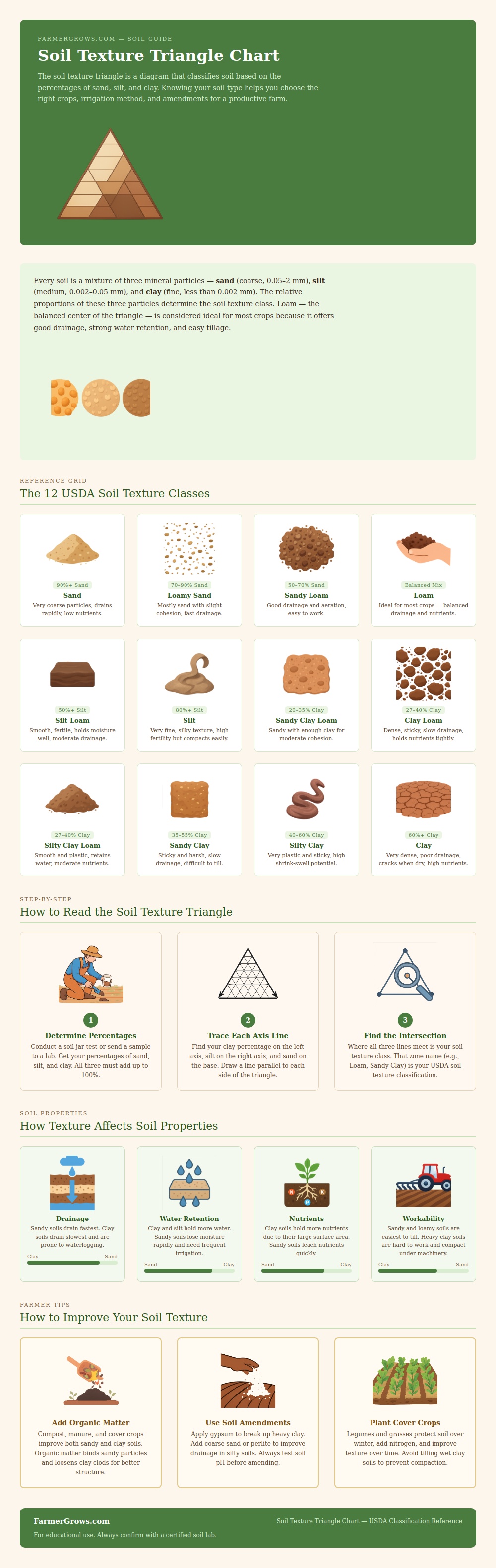
The texture triangle of soil helps to guess the type of ground texture. It is a triangle with three sides that shows the parts of sand, silt and clay. The bottom side points the percentage of sand, the right of clay and the left of silt.
Every side is divided in 100 parts When you know the proportions of those three parts in soil, it is possible to guess its texture.
How to read the soil texture triangle
To find the texture type on the triangle, you identify the spot where the lines of the three percentages cross. The trouble is in the use of the many crossing lines of the diagram. Trace the lines according to your measured values and search the place where they meet.
That area shows the ground type. For instance, a particular mix of sand, silt and clay can mean loam-texture.
The texture triangle is only for clay, silt and sand. It is possible to count and mark several texture classes according to the percentages of those three elements. For sandy loam, loamy sand and sandy textures you use also optional sandy fractions.
The tool can mark until 100 spots simulatenously.
You call ground textures according to the proportions of sand, silt and clay. Sandy loam has mostly sand, drains quickly, but has enough silt and clay for structure. Silt loam is chiefly silty, feels smooth, holds water, but drains more than pure clay.
Those names help to describe the behavior of soil in garden or on field.
That triangle is for mineral soils. Peat is organic, so for it use other classifications. It shows especially the mineral part of such soil.
The USDA, the American Department of Farming, created the texture triangle. Traditionally it is a basic part in soil classification. You tested its loyalty by means of 256 soil samples from 21 lands and 35 publications with texture and lime data.
The composition of soil appears as a spot on an interactive triangle, that shows exactly its place in the system. That algorithm checks several rules for assign one from the 12 texture classes.
The texture triangle of soil is key for understand soil and avoid problems as erosion. It helps sustainable use of ground by means of analysis of the proportions of sand, silt and clay in any sample.