Soil Sulfur Calculator
Estimate elemental sulfur demand, actual amendment weight, split applications, and crop pH fit from current pH, target pH, texture, area, depth, organic matter, and buffer assumptions.
This calculator estimates acidifying sulfur rates for planning, not a replacement for a lab recommendation. Elemental sulfur changes pH slowly through microbial oxidation, and calcareous soils may resist practical pH change.
Sulfur Amendment Estimate
Results combine texture response, pH drop, incorporation depth, organic matter, buffer class, carbonate assumption, and selected sulfur material.
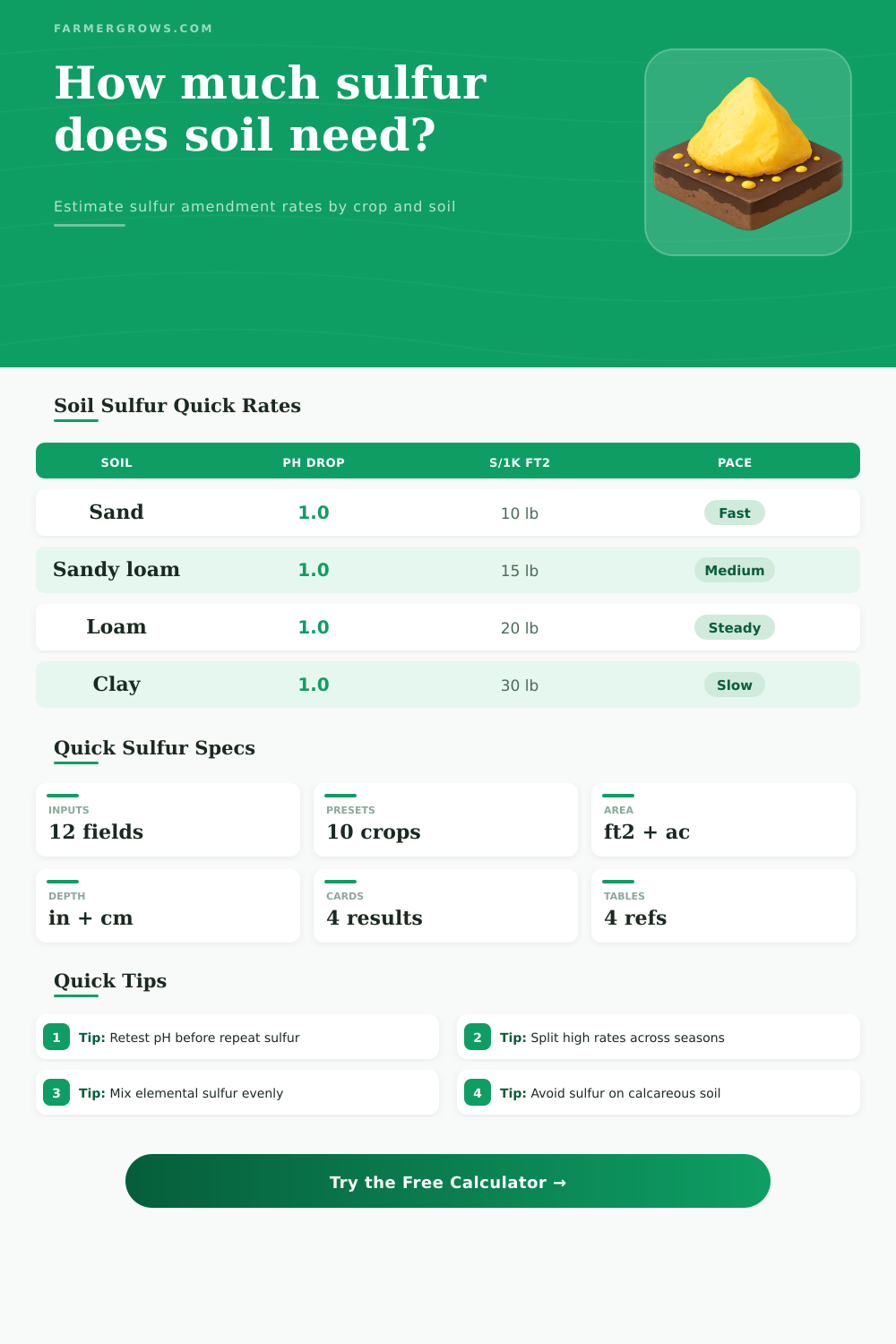
| Soil texture | Approx elemental S for 1 pH unit | Response speed | Buffer note |
|---|---|---|---|
| Sand | 10 lb per 1,000 sq ft at 6 in | Fast | Low clay and low reserve alkalinity |
| Loamy sand | 12 lb per 1,000 sq ft at 6 in | Fast to medium | Still easy to over-apply |
| Sandy loam | 15 lb per 1,000 sq ft at 6 in | Medium | Common vegetable and berry soil |
| Loam or silt loam | 20 to 22 lb per 1,000 sq ft at 6 in | Steady | Moderate cation exchange and organic matter |
| Clay loam or clay | 26 to 32 lb per 1,000 sq ft at 6 in | Slow | Needs careful splitting and retesting |
| Sulfur form | Typical sulfur content | pH-lowering behavior | Best use |
|---|---|---|---|
| Elemental sulfur | 90% to 99% S | Strong acidification after microbial oxidation | Planned pH reduction before planting |
| Bentonite sulfur | About 90% S | Disperses after wetting, then oxidizes | Field and bed incorporation |
| Ammonium sulfate | About 24% S | Some acidifying effect plus nitrogen | Fertilizer program, not large pH shifts |
| Iron sulfate | About 19% S | Quicker but bulky and weaker per pound | Small beds, turf greening, short-term correction |
| Gypsum | About 18.6% S | Supplies sulfate but usually does not lower pH | Calcium and sulfur nutrient supply |
| Crop or setting | Conservative max per application | Retest interval | Application note |
|---|---|---|---|
| Blueberry and acid-loving shrubs | 10 to 15 lb elemental S per 1,000 sq ft | 6 to 12 months | Blend before planting when possible |
| Vegetable beds | 10 to 20 lb elemental S per 1,000 sq ft | 3 to 6 months | Avoid direct seed contact with fresh sulfur |
| Turfgrass | 5 to 10 lb elemental S per 1,000 sq ft | 3 to 6 months | Water in and avoid hot drought stress |
| Field crop soil | 200 to 600 lb elemental S per acre | One season | Use variable-rate/lab guidance for large areas |
| Clay or high CCE soils | Split into multiple low passes | One season or more | May be impractical if free lime is high |
| Crop | Preferred pH range | Too high for crop | Soil sulfur caution |
|---|---|---|---|
| Blueberry | 4.5 to 5.2 | Above 5.5 | Start acidification well before planting |
| Potato | 5.0 to 6.0 | Above 6.5 for scab-sensitive ground | Do not overshoot below crop tolerance |
| Azalea and rhododendron | 4.5 to 5.8 | Above 6.2 | Use organic mulch and retest beds |
| Corn and soybean | 6.0 to 7.0 | Usually above 7.4 | Large pH shifts are rarely economical |
| Alfalfa | 6.8 to 7.5 | Rarely needs acidification | Do not sulfur lower a good alfalfa pH |
Before applying: Use a current soil test for pH, buffer pH, organic matter, and free lime. Elemental sulfur recommendations vary widely because soil buffering varies widely.
After applying: Keep sulfur evenly mixed, moist, and warm enough for microbial oxidation. Retest before adding more, especially on sandy beds or near roots.
A plant’s ability to make its own fruit, resist disease and take up nutrients from soil depend on soil pH. Many gardeners discover their soil is too alkaline for the crops they hope to grow. To remedy this use elemental sulfur. Soil microbes turns it into sulfuric acid, which decreases the pH.
How much? That depends on how much your soil resists change; also its depth, texture, and organic-matter content. Get the rate correct. Applying too little sulfur leave the problem unsolved; applying excessive amounts will lower it past the tolerance range of your crop.
How to Lower Soil pH with Sulfur
Key factors that change how much sulfur you need The first variable is texture. Because sand has low alkalinity reserve and holds very few cations, it will react rapidly. Because clay hold higher buffering capacity, it takes more sulfur to affect an equivalent change. Then there’s the organic matter variable, buffering against change, but sometimes requiring a little bit more sulfur itself. Finally, there’s depth as a variable. Soil that’s six inches thick contain far more particles than soil with sulfur only in its surface.
Thankfully, the calculator accounts for all that math for us; no need to guess around with conversion factors.
How does this work? It depends on what you apply. Pure elemental sulfur will be the most potent for acidification (measured in pounds per pound), but it will require oxidation by microbes before it works. Materials containing iron or nitrogen gives a little bit of acidification as well as supplying nutrients. However, because these contain less sulfur, you’ll be applying more total pounds of product to reach your target pH. Gypsum contains sulfur but doesn’t reduce pH. If you want the benefit of the nutrient without the added acid, that’s the ticket. You can compare all of them side-by-side using the tool; see how they stack up to the target pH.
If the total amount to be applied exceeds what can be handled in one season, it needs to be applied in stages. Soils with lots of carbonates such as high-clay ones may require partial doses over two or three years. Re-test after each application. The initial pass in the calculator is trimmed (the safety reduction setting) to avoid overdose, which can harm roots and overwhelm microbes.
Actual soils don’t necessarily average what models assumes. People also make common errors with sulfur thinking it’s a single treatment: “I applied a large amount; I skipped the retest. Now the crop shows signs of deficiency, or the pH went up again.” Or they simply forgot that the carbonate in their soil may be high enough to neutralize the acid, so even what looks like an adequate rate didnt work.
The calculator will warn you if your carbonate assumptions is high, but a recent soil test for calcium carbonate equivalent (and also buffer pH) is still the best protection against not knowing. Using sulfur is about knowing how much resistance you have, rather than searching for a perfect amount. You will learn what works with your soil (resistance), depth and texture, then find your timing and material based off those factors.
Ideally you want steady movement toward the proper pH range. That way it isn’t going up or down so dramatically that it creates other issues.