
When you go shopping for fertilizer, as most gardeners do, you start out with a bag promising quick action. Sprinkle it on the ground; water it in; wait, and wait, and wait. Maybe nothing happens; maybe something else does (maybe leaf go yellow), the stems break off, the fruit fails to ripen. What happened? Chances are it wasn’t because of lack of effort on your part, or even because general soil was lacking. It’s most likely based off chemistry.
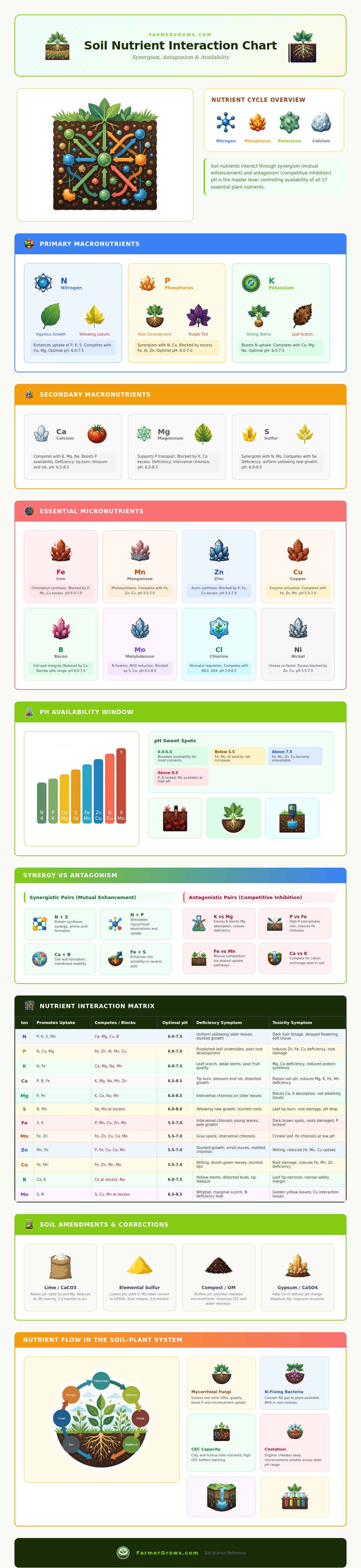
Plants don’t take up one nutrient in isolation; it’s a mistake to treat each one as if it were its own variable. Think tomato-thinking: Think like a chemist. These factors is inter-related as shown in the chart above. That’s why it’s not simply a matter of feeding plant; it’s also about providing the right balance among N-P-K (nitrogen-phosphorus-potassium).
Why Plants Need Balanced Food
Nitrogen promotes green growth, but requires sufficient phosphorus for root development and potassium for firmness of stem. So if there isn’t enough of one, the others will suffer. A lack of balance result in weak foliage that’s more prone to disease. All three macro-nutrients depends on one another to create a sound structure.
Too much nitrogen mean the plant puts all its energy into leaves, not flowers or roots. The extra is no longer a benefit but a problem. PH is master switch for nutrient availability. Most of the important ones are available at soil pH levels between 6.0 and 7.5, as shown on the infographic.
If the soil gets more acid, some micronutrients such as manganese and iron get so soluble that they kills the plant; if it gets too alkaline, these same elements becomes totally unavailable. They’re in the dirt, where the roots can see them (but they’re chemically inaccessible). That’s what can causes a plant to show deficiency symptoms even if you had a soil test saying there was plenty of whatever it lacks. There is, just not in an available form.
You should also watch out for antagonistic relationships, such as one nutrient blocking another. Magnesium and potassium commonly compete for uptake, for example, in the root zone. Too much potassium can causes the plant to have trouble absorbing magnesium. This results in older leaves turning yellow between the veins. But it’s not because there is no magnesium in the soil; it’s because the magnesium gets trapped in a traffic jam at the cell membrane level.
High phosphorus levels can makes iron and zinc unavailable as well. And how do you fix this? You don’t just add missing nutrient(s). Usually you need to reduce the one that’s dominating the system.
Good soil biology buffers the swings in pH with compost and other well-rotted material such as manures, and keeps micronutrients dissolved with their own form of organic chelate. Mycorrhizal fungi help extend root systems, giving plants more surface area to take up nutrients (especially zinc and phosphorus). All this goes on behind the scenes. Biological partnerships does what is difficult for rigid chemical laws to achieve: they turn flexibility in form into a chance for growth.
The point isn’t always to hit a perfect number on the test-strip scale each time when you build soil health. The point is to create an environment that is healthy enough that it will all just work together. Mostly it’s patience. Adjusting soil pH with lime or elemental sulfur requires time (months). That means planning: No hurrying the chemistry; however impatient we may feel about harvest.
Knowing how things work can turn gardening into strategy rather than guesswork. It becomes less about doing things to your plants and more about cooperating with their nature. When you know that each yellow leaf represent an invitation to decode the message, you stop wondering what went wrong and initial confusion fades.