Sod Weight Calculator
Estimate sod weight from area, thickness, moisture, and density so your order matches the lawn, the crew, and the truck. Start with a preset, then tune roll, pallet, and payload settings to fit your supplier.
Choose a real install scenario to seed the fields. Each preset sets shape, density profile, waste, thickness, moisture, roll size, pallet fill, and truck payload.
Sod Weight Output
Calculated from your area, shape, waste, thickness, moisture, density, and delivery assumptions.
| Format | Typical size | Coverage | Best use |
|---|---|---|---|
| Slab | 16 in x 24 in | 2.67 sf | Patch repairs and tight edges |
| Strip roll | 16 in x 48 in | 5.33 sf | Small yards and quick seams |
| Standard roll | 2 ft x 5 ft | 10 sf | Most home lawn installs |
| Big roll | 4 ft x 50 ft | 200 sf | Sports turf and broad fields |
| Moisture band | Wet multiplier | Dry density idea | Planning note |
|---|---|---|---|
| 20-25% | 1.25-1.33x | Light, freshly cut sod | Faster to move and stack |
| 26-30% | 1.35-1.43x | Common delivery moisture | Good baseline for orders |
| 31-35% | 1.45-1.54x | Heavier cut with more water | Check lift and pallet limits |
| 36-40% | 1.56-1.67x | Very wet or freshly irrigated | Add margin for handling |
| 24 lb/ft3 dry | 28% moisture = 33.3 wet lb/ft3 | Typical planning density | Matches about 2.8 lb/sf at 1 in |
| Profile range | Varies by cultivar | Use the profile selector | Preset values stay editable |
| Site type | Waste | Why it changes | Planning hint |
|---|---|---|---|
| Clean rectangle | 5-7% | Few cuts and seams | Order close to measured area |
| Corner lot | 7-9% | Extra turns at borders | Add trim pieces for edges |
| Curved bed line | 8-12% | More offcuts near arcs | Round up before unloading |
| L-shape | 10-14% | More joints and notches | Split into two rectangles |
| Slope repair | 12-15% | Cut loss and slip risk | Keep extra rolls on hand |
| Patch repair | 12-18% | Small zones waste more | Order the next full roll |
| Load | Weight band | Pallet count | Good fit |
|---|---|---|---|
| Light truck | up to 4,000 lb | 1-2 | Small repairs and side yards |
| Half load | 4,000-8,000 lb | 2-4 | Most suburban lawn jobs |
| Flatbed drop | 8,000-12,000 lb | 4-6 | Multiple pallets and longer runs |
| Full route | 12,000 lb+ | 6+ | Big rolls and field installs |
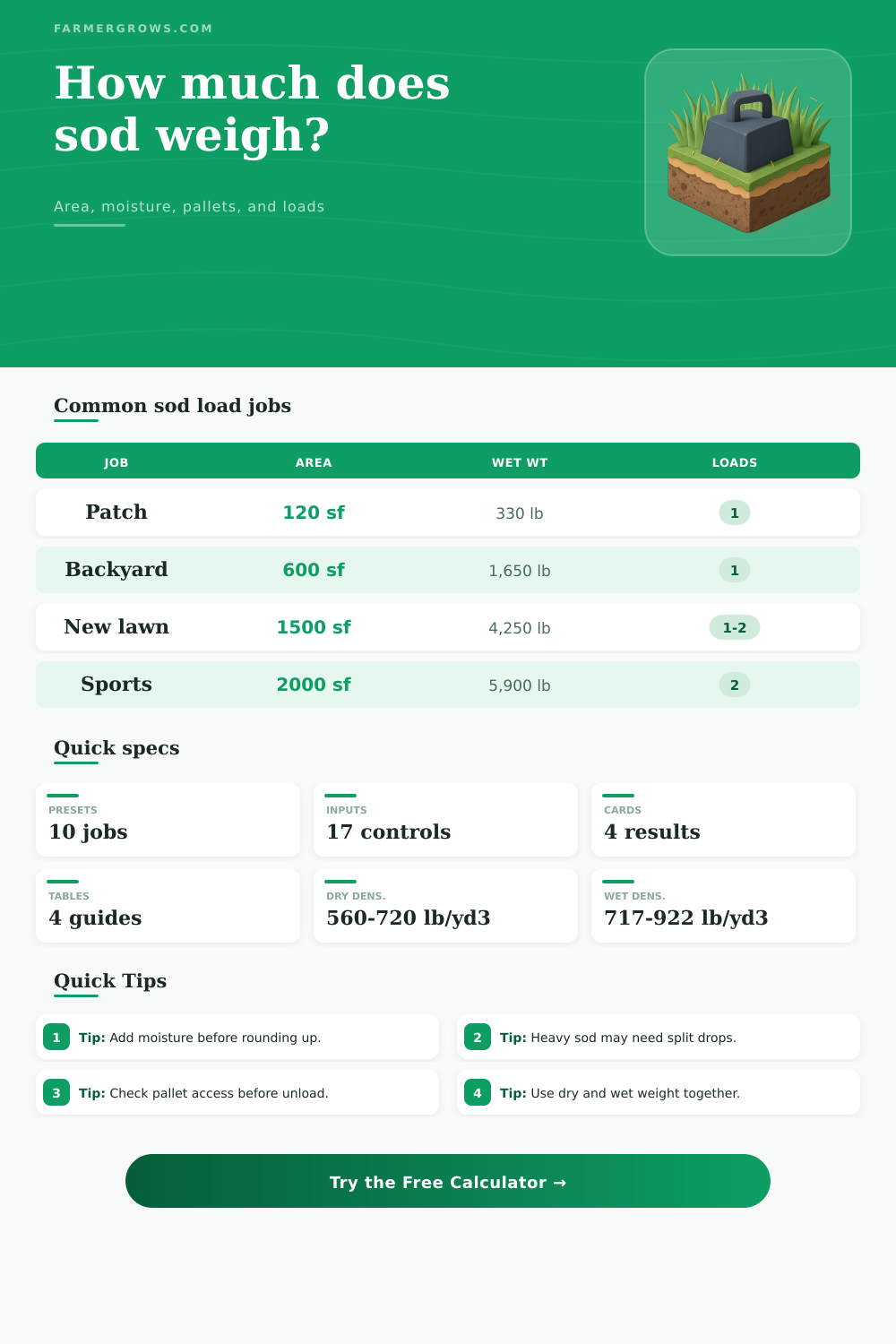
When you order sod, you must calculate a total weight of the sod. The weight of the sod is important to determine how much sod a truck can carry. Sod isnt just grass; it also contain the roots of the grass, soil, and water.
The more water that is contained within the sod, the more weight the sod will have. The percentage of water within the sod change based off the time of day that workers harvest the sod. If you measure the area that is to be covered in sod, but do not account for the weight of sod, you may order too much sod, which may create problems during the sod delivery process.
How to Calculate the Weight of Sod
The first step in calculating the weight of the sod that will be delivered to your lawn is to measure the total area that will be covered by the sod in square feet. You must increase this area measurement by a waste factor to account for the fact that some of the sod will be cut to fit in curve in the lawn. Eight to fifteen percent should be added to the total area of the lawn to account for this waste factor.
If the lawn features numerous curves or irregular shape, more sod will need to be purchased to account for the waste from cutting the sod to fit in these areas. Once you calculate the total area of the lawn with the added waste factor, the thickness of the sod will be determined. The density of the sod will change based upon the type of grass that is to be delivered and the moisture content of the sod.
For instance, Bermuda sod is often lighter than sod that contains St. Augustine grass. Another example is that Bermuda sod hold less water than sod that contains St. Augustine grass. Additionally, sod with a moisture content of twenty percent will weigh less than sod that has a moisture content of forty percent.
To calculate the weight of sod with moisture content, you will multiply the dry weight of the sod by a moisture multiplier. For instance, twenty percent moisture has a moisture multiplier of 1.25 while forty percent has a moisture multiplier of 1.67. The pallets will add to the total weight of the sod that will be delivered to your lawn.
Each pallet will have a tare weight, or the weight of the pallet itself of wooden pallet. If you dont account for the weight of the pallet, the total weight of the sod will be inaccurate. The total weight of the sod and the pallets must be within the maximum payload that the delivery vehicle can carry.
For example, if the payload of a pickup truck is seven thousand pounds, it is important to ensure that the weight of the sod and pallets will not exceed this weight. There are different ways to form sod. Slabs of sod are sixteen inches by twenty-four inches and are used for small area.
Because sod comes in these slabs, there will be more cutting of sod to fit the area. Rolls of sod are generally two feet by five feet in size. Rolls of sod are easier to unroll than slabs.
However, sod that is wet will stick to other rolls of sod. Large rolls are used for large fields of sod. The advantage of large rolls is that they are more easy to transport, but they are also the heaviest type of sod and can be more difficult to move.
To prepare the sod for your lawn, you will need to ensure that the area to be sodded is firm to avoid the pallets of sod sink into the ground. Additionally, you will need to consider how many people are going to be used to move the sod. One person can move thirty pound rolls of sod.
Fifty pound rolls of sod may require more person to move these rolls. Overall, by calculating the area of the lawn that will be sodded, adding the waste factor for sod that will be cut, considering the thickness of the sod, using the information regarding the density of sod with different types of grass and moisture content, considering the weight of the pallets of sod, considering the different formats in which sod can be delivered, and planning the logistics of placing the sod into the lawn, you will know the total weight of the sod that will be ordered for your sod delivery order.