
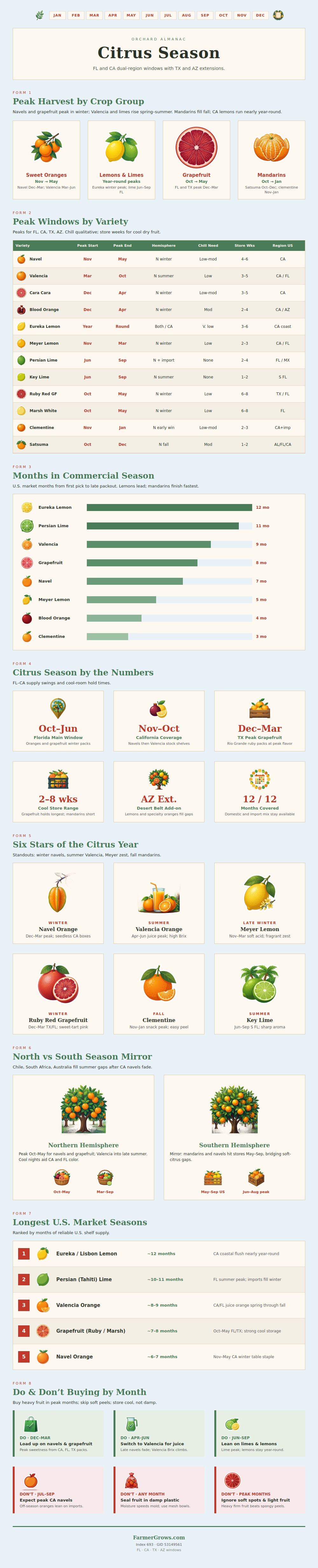
You might have some so-so oranges sitting on the counter. Maybe you purchased them because they appeared attractive and yet they’re an out-of-season piece of fruit, sitting in cold storage for months. Oranges don’t conform to one calendar. Depending on type and where you live, their flavor changes at different times. The chart below breaks that down. It shows seasonal differences in Florida, California, Texas and Arizona, and explains why knowing those changes make it easier to select better fruit.
Citrus is best in winter: Grapefruit and Navel oranges are the sweetest then. The infograph explains why you should of buy your fruit during the middle of the harvest, from December to March. That’s because navel and grapefruit is best in those colder months. During the winter, navels and grapefruit is mostly sourced along the Gulf Coast and in California. Why? Cool nights concentrate sugars and create color development on fruit.
Why Timing Matters for Citrus
When they purchases their orange in the summer, they think it’s the same thing but it isn’t as sweet. It doesn’t have the sugar content. And no, it can’t be helped; the fruit has to go through a bit of a chill in order to produce its flavor.
Look for navel season to peter out by mid April at which point you’ll want to rotate varieties. The Valencia orange is a springtime fruit. If you like juice from oranges, Valencias are the best. Navels are great to eat but they aren’t quite so great squeezed; the Valencias is better at it. As navel production declines, Valencia production increases (see chart). The warmer temperatures of late spring into early summer favor this variety. If you prefer your juice fresh off tree, hold out until April or May. Don’t think about squeezing them in January. It’s just not time.
Limes and lemons differ in consistency. Lemons (particularly California’s Eureka variety) tend to be on the market almost all year. That seems sensible for such a common ingredient; indeed their market window is longest, according to data. Not so with limes: Limes are a summertime fruit. July or August is prime season for making a margarita or pie based off key limes. It’s too bad if you want your lime to taste like it was picked fresh from a backyard tree. It probably wasn’t. In November, good luck trying to get peak-season limes. You’ll likely end up with something imported, and lacking the sharp bite of its homegrown counterpart.
But what happens with the fruit itself? The quality depends on how it’s stored. For example: A grapefruit will store well in cool conditions for as long as eight weeks without much loss of quality. That means they’re still around come deep winter. But what about mandarins and clementines? Those fruits are quite perishable; meant to go fast. Again, they has the shortest storage times, according to the chart, which is why you don’t often encounter a really fresh clementine in early spring. When you do, it’s probably not at its peak.
The southern hemisphere turns the clock around. We love winter oranges here; down there in Chile and South Africa they’re harvested then. Around the world: That’s what keeps us in fresh fruit each month. But there is a cost. What comes from far away, thousands of miles. Is no longer at its best. When ours runs out, in the chart below so do those from the other side of the planet: Southern Hemisphere imports plug the gap. They are available. Peak taste… Not so much.
To shop smart, check its weight: Heavier means more juice. Avoid a spongy peel or soft spots, especially if they is plentiful. Store your citrus in a dry, cool location (no damp plastic; that’ll lead to mold). And use this guide as a reminder for each season, and your fruit won’t disappoint. It’s all about timing, realy. Use the calendar as your guide and let the flavor follow.