
Pruning, irrigation, pest control…you’ve spent years learning all of that, yet your citrus grove becomes yellow. Whether you’re a commercial grower or a home hobbyist, it happens. One day its canopy appears lush; the next, pale. It’s a vague symptom: why are leaf yellow? What caused it? Without a diagnostic plan, you’ll be guessing which fertilizer to apply, and often covering up symptoms while creating new imbalances.
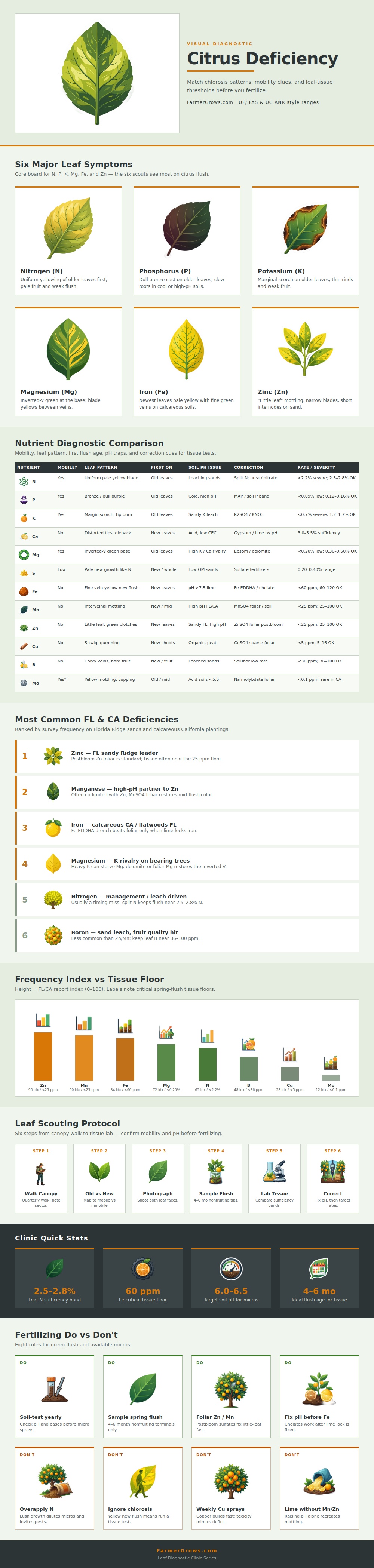
Six typical types of nutritional deficiencies can be broken down into specific categories, as illustrated by the chart above. Pay attention to which leaf first show signs of yellowing, and also to what direction it progresses. Are all the older (lower) leaves turning uniformly pale yellow, but those that are newly unfolding remain green? That’s probably a nitrogen problem. Because nitrogen is mobile within tree, it moves from old to new tissues, a survival tactic that leave a telling signature.
How to Read Yellow Leaves
Or does the youngest foliage (the ones on the outermost ends of branches) go yellow, while the veins stay green? In that case, you’re dealing with fixed nutrient such as zinc or iron, which the tree can’t shuffle around from old tissue. The new growth suffer immediately. Knowing this would of save you a lot of money on the wrong amendment. Which deficiency shows up first depend on location and what’s in the soil.
For example, on sandy soils like those in Florida Ridge, nutrient deficiencies show up most often where zinc gets leached out. The signs are small, narrow leaves with short spaces between nodes. On high-pH soils (such as in California), iron and manganese get locked up. Even when they’re in the ground, the roots can’t take it up. Your soil test may say you’ve got a lot of iron, but because the pH is too high, the iron are chemically out of reach for plants.
A second hint is magnesium deficiency, which appears as leaves that begin to turn yellow around edges (with the inner area remaining green). You’ll see this inverted V shape of green leaf tissue at the bottom half of the leaf and the remainder turning yellow. This happens frequently due to high potassium levels. The nutrients gets in a tussle, and high levels of one crowd out the other; again, balance is more important than abundance. One dominant player throws the whole system off track.
First, take a step back: It’s worth a fast walk through the canopy before you rush aimlessly to garden center. Are the symptoms present on new or old foliage? Is the pH of your soil off? Correcting it with lime or peat moss is often more effective than applying more fertilizer. Chelated fertilizers may provide temporary relief if the pH isn’t correct, but nothing but correction of the soil environment will do the trick permanently.
If you are in doubt, sample the spring flush and have it analyzed for tissue content. Results will be most accurate if they come from samples collected four to six months later, when the flush appears. Compare these findings with sufficiency bands; then you’ll know just what’s up (or down).
No need to guess: Guesswork equals over-application, and that burns roots…or dilutes other nutrients. You want a balanced, steady supply.
Growing citrus is not about fast answers but patience, listen to the leaves, change tactics, and wait for the feedback. Learn from the pattern of yellowing leaves and understand how nutrients move. See through the fog of misunderstanding and make sense off things again. If you learn how to read the tree, the tree will teach you where to intervene.