Eggplant Seed Germination Time Calculator
Estimate first sprouts, main emergence, transplant-ready timing, and schedule fit for eggplant seed from seed-mix warmth, heat mat setup, seed age, sowing depth, moisture, variety type, and transplant target.
📋Named eggplant seed scenarios
Choose a realistic eggplant sowing setup, then adjust the seed mix temperature, heat mat behavior, seed age, depth, moisture, and transplant target.
🌱Eggplant germination inputs
Use the temperature inside the seed-starting mix, not the air above the tray. Eggplant seed is slow in cool media and can rot if cool moisture lingers too long.
Eggplant seed timing estimate
Calculated from the entered seed mix temperature, heat mat setup, depth, moisture, seed age, and transplant target.
Eggplant germination breakdown
📊Warmth comparison
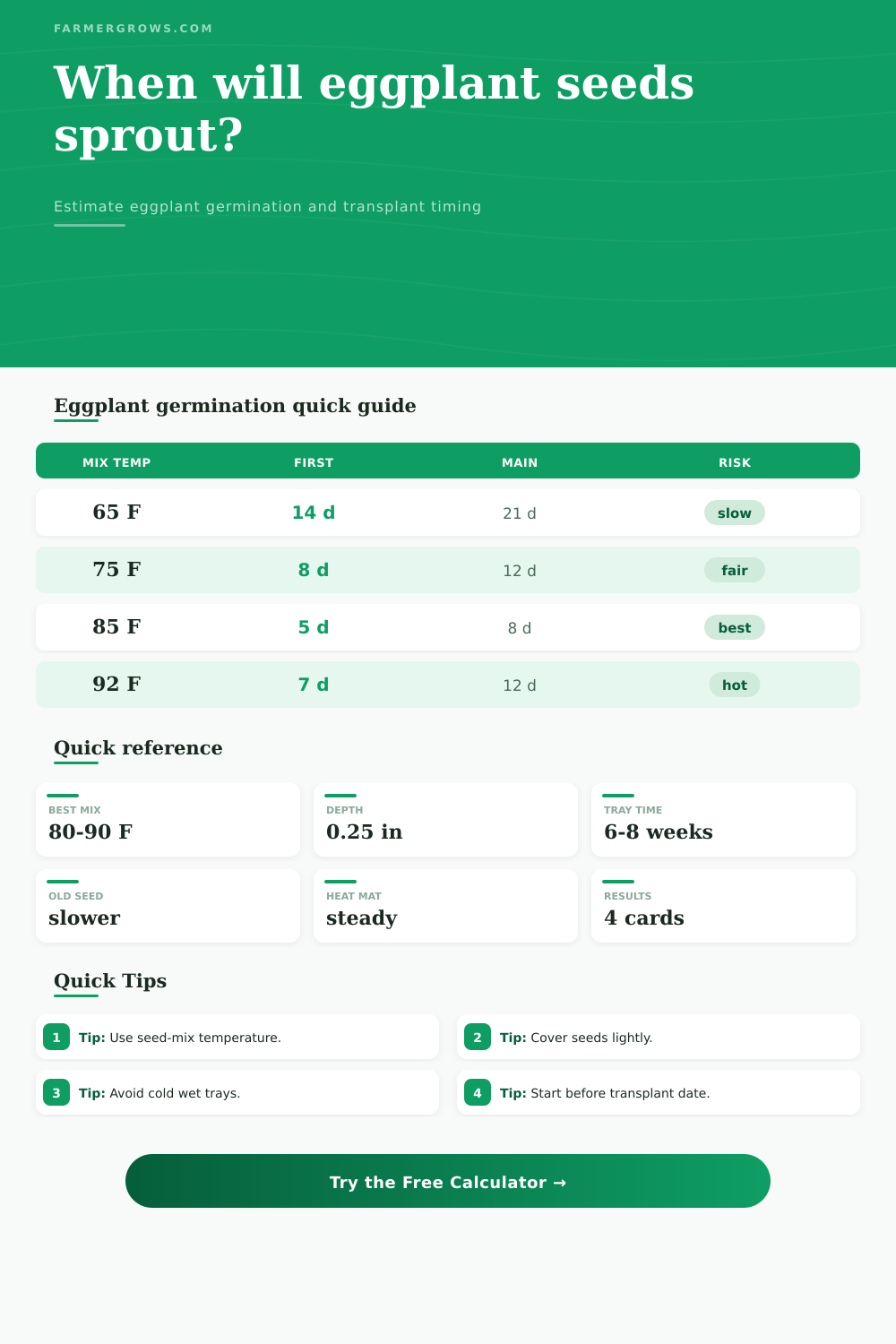
Compare the same eggplant seed lot at cooler, current, ideal, and hot tray temperatures. This shows why heat mat control matters.
🧪Current setup scores
📘Eggplant seed reference tables
| Seed mix temp | Typical emergence | Stand outlook | Tray action |
|---|---|---|---|
| 60-64°F | 18-30 days | Poor to uneven | Warm before trusting the tray |
| 65-69°F | 12-21 days | Slow | Add bottom heat if possible |
| 70-79°F | 8-14 days | Fair to good | Keep moisture steady |
| 80-90°F | 5-9 days | Best | Check cells daily after day 5 |
| 91-96°F | 6-12 days | Heat risk | Vent dome and verify probe |
| Variety type | Sprout habit | Seedling time | Planning note |
|---|---|---|---|
| Italian globe | Moderate | 48-56 days | Common garden transplant timing |
| Asian long | Slightly quick | 45-52 days | Often vigorous in warm trays |
| Thai round | Moderate | 50-58 days | Benefits from steady warmth |
| Mini patio | Quick | 42-50 days | Useful for container schedules |
| Heirloom mixed | Uneven | 52-60 days | Allow wider emergence window |
| Seed lot | Delay | Likely stand | Cell strategy |
|---|---|---|---|
| Fresh to 1 year | None | 80-92% | One or two seeds per cell |
| 2 years | 1-2 days | 68-84% | Sow a small backup row |
| 3 years | 3-5 days | 48-70% | Use extra cells or test first |
| 4+ years | 5-9 days | 22-55% | Heavy sow or replace packet |
| Tested lot | Small | Use test result | Plan from real sprout count |
| Stage | Typical timing | What to see | Decision |
|---|---|---|---|
| Loop emergence | Day 5-14 | Hooked stems lifting mix | Remove dome after most are up |
| True leaves | 2-3 weeks | First real leaves expanding | Pot up if crowded |
| Harden off | 5-7 weeks | Stocky plants, several leaves | Start outdoor exposure slowly |
| Transplant | 6-8 weeks | Warm nights and sturdy stems | Plant after cold stress risk |
| Delayed tray | 8+ weeks | Rootbound or pale starts | Pot up and feed lightly |
Place the thermostat probe in a spare filled cell at seed depth. A mat setting is only useful when it matches the actual seed mix temperature.
Eggplant seed is small. A light 1/4 inch cover keeps it moist without forcing weak seedlings through a deep layer of mix.
This calculator estimates eggplant emergence and transplant readiness for seed-starting trays. Real timing can change with seed lot quality, sanitation, mix temperature swings, salinity, damping-off pressure, and local weather.
Most gardeners feel they must rush to plant eggplant seeds. Plant when the almanac says, right? Wrong; seed doesn’t read calendars. It wants moisture, and it want warmth. When these conditions do not match up, trays of seeds languish on windowsills week after week while faster-growing tomatoes spring to life nearby.
Define the physical conditions, and let a calculator do the math for you. A far better option than trying to guess what’s wrong: Is the soil too cold to be merely slow, or hostile to germination? The largest factor in this equation is temperature of the seed mix. Room air temp isn’t quite as important.
Why Eggplant Seeds Need Warm Soil
The nightshades (including eggplant) does not like cool soil; they thrive on heat. Metabolic activity grinds almost to a halt when the soil remain below 70 degrees Fahrenheit. The embryo may still be alive but barely pushing forward toward the light, struggling along. It’s burning off the reserve energy it packed into the seed, just to inch upward. The result are those pale, leggy-looking seedling that look more like survivors than athletes.
When most of us home growers judge heat, we’re doing it wrong: by feeling how hot or cold the tray surface feels against our fingertips. Of course your hands is room temperature, so a bit-warm tray registers neutral to you. Guess what? Seed doesn’t know any better; it demand consistent bottom heat to sustain those critical enzymatic reactions needed to get the seed coat to swell open and split.
Those seeds are teeny-tiny (eggplants in particular), so depth is important. If you plant too deeply, there’s no way for that tiny shoot to get past the physical obstacle. A quarter inch of covering seems just right: It’s dark enough to make the seed happy, and it hold moisture without being impenetrable. To accommodate this variable, the tool adjusts the time until emergence according to the distance the radicle must travel before popping up into air. It is quicker when planted shallow, assuming the growing medium doesn’t immediately dry out beneath grow lights.
Age of seeds can be forgotten about till it’s too late: While you may find a few germinations from a packet of three-year-old seeds (and there are ways to test whether yours is still viable), getting those embryos going will take far more energy than fresh ones will. Older seeds requires not only steady moisture, but also exactly right heat. Any interruption (the medium dries out for a single day; the soil temperature drops) and they’ll probably give up the ghost altogether. That strength is what gives fresh seed its buffer, and something older seeds just don’t have.
That’s where understanding storage conditions means adjusting expectations accordingly. It’s acknowledging biological reality. All of it comes back to moisture management: Water carries heat. If you’re mixing up seeds to germinate in potting soil, that moist medium holds heat better than a dry one. But if your medium is soaked in cool temperatures, before the seed has even had time to breathe, it’s just asking for rot and damping off. Again, the balance is delicate.
Ideally, the medium should be damp, like a wrung-out sponge, but not pooling water in puddles. On the page, there’s a chart (a sort of reference table) that shows the connection between success rates and speed at various temperature ranges. This helps you determine whether a heat mat is needed, or if you just need to change your watering routine.
Then there is variety timing. A mix of heirlooms is hard to predict, but mini patio types are usually easier because they grow quickly. Heavy Italian globes take longer then slim Asian long eggplants, which sprout fast. Set your expectation for seeing that earliest hint of green breaking surface to match what you have sown.
Only half the challenge of starting seeds on schedule, according to when the last frost is expected here, is knowing when to start; the other half is growing strong plants so they can survive transplant day outside. A weakling that’s spent weeks fighting its way along in a chilly tray won’t fare well out in the great wide open, all tuckered out before it even gets started.
Give the new seed what it craves those first couple days, and you’ll get strong starts. Warmth, consistency, and patience are all factors that go a long way toward turning your summer harvest into something more than a fond memory.
You should of planted earlier if you want best results. This moddern approach works naturaly better. It feels much more comfortabley to watch them grow.