
Once you began looking, the caterpillars were nearly everywhere: hanging off the limbs of walnut trees; coiled around petunia stems; tucked inside leaves of kale as if they were camouflaged. They were green fuzzballs that appeared innocent enough to anyone not trained to recognize them. That was precisely the trouble.
A helpful species of leaf-eater could be mistaken for one that’s a scourge; a cabbage looper might resemble a luna moth caterpillar, and what then? Your cabbage crop devoured (and no more moths next year, right?). It depends on knowing little things, which are details most gardeners ignore until it is too late. This knowledge can be the difference between a pest-plagued vegetable patch and a healthy population of pollinators.
How to Tell Good Caterpillars from Bad Ones
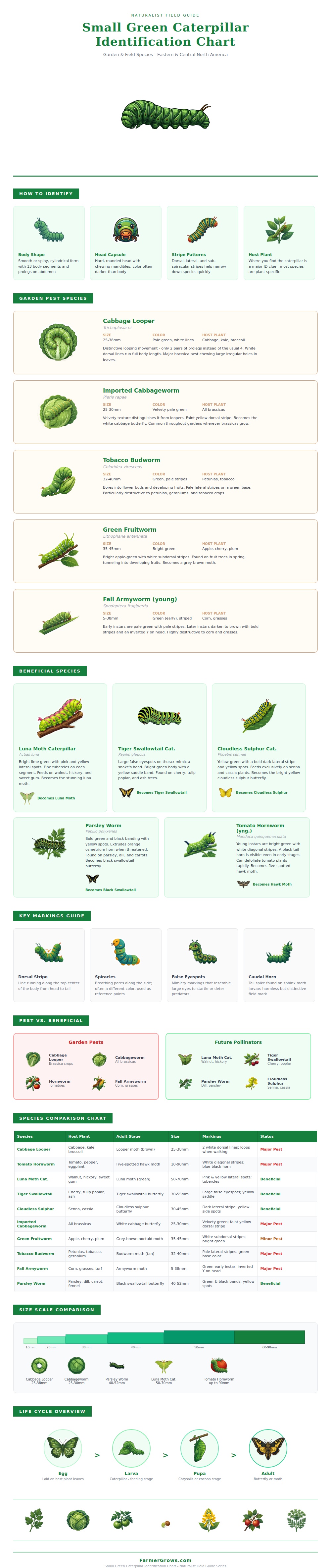
First lesson: Read their bodies. A caterpillar isn’t just a soft tube of hunger; they’re animals, built in ways that have clues to reading who they are. What do you see? It has a hard, rounded head capsule that is typically darker than the rest of its body. Any stripes on side, or even on the back? Those are evolutionary signals that will help you narrow down to a species fast. As chart above explains, lateral and dorsal stripes correspond to certain families, making what may be a confusing green blur into an identifiable livig thing. It’s as much about learning patterns as it is botany.
Your best detective work will be done with host plants. Because caterpillars tend to be selective eaters (yes, even notorious ones), they are limited to a particular family of plants most of the time. For instance, if you see a pale green worm with white stripes on it on your broccoli, chances are it’s a cabbage looper. The way the worm moves… Arching its back, then walking forward in sort of a looping motion, is characteristic behavior, since this creature has just two pairs of prolegs rather than the usual four. Because its movement is mechanically restricted, it is relatively easy to identify once you learn what to look for.
Compare that to the behavior of an imported cabbageworm. He doesn’t loop so much when he’s moving along. Instead, he stays closer to ground level and glides right along, eating all the brassicas he wants without displaying that looping gait. Knowing this would of save your cabbages from becoming shreds before you’re aware of the trouble.
But not all green visitors are enemies: In fact, some of the showiest creatures in the garden begin as nondescript larvae. For example, the Luna moth caterpillar eats hickory and walnut trees, and although it is not beautiful itself (it’s bright lime green with dainty pink side-spots), it becomes one of the biggest moths in North America. Or consider the Tomato Hornworm. Its black tail horn may make its youth seem scary, but really this creature is just maturing to be a giant hawk moth. Again, these are our friends, adults of such species is vital pollinators, or are otherwise just a necessary part of the natural ecosystem balance. If you know who they are, you can let them complete their life cycle, rather than spraying with pesticide (which will also kill other animals).
That’s largely a psychological trick: It asks us to go from eradicating-anything-green-blob mode to identifying-and-observing mode. First, identify the host plant (then squish the thing), and before you do, see if it has any of those distinguishing horns or stripes. This chart above presents them all side by side, pointing out who’s friend and who’s foe. It shows which to leave alone and which to target with your controls. It’s an easy-to-read reference that converts anxiety into action. No memorization required; just grasp the logic behind the identification process.
I GARDEN, remember? It’s a conversation, not a monologue, with the plants that grow here. If I can learn to translate their messages, they become less threatening and more neighborly. They are just someone with an agenda different than mine. Some are helping pollinate your flowers, or just looking pretty in your yard. Others is eating your dinner. Knowing who’s who helps you make better decisions on what to do.
The next time something flashes green against your foliage, slow down. Get closer and look for the stripes (the plant they’re on matters, too). Is it a guest or intruder? A little mindfulness makes all the difference.