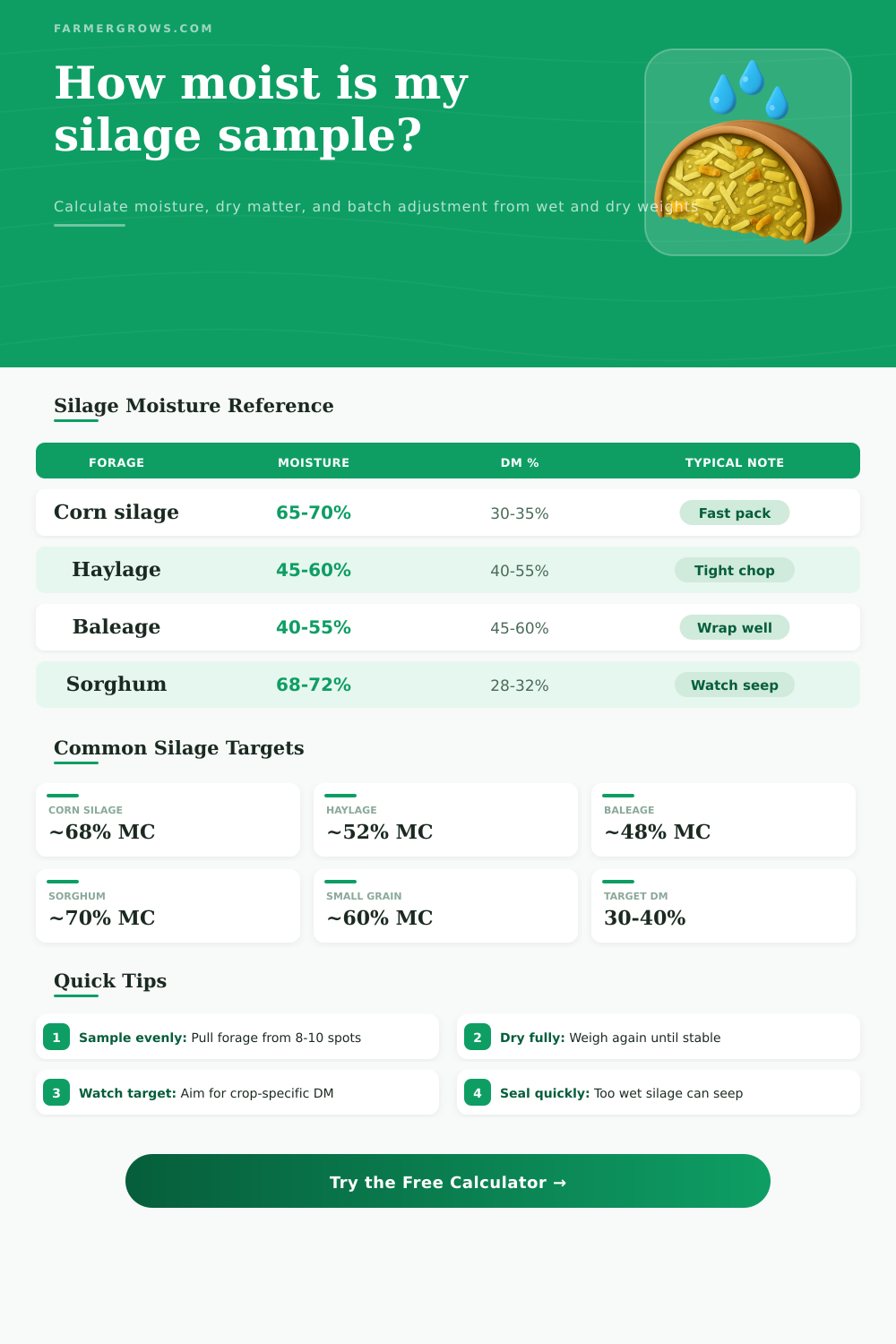
🌾 Silage Moisture Calculator
Measure moisture, dry matter, and batch water adjustment from wet and dry sample weights
Silage Moisture Reference
| Forage | Moisture | DM % | Typical use |
|---|---|---|---|
| Corn silage | 65-70% | 30-35% | Fast pack |
| Haylage | 45-60% | 40-55% | Tight chop |
| Baleage | 40-55% | 45-60% | Wrap well |
| Sorghum | 68-72% | 28-32% | Watch seep |
Water In One Ton
| Moisture | Dry matter | Water / ton | DM / ton |
|---|---|---|---|
| 45% | 55% | 900 lb | 1,100 lb |
| 50% | 50% | 1,000 lb | 1,000 lb |
| 60% | 40% | 1,200 lb | 800 lb |
| 70% | 30% | 1,400 lb | 600 lb |
Materials And Equipment
Right moisture is one of the main things you must get during making silage. The most important part for good silage is proper moisture content. If you get it wrong, big problems can happen, from nutrient loss to feed with a foul smell that animals refuse to eat
The perfect moisture level depends on the kind of storage you use. Optimum silage moisture ranges from 55 to 60 percent for upright oxygen-limiting silos, 60 to 65 percent for upright stave silos, 60 to 70 percent for bags and 65 to 70 percent for bunkers. For corn silage in traditional upright silos ideal moisture is around 63 to 68 percent, while in air-limiting silos it is around 55 to 60 percent.
Right Moisture for Good Silage
Too wet and immature harvested silage reduces the yield per acre. It causes nutrient losses and environmental damage because of seepage, and commonly produce bad, sour clostridial fermentation. Harvest in moisture above 70 percent not only gives less product, but also cause seepage and very bad clostridial fermentation.
Clostridial bacteria are very bad and change sugar of forage and organic acids into butyric acid, carbon dioxide and ammonia. Silage with those bacteria lose dry matter, have a foul smell because of the butyric acid and show higher pH, poor forage quality and taste.
Quality of corn silage is determined more exactly by whole-plant moisture content than by corn maturity stage. A common way to estimate plant moisture by maturity is to check where the milk line is in the kernal. Ideally you chop corn silage when the kernel reaches one-half to two-thirds of the milk line and has 32 to 38 percent of dry matter.
Milk-line ranges between hybrids, so it is best to harvest a sample before cutting the whole field. Checking moisture content at around 50 percent milk line is a good starting point.
Whole plant moisture content usually changes by 0.5 units per day, and in dry weather even up to 1.0 unit per day. Things move quickly, so timing is important.
Different moisture levels define the types of silage. High-moisture silage has 30 percent dry matter or less, medium-moisture silage has 30 to 40 percent dry matter and low-moisture or wilted silage has 40 to 60 percent dry matter. Silage is around 70 percent moisture, so you must think about the weight of water.
Two simple and cheap ways to check silage moisture are using a 250 watt red heat lamp or a microwave. Corn without rain with the bottom four to seven leaves brown and dry usually has proper moisture content for good silage fermentation. For silage to ferment well, it needs moisture, which explains why hay cannot be used for silage.