🌾 Silage Bunker Capacity Calculator
Estimate bunker volume, tons, dry matter, and feed days from bunker width, length, wall height, and packed fill depth.
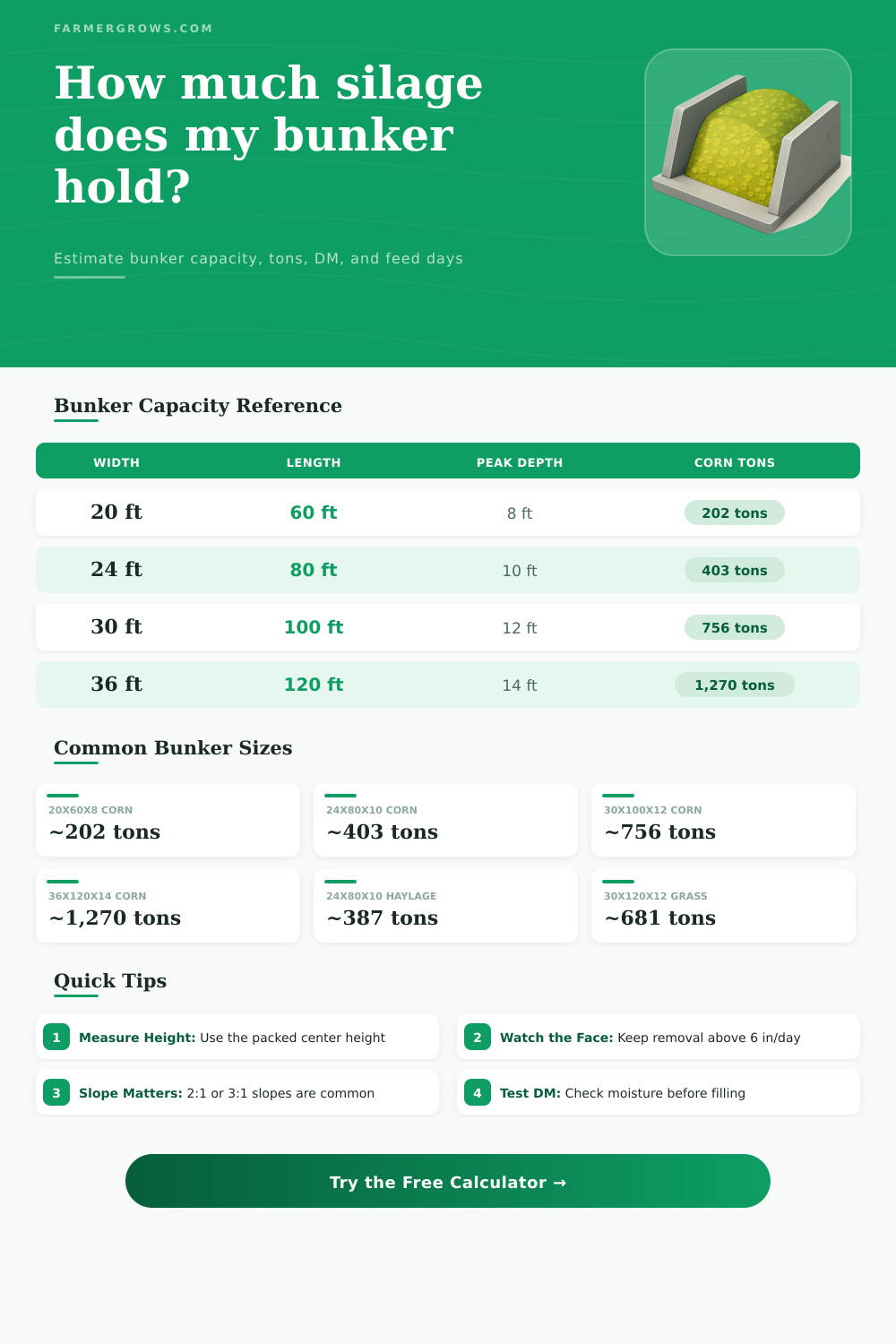
| Width | Length | Peak Depth | Corn Tons |
|---|---|---|---|
| 20 ft | 60 ft | 8 ft | ~202 tons |
| 24 ft | 80 ft | 10 ft | ~403 tons |
| 30 ft | 100 ft | 12 ft | ~756 tons |
| 36 ft | 120 ft | 14 ft | ~1,270 tons |
| Silage Type | Density | DM % | Tons / 1,000 cu ft |
|---|---|---|---|
| Corn silage | 42 | 35% | 21 tons |
| Grass haylage | 38 | 45% | 19 tons |
| Alfalfa silage | 40 | 40% | 20 tons |
| Sorghum silage | 40 | 35% | 20 tons |
| Small grain | 38 | 40% | 19 tons |
| Width | 8 ft depth | 10 ft depth | 12 ft depth |
|---|---|---|---|
| 20 ft | 3.4 tons | 4.2 tons | 5.0 tons |
| 24 ft | 4.0 tons | 5.0 tons | 6.0 tons |
| 30 ft | 5.0 tons | 6.3 tons | 7.6 tons |
| 36 ft | 6.0 tons | 7.6 tons | 9.1 tons |
Silage bunker capacity is something each farmer must think about when he plans feed storage. The right size helps keep expenses low and ensure enough feed for the whole herd
The size of pits and bunker silos range according to needs, but usually they are 6 to 18 metres wide and 12 to 60 metres long. The capacities of such silos go from 36 to 1 450 tons dry matter. Because the range is that broad, the choice of size depends on the number of animals to feed and the time that the feed must last.
How to Choose the Right Bunker Silo Size
Research at the University of Wisconsin and Cornell University shows that bunker silos ensile well when you fill them to a density above 14 pounds dry matter per cubic foot. The actual capacity adjusts according to the moisture content, the length of the cut and the packing density. In bunker silos with vertical side walls the whole volume is not reached, because the front surface leans in a 45-degree slope.
Densities of silage dry matters are around 12.5 pounds per cubic foot for alfalfa and 16.0 pounds per cubic foot for corn and sorghum.
Porosity can show the packing density and be a maximum of 40%, because silages generally require that. You fill bunker silos and drive-over piles by using the progressive wedge method to minimize the surface open to air and maximize the efficiency.
Losses accrue quickly. In a 30-foot wide and 100-foot long bunker you can loose around 50 tons of corn silage. That would suffice to feed ten lactating cows during a year or value around 2 250 dollars, at a price of 45 dollars per ton.
Good covering of the bunker helps to reduce that. Plastic covers should be 6 to 8 mil thick. The 8 mil plastic is easier to handle, more resistant to tears and more against oxygen diffusion.
You consider also concrete walls and floors. They reduce shrink losses, work and care and reduce disease exposures, which quickly pays the investment. Precast concrete bunker silos give big volume storage capacity, the lowest cost per ton of silage storage and the lowest annual fixed costs between all silage storage systems.
The feed rate also matters for the planning. It shows how fast you fill or empty the silage bunker. The required capacity depends on how many tons are stored according to the kind of silage that you layup.