Shrub Spacing Calculator
Estimate center spacing, row count, and canopy coverage before planting hedges, borders, screens, or mixed shrub groupings.
🌿Preset shrub layouts
Choose a real landscape layout to seed mature width, spacing, and edge clearance for common shrubs.
⚙Spacing inputs
The calculator uses mature shrub width, planting length, planting width, center spacing, row spacing, edge buffer, and stagger offset.
Spacing, count, rows, and coverage are calculated from the layout values above.
📈Spacing comparison
-
-
-
-
-
-
-
-
Start from mature spread, not pot size.
Tighter centers mean more pruning.
📑Reference tables
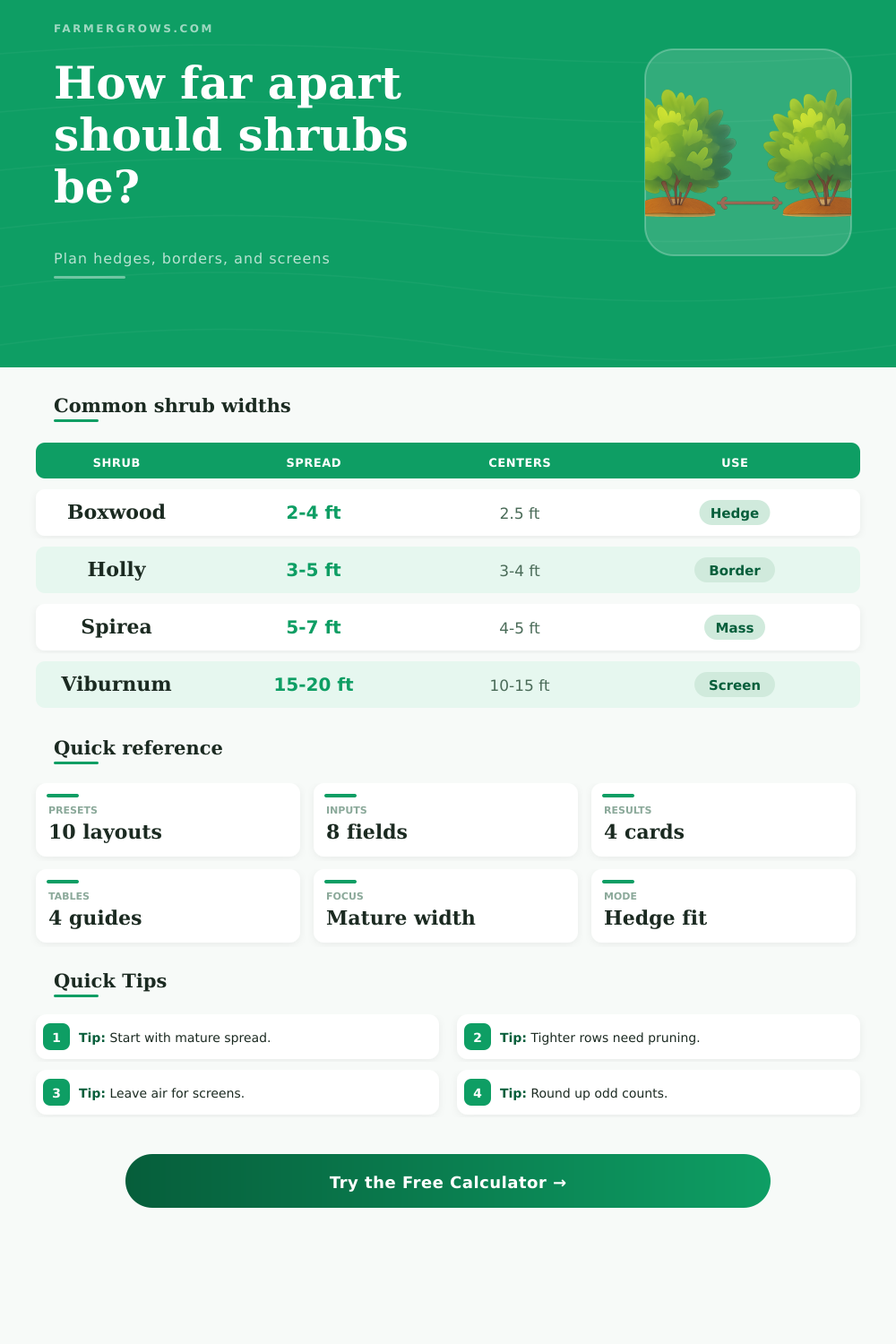
| Shrub | Spread | Centers | Use |
|---|---|---|---|
| Boxwood | 2-4 ft | 2.5-3 ft | Hedge |
| Japanese holly | 3-5 ft | 3-4 ft | Border |
| Japanese spirea | 5-7 ft | 4-5 ft | Mass |
| Korean azalea | 6-12 ft | 4-6 ft | Border |
| Shrub | Spread | Centers | Use |
|---|---|---|---|
| Panicle hydrangea | 6-12 ft | 5-8 ft | Screen |
| Yaupon holly | 8-12 ft | 6-8 ft | Screen |
| Sweet viburnum | 15-20 ft | 10-15 ft | Screen |
| Chinese fringe flower | 6-10 ft | 4-6 ft | Accent |
| Goal | Width factor | Row factor | Look |
|---|---|---|---|
| Formal hedge | 0.5-0.67x | 1.0x | Tight |
| Informal hedge | 0.67-0.75x | 1.0x | Natural |
| Mass planting | 0.75-1.0x | 0.9-1.0x | Layered |
| Privacy screen | 1.0x+ | 1.0x | Dense |
| Run | Example | Centers | Count |
|---|---|---|---|
| 10 ft | Boxwood | 3 ft | 4 |
| 20 ft | Holly | 4 ft | 4 |
| 30 ft | Spirea | 4.5 ft | 6 |
| 40 ft | Hydrangea | 6 ft | 7 |
Proper shrub spacing are a necessary part of landscaping because proper shrub spacing will ensure that the shrubs dont crowding each other. If you do not use proper shrub spacing, the shrubs will compete for the available air and light within the landscaped area, which can lead to the shrubs becoming a tangled mess. Proper shrub spacing ensures that the shrubs can fill the space that they need in order for grow.
To properly space the shrubs in your landscaping project, you must calculate the space require for the shrubs to accommodate their mature width. The shrub may be small when purchased for your landscaping project, but it will grow to become much larger shrub over time. You should measure the mature width of the shrub when determining the space requirements for the shrubs.
How to Space Shrubs
If you do not calculate for the mature size of the shrubs, they may grow into a solid wall of shrubs. There is different methods for spacing shrubs within your landscaping project. If you would like to create a hedge with the shrubs, you should space the shrubs so that their centers are located at a distance of two-thirds of the mature width of the shrub.
If you place the shrubs closer than this distance, you will have to prune the hedge more frequent. For borders without any specific requirements for the shrubs, the spacing should be three-quarters of the mature width of the shrub, which allows for the shrubs to maintain there natural form. Additionally, allowing for more space between shrubs will allow for better air circulation, which is an important factor in preventing disease in areas with high humidity levels in your yard.
The row spacing for the shrubs and the distance of the shrubs from the edge of the planting bed should also be considered when landscaping with shrubs. If you would like to create a densely forested planting area, ensure that the row spacing matches the mature width of the shrubs. If you would like to create a screening area of shrubs, provide more space between rows so that the shrubs do not suffocate the roots of the shrubs.
Provide a buffer of one to two foot between the shrubs and the edge of the planting bed. Additionally, shifting the even numbered rows forward a few inches will prevent the shrubs from creating a grid pattern within your planting area. To calculate the number of shrubs that are required for a planting bed, calculate the amount of space that the shrubs can use.
Subtract the size of the edge buffers from the total length and width of the planting bed to determine the space that the shrubs will occupy. Divide the total space by the distance that the shrubs should be spaced to determine the number of shrubs that will fit into the planting bed in each row. This calculation will allow you to estimate how many shrubs you should plant into each row to ensure that you are not underplanting or overplanting the shrubs.
A variety of environmental factors will impact how the shrubs grow in your yard. Soil quality will have an impact on the growth of the shrubs; clay soil will hold more water than sandy soil, which will impact the rate at which the shrubs grow. The area that is exposed to the sun will impact the shrubs’ growth rate; south facing border areas will experience more sun exposure than the shrubs growing in shaded areas.
Many people make a variety of mistakes when they are planting shrubs in their yard. One of the most common is using the size of the shrubs in there nursery pots to determine where to space the shrubs. Shrubs that are contained in small pots may not reflect the mature size of the shrub.
People also tend to forget to include a stagger-offset in their landscaping plans. If individuals decide on the desired spacing of the shrubs, they can decide whether they would like the shrubs to be closely spaced or loosely spaced. If the individual wants the shrubs to be closely spaced, they can save money on the purchase of shrubs; however, they will have to prune the shrubs more often.
If the shrubs are to be more loosely spaced, more work will have to be done in removing weeds that may grow up in these spaces between the shrubs. Additionally, specific shrub varieties may require specific spacing between those shrubs. For instance, Japanese spirea shrubs may mature to a width of five to seven feet, in which case the shrubs should be spaced four feet apart from each other.
Shrubs like hydrangeas and viburnum should be spaced at wider distances from each other, such as ten feet apart, to allow the shrubs to breathe and to help prevent the development of fungal issues. Finally, once shrubs are planted in the yard, you should use proper pruning techniques to manage those shrubs. Shrubs that are spaced more closely will require more frequent pruning to prevent the shrubs from developing leggy growth.
Shrubs that are more loosely spaced will only require light trimming of the shrubs. If you use proper shrub spacing techniques when landscaping a yard, the shrubs will grow to fill the space that they need to grow and thrive in the years following the planting of those shrubs.