Sheep Per Acre Calculator
Estimate a practical sheep stocking rate from usable forage dry matter, flock demand, grazing season length, pasture growth, target residual, paddock size, and rotational rest needs.
Choose the pasture and flock situation closest to your farm, then fine tune forage, utilization, sheep class, intake, grazing days, and rotation targets.
Sheep Stocking Rate Results
Calculated sheep carrying capacity and rotation plan.
| Pasture condition | Standing dry matter | Daily growth | Practical utilization | Use note |
|---|---|---|---|---|
| Thin dry pasture or rough range | 500 to 1,200 lb/ac | 0 to 12 lb/ac/day | 25% to 40% | Use larger buffers and longer rest. |
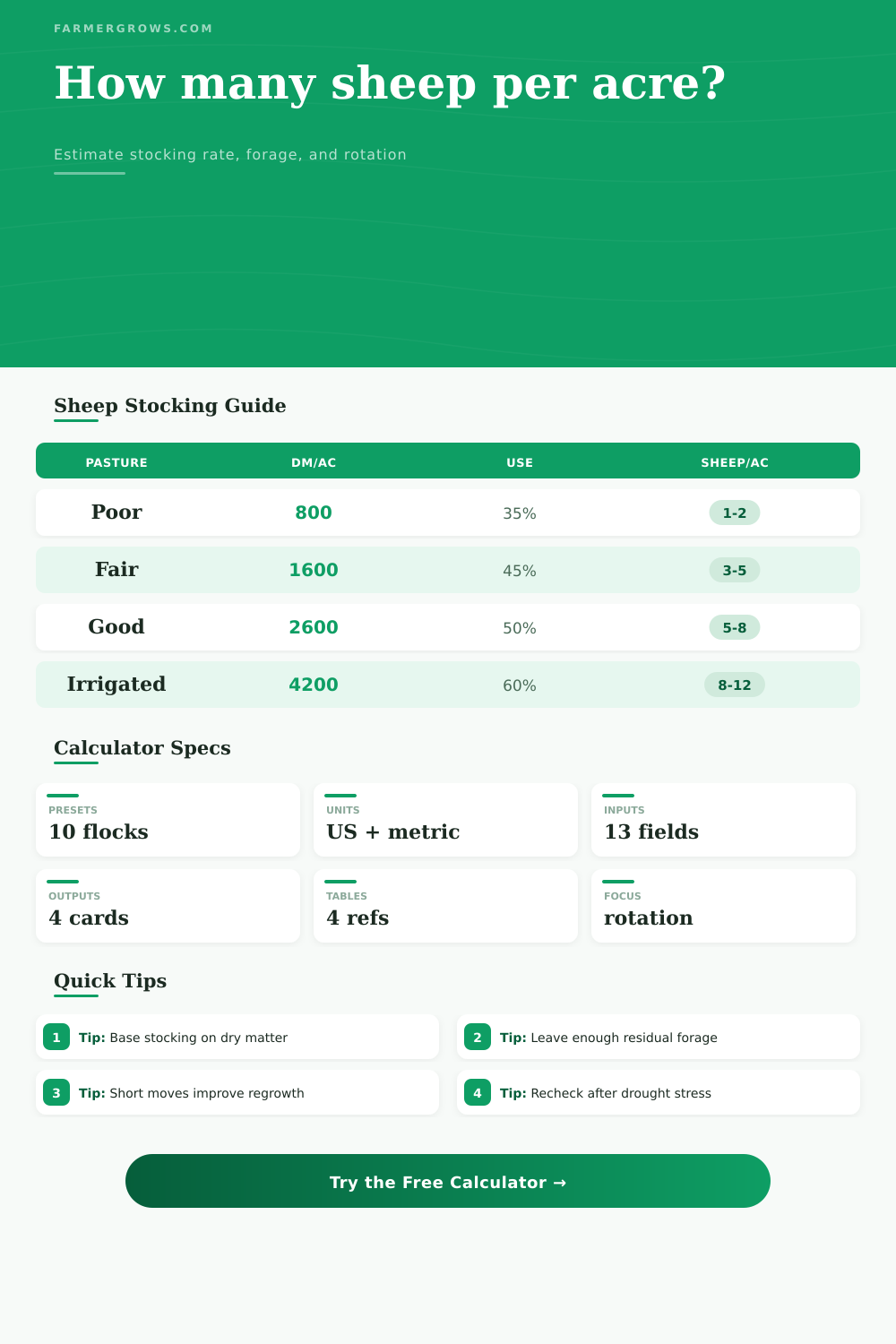
| Fair permanent grass pasture | 1,200 to 2,000 lb/ac | 10 to 25 lb/ac/day | 35% to 50% | Works for moderate stocking with rotation. |
| Good grass legume pasture | 2,000 to 3,200 lb/ac | 25 to 50 lb/ac/day | 45% to 60% | Common basis for productive sheep paddocks. |
| Excellent managed sward | 3,000 to 4,500 lb/ac | 45 to 75 lb/ac/day | 50% to 65% | Needs active residual and rest management. |
| Irrigated high production pasture | 4,000 to 6,000 lb/ac | 65 to 110 lb/ac/day | 55% to 70% | High capacity but quality can shift quickly. |
| Grazing system | Typical utilization | Move frequency | Residual target | Stocking caution |
|---|---|---|---|---|
| Continuous grazing | 30% to 40% | Season-long | 4 to 6 inches | Patch grazing reduces usable forage. |
| Slow rotation | 40% to 50% | 5 to 14 days | 3 to 5 inches | Watch regrowth bites before moving. |
| Moderate rotation | 50% to 60% | 2 to 5 days | 3 to 4 inches | Good default for mixed ewe flocks. |
| Daily strip grazing | 60% to 70% | 0.5 to 1 day | 2.5 to 4 inches | Requires water, fence, and close checks. |
| Season or pasture state | Common rest target | Growth signal | Rotation note |
|---|---|---|---|
| Fast spring growth | 18 to 25 days | Rapid leaf replacement | Shorten rest before forage gets too mature. |
| Normal cool-season growth | 25 to 35 days | Three new leaves on grasses | Useful planning range for many ewe flocks. |
| Summer slump | 35 to 55 days | Slow regrowth and heat stress | Lower stocking rate or add hay early. |
| Drought stressed pasture | 45 to 75 days | Plants remain short after rain | Use conservative utilization and buffer. |
| Stockpiled dormant feed | Rest before grazing | No meaningful regrowth | Treat as a finite standing forage bank. |
| Scenario | Forage basis | Sheep demand | Estimated rate | Best use |
|---|---|---|---|---|
| Dry ewes on fair pasture | 1,600 lb/ac, 40% | 150 lb at 2.5% | 3 to 5 sheep/ac | Maintenance flock with caution. |
| Ewes with twins on good pasture | 2,800 lb/ac, 55% | 165 lb at 4.4% | 3 to 6 sheep/ac | Lactation with close monitoring. |
| Finishing lambs on clover mix | 3,000 lb/ac, 60% | 85 lb at 3.8% | 7 to 11 sheep/ac | Short rotations and high-quality forage. |
| Irrigated intensive pasture | 4,500 lb/ac, 65% | Mixed at 3.4% | 8 to 14 sheep/ac | Strong growth with reliable water. |
Measure forage: Clip a small known area, dry or estimate dry matter, and scale it to pounds per acre. Stocking by height alone can overstate usable feed.
Protect regrowth: If sheep stay long enough to bite new regrowth, lower paddock days, add paddocks, or reduce head count before pasture recovery slows.
Most first-time sheep keepers assumes their pasture has plenty of feed. I have a whole green acre, how hard could that be? Turns out, pastures is a bit more math than meets the eye. It is a renewable resource, but it can runs out fast when you get things out of whack.
And there’s your problem: How do you prevent getting into trouble in the first place? You can use the calculator, which requires you to do some real-life figuring off the dry matter present. Because what looks like an abundance isn’t necessarily edible. This number assumes standing forage vs. This refers to dry matter intake.
How to Keep Your Pasture Healthy
A 150 lb. A mature dry ewe consume approximately 3.5 lbs. Of feed per day (or 2.5% of her bodyweight in terms of dry matter). Multiply by your flock size and the length of time they are out grazing, and there’s your answer.
That’s right: A sheep doesn’t eat all the blades you’ve grown; they leave behind stubble which will regrow. By going in too closely, you’ll damage crown of plants and encourage weed growth. Adjust your target residual height with help of tool. In a grass pasture, three inches is often ideal. It gives them plenty of food without damaging the root system. Two inches may get you slightly more short term forage, but at what cost? Think longterm pasture health. The margin is tiny, representing difference between having a sustainable farm and constantly buying hay.
The problem is the timing of rotation. Productive pasture won’t help if you leave sheep on it two weeks because those sheep ate new regrowth which harms potential of that pasture. The calculator ask questions about paddock size and rest days… Those are the tools you use to avoid overgrazing.
When growth is fast (like in spring), perhaps your rest period is just two weeks. That same pasture may require a forty-five day rest to recover in heat of summer. If you use a static number for all year, you’ll have problems. Adjust move frequency according to the season. Speed up during rapid growth, slow down in the heat. Seasonal shifts are shown in reference tables, they outline how rest intervals expand with slowed growth.
And don’t overlook buffer inputs. Nature is never constant; you’ll always be a little off on your estimate. A ten or twenty percent safety buffer can accounts for reduced intake from wet weather. It could also be a sudden dip in forage quality or uneven grazing pressure. It’s better to plan for a slightly smaller flock then to find yourself buying expensive hay because you optimized too aggressively.
The calculator do the work. But you still have to carefully interpret the results. Run the carrying capacity estimate through your head and ask yourself if it sounds realistic given your rainfall patterns and soil type. If it seems like numbers are too good to be true, they likely are. Tweak your growth rate expectations down until the plan feels conservative enough to get you through a bad month.
There’s no one stocking rate that you set once and never think about again. Stocking rate is a constant dance of supply (what does the land provide) and demand (what does the flock ask for). You’re aiming to reach some point where the sheep don’t leave ground stripped bare, while still keeping grass from heading out to seed.
Learning to read the pasture and adjust your moves accordingly takes practice. Begin with conservative estimates, observe your particular pasture’s response, and refine your inputs over time. It’s not only about fitting sheep onto an acre; it’s also about maintaining an acre in good condition so that it can produce year after year. That makes a simple grazing operation a resilient system.
You should of started earlier to see how vegetasion grows.