Septic Tank Size Calculator
Estimate septic tank gallons, daily design flow, reserve storage, and drainfield area from bedrooms, occupants, fixture load, laundry and disposal use, soil percolation, reserve days, and a local safety factor.
Choose a starting point, then adjust the local rule and soil loading fields to match the site evaluation or permit worksheet.
Septic Sizing Estimate
This planning result rounds up to standard tank sizes and keeps the soil absorption estimate separate from final engineered design.
Calculation Breakdown
After calculating, these cards compare common tank sizes against the estimated daily design flow and reserve-day target.
Run the calculator to compare reserve.
StandardRun the calculator to compare reserve.
StandardRun the calculator to compare reserve.
StandardRun the calculator to compare reserve.
StandardRun the calculator to compare reserve.
StandardRun the calculator to compare reserve.
Standard| Percolation or soil group | Planning loading | 450 gpd field | 750 gpd field |
|---|---|---|---|
| Very fast sand, 1 to 5 min/in | 1.20 gpd/ft² | 375 ft² | 625 ft² |
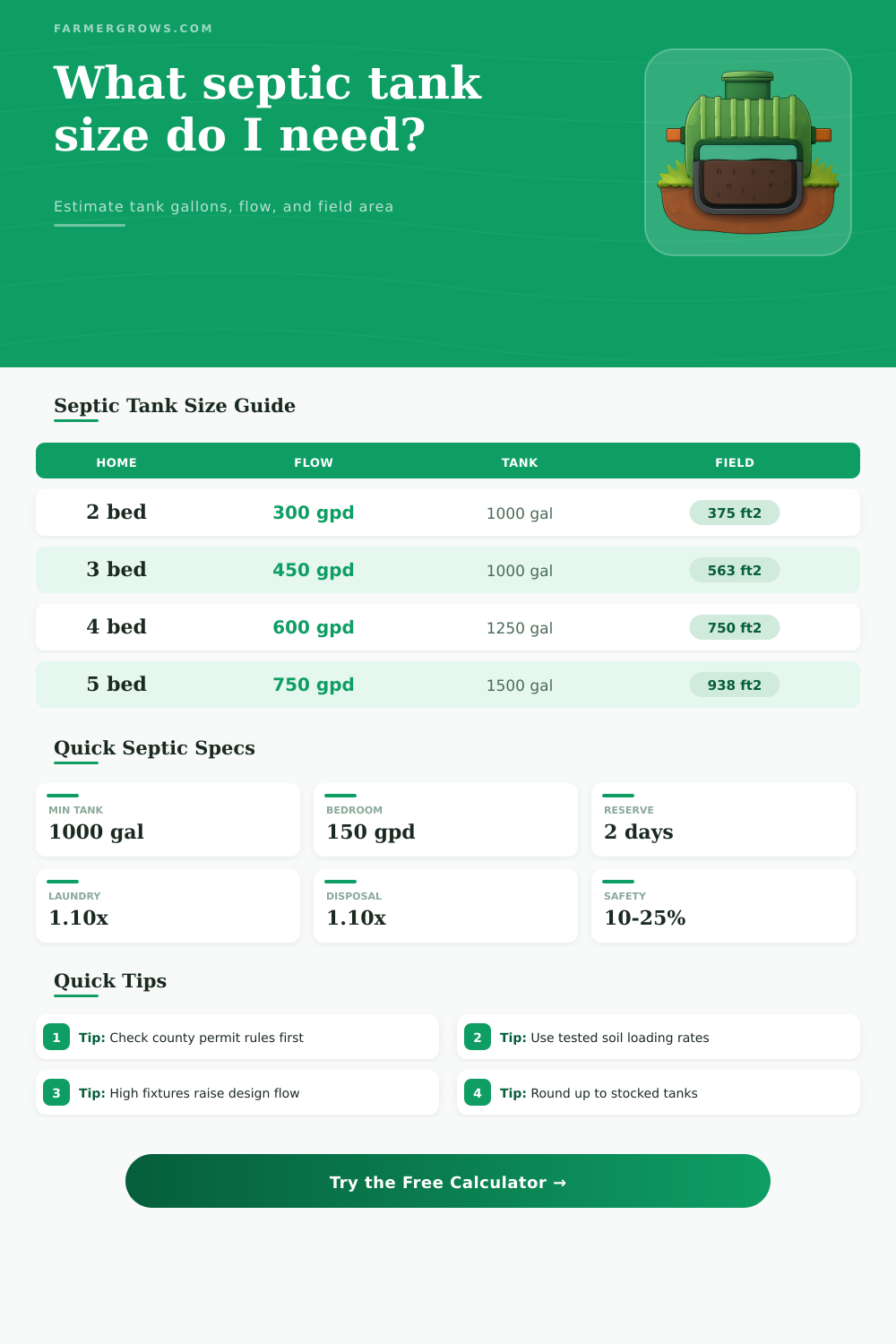
| Sandy loam, 6 to 15 min/in | 0.80 gpd/ft² | 563 ft² | 938 ft² |
| Loam, 16 to 30 min/in | 0.60 gpd/ft² | 750 ft² | 1250 ft² |
| Clay loam, 31 to 45 min/in | 0.45 gpd/ft² | 1000 ft² | 1667 ft² |
| Slow clay, 46 to 60 min/in | 0.30 gpd/ft² | 1500 ft² | 2500 ft² |
| Bedrooms | Baseline design flow | Common minimum tank | Notes |
|---|---|---|---|
| 1 to 2 bedrooms | 150 to 300 gpd | 1000 gallons | Many local rules keep a 1000 gallon floor. |
| 3 bedrooms | 450 gpd | 1000 gallons | Often the standard small-home starting point. |
| 4 bedrooms | 600 gpd | 1250 gallons | Use fixture load if bathrooms are oversized. |
| 5 bedrooms | 750 gpd | 1500 gallons | Reserve days may push the result higher. |
| 6 bedrooms | 900 gpd | 2000 gallons | Often needs careful local review. |
| 7 to 8 bedrooms | 1050 to 1200 gpd | 2500 to 3000 gallons | Large homes may use multiple tanks. |
| Fixture load condition | Calculator treatment | Typical trigger | Planning note |
|---|---|---|---|
| Normal fixture count | No extra gpd | About 7 fixture units per bedroom | Bedroom and occupant flow normally control. |
| Moderate extra fixtures | 15 gpd per extra unit | Large tub, extra bath, utility sink | Adds hydraulic demand before multipliers. |
| Frequent laundry | 1.18x multiplier | Large family or farm clothing | Raises peak water volume into the tank. |
| Garbage disposal | 1.10x to 1.20x multiplier | Food solids sent to tank | May increase solids loading and service need. |
| Reserve or factor | Use in calculator | When to choose it | Effect |
|---|---|---|---|
| 1.5 reserve days | Daily flow x 1.5 | Compact low-use cabin | May still round to 1000 gallons. |
| 2.0 reserve days | Daily flow x 2.0 | Common planning default | Balances flow and standard tank sizes. |
| 3.0 reserve days | Daily flow x 3.0 | Rural or high-variability homes | Often selects the next tank size. |
| 10% to 25% safety | Applied to final design flow | Local code, future use, uncertainty | Raises tank and drainfield sizing. |
This calculator is an estimating tool for conventional household septic planning. It does not replace a licensed designer, soil evaluator, installer, engineer, or local health department permit review.
Choosing a septic tank requires you to calculate teh holding capacity of the tank with an ability of the soil to absorb the wastewater. Furthermore, you must also ensure that you match the holding capacity of the tank to the daily flow that your household produce. Should the holding capacity of the septic tank not match the flow of your household, you could end up with either buying a septic tank that is too large for your needs and costs too much money, or buying a septic tank that is too small to effectively handle the waste of your household.
Several factor influence the sizing of your septic tank, so it is important for you to understand those factors to ensure that you select the correct septic tank for your household. One factor is the number of bedrooms in your house, which will provide a minimum size for your septic tank. Each health department use the number of bedrooms to estimate the number of individuals that live in your house.
How to choose the right septic tank size
However, the number of individuals that live in the house is a more accurate factor for determining the size of the septic tank. For instance, a home with three bedrooms may contain two individuals, or it may contain six individuals. The number of gallons of wastewater that two individuals produce is not the same than the number of gallons produced by six individuals.
Other factors to consider include the daily gallons of water that is used per person in your household, the number of water fixtures in your home, and the number of individual laundry and garbage disposal machine in your home. Other considerations include the loading rate of the soil in which the septic tank will be installed, the number of days of reserve septic tank space that you would like to have in your tank, and the local safety factor for your county or region. The calculator will provide several different outputs based off the factors that you enter into the calculator.
The size of the septic tank that is recommended for your household, the total daily flow of water that your household will use, the area of the drainfield in your lot in which the septic system will be installed, the amount of reserve space that will be included in your septic tank, and the total number of gallons that your household will use on a single day are some of the different types of information that the calculator will provide. Many people make mistake with the installation of septic tanks and drainfields. For instance, many people may purchase a large septic tank to allow for waste to settle for longer periods of time, but they do not realize that the size of the septic tank will not impact the amount of water that the soil can absorb.
Similarly, the size of the drainfield will not impact the amount of water that a septic tank that is too small can effectively treat. The two systems work together to provide for the needs of your household. Therefore, it is important for you to understand that the septic tank and the drainfield are connected, and the calculator will maintain that connection between the two.
Finally, local rules may impact your decision of the sizing of your septic tank. Some counties may require specific materials to be used in the construction of your septic tank. Other counties may require specific setbacks from the structure of your home, or require that your drainfield have a specific amount of reserve space for your septic tank.
Additionally, some counties may have rules regarding the use of garbage disposals, or may require that you construct your septic tank to provide for advanced treatment of your wastewater if the soil in your county test low for thresholds. These rules will override the numbers provided to you by the calculator. Thus, you should use the calculator to determine the size of your septic tank, but you should also present this number to a local official who will ensure that the septic tank will meet all of the requirements of your county and region.
It is also important for you to understand the difference between the physical capacity of a septic tank and the effective treatment capacity of that septic tank. For instance, a septic tank that has a physical capacity of 1500 gallons will not allow for the use of 1500 gallons of wastewater for any given day. The portion of the tank that is used to reserve space will help to ensure that the septic tank will have adequate space to handle the needs of your household if the number of individuals in your home change, or if you begin to use the laundry and showers in your home at the same time.
The soil in which your septic tank will be installed may vary throughout your lot. It is possible that a percolation test will reveal that the soil in one area of your lot will exhibit different properties than the soil in another area. Such loading rates that are entered into the calculator are typical values, but the actual loading rates will depend upon the test results for the soil in which the septic tank will be installed.
Furthermore, if the calculator reveals that your absorption area will be large, this is due to the slow draining properties of the soil in your area, and you may need to install a different type of septic system than the one that is often sold in stores. The number of water fixtures in your home can help to indicate how the water will be used in your home. For instance, if your home has a home office in one of the basements, that area may contain a laundry room, which will increase the number of fixtures in your home.
Each additional fixture will increase the volume of the water that is used by your home. Thus, the calculator can assist in determining the size of your existing septic tank, in comparison to the size of the septic tank that is recommended for your home. Such a comparison may be useful if you are planning to renovate your home.
Based upon the size of your existing septic tank, you can determine if it will provide enough space for the buffer for your future needs in your home. If it will not, then you can make a decision regarding whether or not you will need to upgrade the septic tank that you have now, or if you will need to redesign the entire system. You should of checked the soil first.
Its alot of work to fix later. Youll want to recieve professional advice. This moddern system isnt simple.
Youre going to need more than just a tank. The furnitures in the house dont matter, but the septic tank does. Dont forget about the drainfield.
It’s important to do it right. You should of consulted a pro. The tank’s size is vital.
The rooms size might change. The homes needs change. The drainfields length matters.
The septic tanks capacity is key. The tank’s maintenance is hard. The soil’s quality is vital.
The system’s design is complex. The area’s drainage is poor. The water’s flow is high.
The tank’s location is important. The tank’s age is old. The tank’s cost is high.
The tank’s life is long. The tank’s use is daily. The tank’s part is small.
The tank’s job is big. The tank’s role is key. The tank’s task is hard.
The tank’s goal is clear. The tank’s plan is set. The tank’s way is best.
The tank’s idea is good. The tank’s method is sound. The tank’s logic is solid.
The tank’s truth is real. The tank’s fact is true. The tank’s sense is clear.
The tank’s value is high. The tank’s worth is great. The tank’s price is fair.
The tank’s deal is good. The tank’s offer is best. The tank’s choice is yours.
The tank’s fate is set. The tank’s end is near. The tank’s start is now.
The tank’s life is here. The tank’s way is home. The tank’s heart is full.
The tank’s soul is deep. The tank’s mind is sharp. The tank’s eye is keen.
The tank’s hand is strong. The tank’s foot is firm. The tank’s head is high.
The tank’s back is straight. The tank’s face is bright. The tank’s voice is loud.
The tank’s song is sweet. The tank’s dance is light. The tank’s dream is big.
The tank’s wish is true. The tank’s hope is real. The tank’s love is deep.
The tank’s joy is great. The tank’s peace is calm. The tank’s life is good.