Seeds Per Hole Calculator
Estimate how many seeds to drop in each hole or station using germination, field emergence, target plants, reliability, spacing, and thinning pressure.
This tool is for direct seeding in holes, stations, hills, and closely spaced garden rows. It finds the smallest practical seed count that reaches your stand reliability target, then estimates total seed needs and likely thinning.
Your Seeds Per Hole Plan
Results update after calculation.
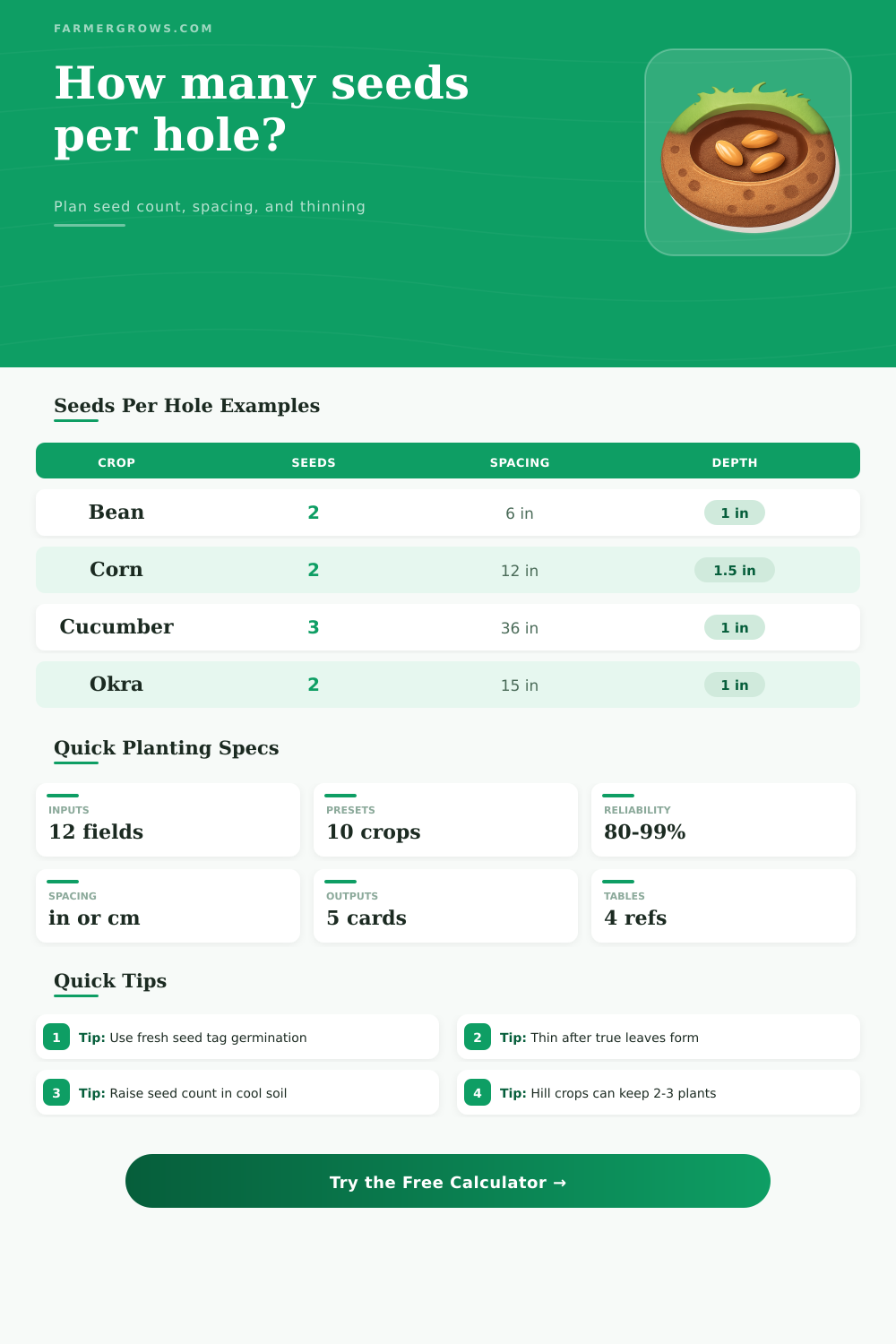
| Crop | Typical seeds per hole | Final plants | Spacing in row | Planting depth |
|---|---|---|---|---|
| Bush bean | 2 seeds | 1 plant | 4-6 in | 1 in |
| Sweet corn | 2 seeds | 1 plant | 10-12 in | 1-1.5 in |
| Pea | 2 seeds | 1 plant | 2-3 in | 1 in |
| Cucumber hill | 3-5 seeds | 2-3 plants | 36-48 in | 1 in |
| Squash hill | 3-5 seeds | 2 plants | 36-48 in | 1 in |
| Okra | 2-3 seeds | 1 plant | 12-18 in | 0.75-1 in |
| Sunflower | 2 seeds | 1 plant | 12-24 in | 1 in |
| Beet | 1-2 clusters | 1 plant | 3-4 in | 0.5 in |
| Live emergence per seed | 1 seed succeeds | 2 seeds succeeds | 3 seeds succeeds | 4 seeds succeeds |
|---|---|---|---|---|
| 95% | 95% | 99.8% | 99.99% | 99.99%+ |
| 85% | 85% | 97.8% | 99.7% | 99.9% |
| 75% | 75% | 93.8% | 98.4% | 99.6% |
| 65% | 65% | 87.8% | 95.7% | 98.5% |
| 50% | 50% | 75.0% | 87.5% | 93.8% |
| Planting layout | Length | Rows | Hole spacing | Approx holes |
|---|---|---|---|---|
| Bean row patch | 20 ft | 2 | 6 in | 80 |
| Corn block | 12 ft | 4 | 12 in | 48 |
| Pea trellis | 16 ft | 1 | 3 in | 64 |
| Cucumber hills | 24 ft | 1 | 36 in | 8 |
| Okra rows | 25 ft | 2 | 15 in | 40 |
| Situation | What to do | Timing | Reason |
|---|---|---|---|
| Two seedlings, keep one | Snip weaker stem | True leaves | Avoid root damage |
| Hill crop with many seedlings | Keep strongest 2-3 | 2-4 leaves | Preserve vigor |
| Gap in row | Re-sow immediately | At emergence | Close age gap |
| Old seed lot | Test germ first | Before sowing | Reduce waste |
Use the seed tag first. Packet advice is a starting point, but the seed lot's germination percentage and your field emergence conditions are what change seeds per hole.
Thin instead of pulling when crowded. Snipping extras at soil level protects the seedling you want to keep, especially in beans, corn, cucurbits, beets, and lettuce stations.
The seed packet says there are 50 plants per packet. What it actualy delivers is forty-two. Three went bad, four were gobbled by slugs, and five just never felt like sprouting in your particular mix of clay soil. That’s seed-packet math (clean) vs. Gardening is a messy business.
To hedge against such chaos, most gardeners intuitively add some excess seeds to each planting hole…but how much? How does one estimate that guesswork in a way that isn’t wasteful or results in a sardine-can bed that then needs aggressive thinning later on? Enter the calculator above, where plugging in your desired spacing and average germination rate spares you the headache of trying to calculate manually based off all those variables.
Simple Math for Happy Plants
And that’s really the heart of the math: not wishful thinking, but numbers. If you take eighty-five percent germination from your seed-tag and multiply it by the nine out of ten emergence rate predicted by field conditions, you end up with way fewer successful seeds per seed. That’s why the reliability setting matter. Ninety percent would indicate you’re looking for good odds, but don’t sow more than necessary. Ninety-nine percent could inflate seed costs unwisely (unless, perhaps, you’re growing something very valuable in nursery tray, or you’ve got a crop that’s just extra-pricy). It is a little tweak, but it makes a big difference in the number of actual corn or bean seeds you hold in your palm before planting first seedling.
The preset choices reflect that: Not all plants require same approach. With big seeds (such as corn and beans), it’s fine to sow two per hole; that gives a good chance of having at least one sprout survive, yet makes thinning feasible. But with hill crops such as cucumbers and squash, the goal change: Now you’re aiming for a cluster, not just a spot filled in by a few aggressive vines. Under-sow these, and your coverage will be scant. Over-sow them, and then you’ll be spending all summer ripping out excess stems. The vegetable reference table on the page spells this out plainly.
The hardest thing for most home gardeners to do is thin. It seems to waste all that effort (or even food!). If two seeds sprout in the same hole, and you wanted just one, you’re better off snipping the weaker seedling’s stem at ground level than tearing it out by the roots, which will mess around with the remaining plant’s root system. Perhaps stunting it just as it was trying to get established. That’s a technical point few of us think about, but it makes a difference. It turns a wrestling match in the dirt between tender young thing into a neat surgical operation.
Old seed is another wild card that screws with basic math. Maybe yours was a packet of tomatoes, and even though it’s three years old, they’d still sprout. But now the germination percentage has plunged from ninety-five to maybe sixty percent. Sow that at standard rate? You’ll have holes, but no plants in them. To compensate for this, the tool wants you to enter your estimated germination rate. Now, be honest. Did you think the seed was old, or kept improperly? Downsize that number. The calculator will make up for this by telling you to sow more seed per hole so that your stand is as reliable as you want it. Better to have a couple of extra plants to thin out than a bare row to replant a couple of weeks later while your neighbors are picking there own.
Emergence also depends hugely on soil conditions: If you had some serious downpours prior to sowing, the ground may have become crusty and trapped emerging seedlings beneath surface, even if your seeds were of high quality. Under such circumstances, when emergence rates in the field drop anyway, then adding extra seeds per hole isn’t a waste, it’s insurance. You’re buying yourself peace of mind.
What you want to do is walk out of the garden with an evenly spaced stand of healthy plants. These plants need enough space around them so they don’t compete too hard for resources or get in each other’s way in their early days. So now that we have these figures in hand, planning becomes a logical exercise, not a frenzied leap-of-faith affair. How many seeds do I need? What’s my packet count? How much space goes between each hole? Are some destined for aggressive thinning next week? No more guesswork: The ground itself tell you what it needs, and you provide it.
The sum of all this is a calculated gamble where the variables are both practical (spacing) and based on chance (chances of success). Each seed has its shot; each hole has a mission. That’s what turns a seemingly random scatter of organic debris into something useful. It is garden.