Johnnys Seeds Seed Starting Calculator
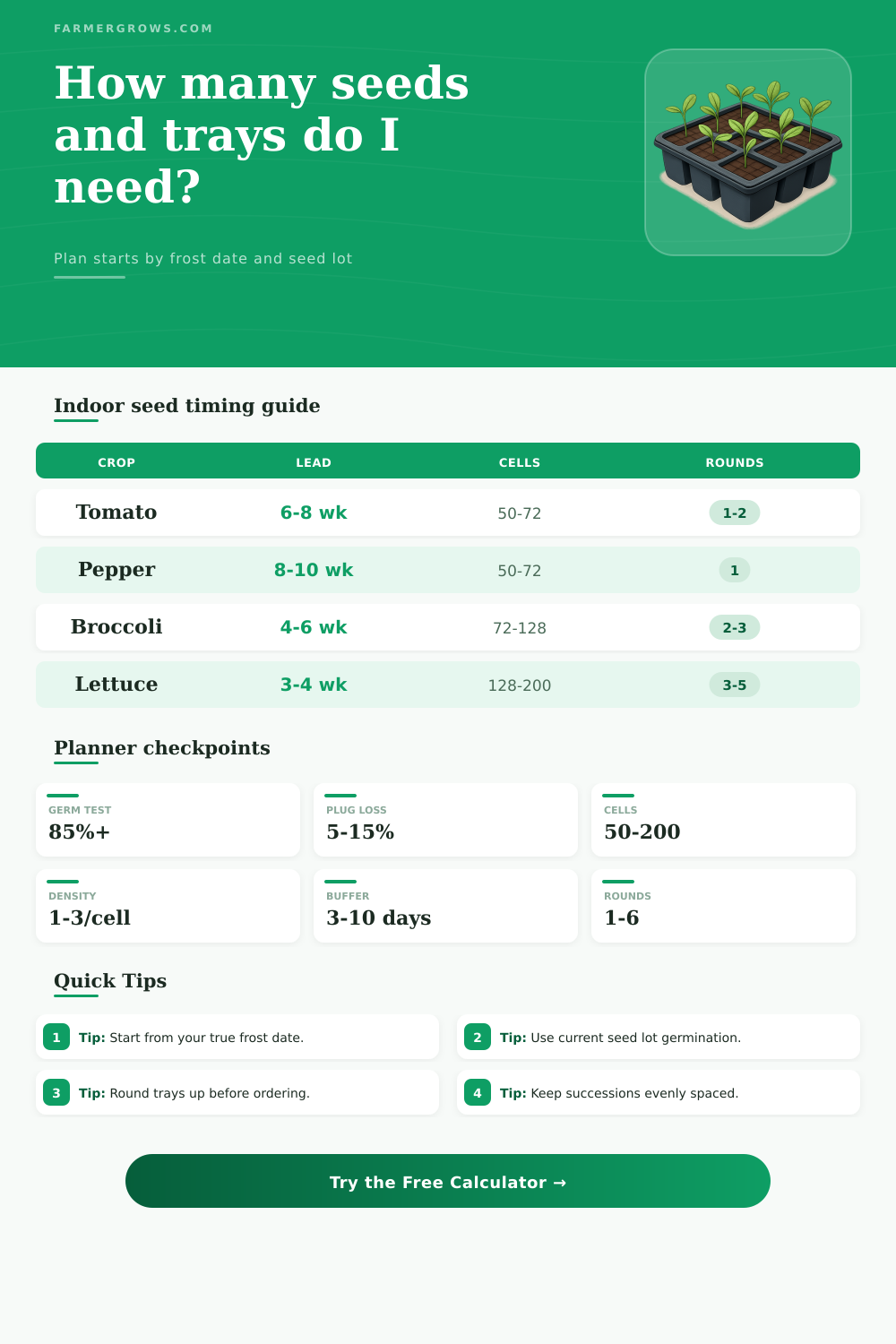
Plan named crop starts from a frost date, indoor lead time, seed lot germination, tray size, plug loss, sowing density, and succession spacing before filling flats.
Use these real catalog-style crops as starting points, then adjust the seed lot, tray, and succession numbers to match your packet and bench space.
Seed Starting Plan
| Crop group | Typical lead | Set-out timing | Common tray | Notes |
|---|---|---|---|---|
| Tomato | 6 to 8 weeks | 1 to 2 weeks after frost | 50 to 72 cells | Warm soil and steady light reduce stretch. |
| Pepper | 8 to 10 weeks | 2 weeks after frost | 50 to 72 cells | Slow early growth benefits from larger plugs. |
| Broccoli and cabbage | 4 to 6 weeks | 2 to 4 weeks before frost | 72 to 128 cells | Keep cool and move before roots bind. |
| Kale and chard | 4 to 6 weeks | 2 to 4 weeks before frost | 72 to 128 cells | Good for spring and fall succession starts. |
| Lettuce | 3 to 4 weeks | 2 to 3 weeks before frost | 128 to 200 cells | Multiple small batches beat one large batch. |
| Basil | 5 to 6 weeks | After frost and warm nights | 72 to 128 cells | Use extra seed if multi-sowing clumps. |
| Cucumber and squash | 3 to 4 weeks | 1 to 2 weeks after frost | 50 to 72 cells | Do not hold too long in small cells. |
| Onion | 10 to 12 weeks | 4 to 6 weeks before frost | 128 to 200 cells | Often multi-sown and trimmed before planting. |
| Seed lot germination | Plug loss | Surviving plug rate | Seeds for 100 plants | Planning use |
|---|---|---|---|---|
| 95% | 5% | 90% | 111 | Fresh, vigorous seed with careful handling. |
| 90% | 10% | 81% | 124 | Typical vegetable seed starting buffer. |
| 85% | 12% | 75% | 134 | Older seed lot or uneven greenhouse bench. |
| 80% | 15% | 68% | 148 | Risky lot, sensitive crop, or cool media. |
| 70% | 15% | 60% | 169 | Run a germination test before sowing flats. |
| Tray format | Best fit | Seeds per cell | Handling note | Planning caution |
|---|---|---|---|---|
| 50-cell deep | Tomato, pepper, cucumber | 1 to 2 | Large plugs transplant cleanly. | Uses more bench space per plant. |
| 72-cell standard | Mixed vegetables | 1 to 2 | Good balance of root volume and capacity. | Pot up long-season crops if held late. |
| 98-cell plug | Herbs and flowers | 1 to 3 | Fits medium successions well. | Watering must stay even. |
| 128-cell tray | Brassicas and greens | 1 to 3 | Efficient for many small starts. | Move before plugs become rootbound. |
| 200-cell tray | Lettuce, onion, scallion | 1 to 5 | Excellent for dense small starts. | Needs careful thinning or clump planning. |
| Crop type | Common interval | Rounds | Why it helps | Stop point |
|---|---|---|---|---|
| Lettuce and salad mix | 7 to 14 days | 3 to 6 | Keeps harvest quality steady. | When heat causes bolting. |
| Basil | 14 to 21 days | 2 to 4 | Replaces cut stems and tired plants. | Late summer or cool nights. |
| Broccoli | 14 to 21 days | 2 to 3 | Spreads head maturity. | Before high heat or deep winter. |
| Cucumber | 21 to 28 days | 2 to 3 | Refreshes vines after disease pressure. | About 70 days before frost. |
| Tomato and pepper | 0 to 21 days | 1 to 2 | Usually one main batch plus backups. | When season length runs short. |
This planner is designed for seed-catalog ordering and greenhouse bench planning. Always adjust for local weather, cultivar notes, and your own transplant standards.
Starting a seed flat require that you plan for many different variables until you can find the right number of transplants that you can produce when the weather become suitable for planting. People often find themselves with a large gap between the number of days that they calculate based off the frost dates and the actual numbers of plants that they have grown. Some of the reason for such large gaps may include the germination rate of the seeds, the potential for plug loss, as well as the potential effects of the timing and size of the seed trays that they utilize in there greenhouse.
The germination rates of the seeds will determine the number of plug that will emerge from the flats, but that rate may often not reflect the actual number of plugs that will be available for the gardener to use. Plug loss may occur within the home greenhouse as well, and the more succession of seeds that are sown into the flats, the greater the potential for loss of those plugs. By entering the germination test and plug loss rate into the calculator that is available on the page, the calculator will provide an indication of how many extra cells must be filled with seeds in order to account for potential losses.
How to Plan Seed Flats
The timing in which the seeds are sown will impact the amount of space and light that is used in the greenhouse to grow the plants. Warm crops, such as tomatoes and peppers, require a lead time of six to ten week before they can be transplanted into the soil outside of the greenhouse. Crops such as lettuce and brassicas can begin to be started closer to the frost date.
The longer that the crops are started on the bench inside the greenhouse, the more space and light that is required of the grower. By using the tool to set the lead time for the crops, the tool will automatically adjust the sowing date of the seeds to reflect the lead time that has been set. Succession planting allows for the harvest of vegetables to be spread out over a longer period of time.
Iflettuce is sown into the ground in one succession, it is possible that the plants will all bolt at the same time if there is a heat wave during the growing of the lettuce. By sowing smaller rounds of lettuce every ten or fourteen days, there will be a continual supply of lettuce that can be harvested without the risk of all of the plants sudden bolting. The same logic can be applied to basil and broccoli, though with different intervals between sowing the seeds.
By entering the number of rounds and the spacing between those rounds of sown seeds, the calculator will indicate whether or not there is enough space on the bench to allow for such a plan to occur. The size of the trays in which the seeds are sown may impact the number of plant that emerge from the flats. A fifty-cell tray may be best for starting tomato plants, as the plants require more space in which to develop their roots.
However, fifty-cell tray may waste space if using flats to start onions or lettuce. Furthermore, a two-hundred-cell tray can hold more plants per square foot than a fifty-cell tray, but requires the gardener to water the flats more careful and begin to transplant the plants when the roots of the flats begin to bind to one another. By entering the number of cells per tray and the number of seeds per cell, the grower can begin to determine what type of flats are required for what types of plants.
The reference tables on the page contain information that can assist in the decision of which variables to adjust in the construction of an effective plan for sowing the plants. One table indicates the lead times of the plants when sown indoors. Another provides information regarding germination percentages and plug loss and the number of surviving plugs.
A third table includes information regarding the different tray formats and which crops may be best sown in those trays. These tables can indicate whether the grower will need to take a conservative or an aggressive approach to the sowing of the seeds. Often, the weather will change the plans that have been made for the greenhouses and flats.
A cold snap may delay the dates on which the transplants can go outside the greenhouse. Furthermore, warm days in spring will cause the crops to bolt earlier then they should. By using the buffer days feature on the website, the grower can provide for an additional period for the transplanting of the flats.
Additionally, adding days to the buffer will allow for either the movement of the first transplant of seeds, or the ability to add extra rounds of sowing of seeds at the end of the season. Using the buffer days feature will allow for the grower to see how many additional seeds and flats of seed trays will be required if such buffer days are to be introduced into the growing cycle. The germination percentage that is printed on the seed packet may not necessarily be the germination percentage of the seeds that are going to be used in the flats.
Seeds that are of an older age, or the seeds that have come from the plants that the gardener grew himself will have lower germination rates. By performing a paper-towel test on the seeds to be used, an accurate germination rate can be determined. By using that germination rate, the grower can adjust the number of flats of seeds to ensure that there will be enough plants to grow without sowing too many seed.
Finally, while planning with the calculator, the grower may find themselves with a number of plants that emerge from the flats that will exceed the capacity of the flats. For instance, if the flats contain seventy-two cells but the plan calculates to sixty-three plants to be grown, there will be nine extra plants that will emerge from the flats. These extra plants can be used as insurance against the failure of some of the plants, or can be sown into the ground in conjunction with any succession planting that is performed.
The calculator will indicate the number of extra plants that will emerge from the flats so that the grower can determine whether or not there will need to be any changes in the number of plants that are to be sown.