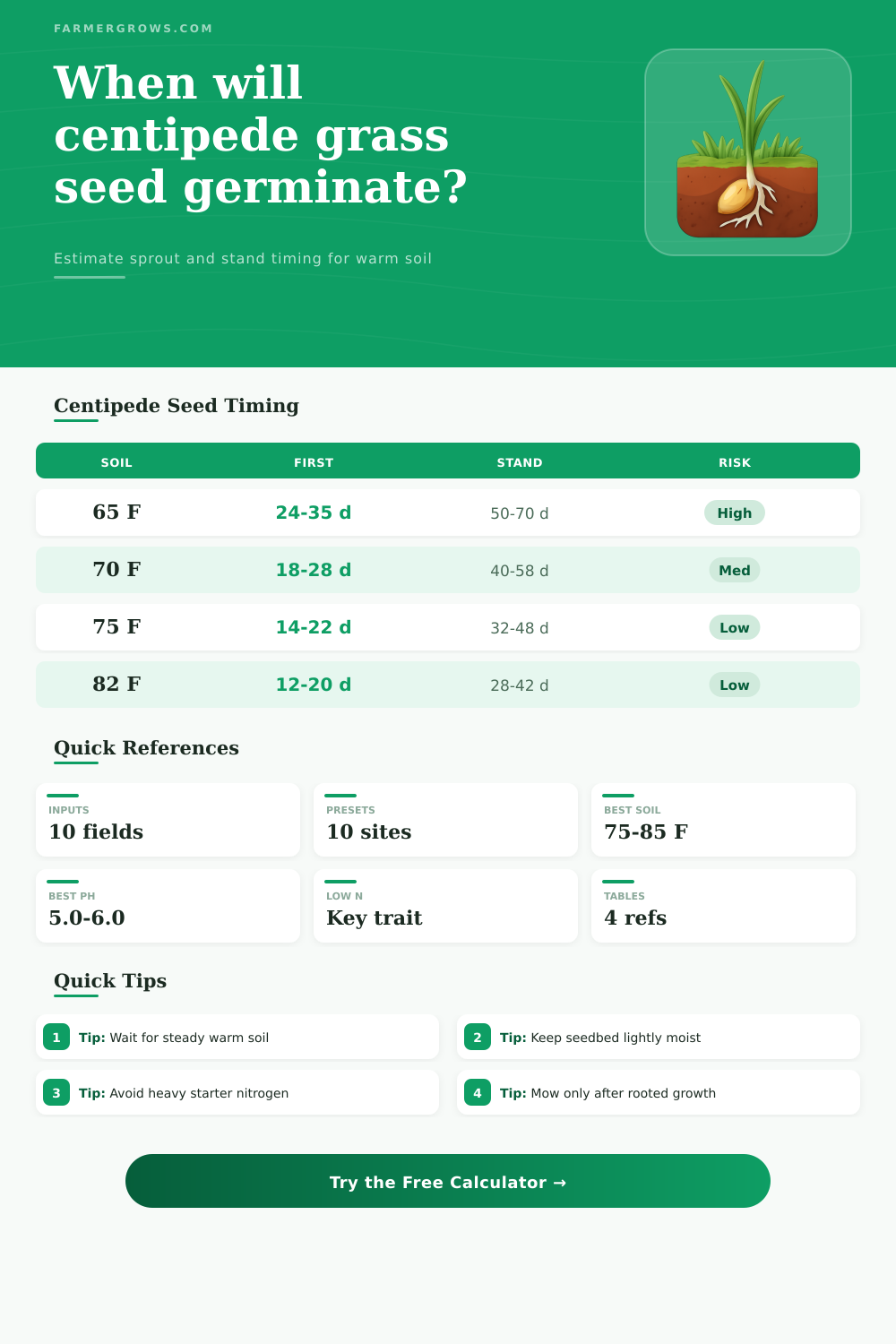
Centipede Grass Seed Germination Time Calculator
Estimate first sprout, usable stand, and first-mow windows for centipede grass from warm-season soil temperature, acidic pH, moisture, seedbed cover, and low-fertility site fit.
Centipede is slower and less fertilizer-hungry than Bermuda, fescue, or zoysia. This calculator rewards warm soil, modest nitrogen, acidic pH, and steady shallow moisture instead of aggressive feeding.
Centipede Germination Estimate
Adjust the inputs and calculate to see the establishment window.
| Seed type | Typical first sprouts | Stand timing | Centipede-specific note |
|---|---|---|---|
| Common centipede, hulled | 14 to 24 days in warm soil | 32 to 50 days | Often the quickest seeded option because dormancy is reduced. |
| Common centipede, unhulled | 20 to 35 days | 45 to 70 days | Hulls can delay water uptake, especially in cool spring soil. |
| TifBlair centipede | 14 to 28 days | 35 to 58 days | Selected for establishment from seed, but still needs warm soil. |
| Oaklawn or Covington | 16 to 30 days | 38 to 62 days | Use local seed-lot guidance when available. |
| Average soil temperature | Expected first sprouts | Stand development | Decision guidance |
|---|---|---|---|
| Below 65°F | Very slow or uneven | Often delayed past 70 days | Wait unless erosion control makes seeding unavoidable. |
| 65 to 70°F | 22 to 35 days | 50 to 70 days | Marginal; protect moisture and expect patchy emergence. |
| 70 to 75°F | 16 to 28 days | 38 to 58 days | Usable window for late spring and early summer seeding. |
| 75 to 85°F | 12 to 22 days | 28 to 48 days | Best centipede seed window if moisture is steady. |
| Condition | Centipede response | Timing effect | Management note |
|---|---|---|---|
| pH 5.0 to 6.0 | Best nutrient balance for centipede | Normal estimate | This is where centipede often outperforms higher-input turf. |
| pH below 4.8 | Seedlings may stall | Add 5 to 10 days | Confirm with a soil test before correcting strongly. |
| pH above 6.5 | Iron and micronutrient stress is more likely | Add 7 to 14 days | Centipede is less happy than Bermuda on many high-pH sites. |
| High nitrogen starter | Soft growth and disease risk | May not speed rooting | Use low fertility until seedlings are established. |
| Seedbed factor | Best range | Delay risk | Why it matters |
|---|---|---|---|
| Seed cover | Pressed in or 1/8 inch cover | Deep cover slows emergence | Centipede seed is small and should not be buried like larger pasture seed. |
| Moisture | Lightly moist surface | Dry cycles add 6 to 14 days | New roots are shallow before stolons begin spreading. |
| Texture | Sandy loam to loam | Crusted clay can delay | Centipede tolerates sandy low-fertility soil better than many turfgrasses. |
| Sun | 6 or more hours | Shade thins seedlings | Low light stretches the establishment period and weakens fill-in. |
Low-fertility fit: Centipede is not a fast, heavy-feeding grass. A light starter approach usually fits it better than the aggressive nitrogen used for quick Bermuda coverage.
Warm-season patience: First sprouts are only the start. A usable stand often takes several more weeks because centipede spreads slowly by stolons after germination.
Lawn seed is one item most homeowners handle uniformly, but not centipede grass. This stubborn, slow-growing type likes poor soil condition and lazy summers. Planting it with too much fertilizer or too early in the cold spring will kill it off before it even gets started. Because it’s fussy, don’t just broadcast it around on bare ground and hope for the best.
A device on this page tell you exactly when to sow. It calculates your precise window of opportunity by looking at temperature, moisture, and pH level rather than using a general range of time like “spring” that may or may not work in your yard. The biggest determinant based off all of this? Soil temperature.
How to Plant Centipede Grass Seed
Because centipede is a warm-season grass, it will not grow until the soil are warm. Don’t attempt to sow in late March (though many do, thinking it’s time since somebody else nearby is planting a different kind of grass). If your soil is sixty-five rather then seventy-five degrees, as the calculator tells you, you’ll have to wait considerably longer (weeks at lower temps). At cool soil temperatures even very small seeds are vulnerable to drying out in the wind, to attack by mold, or to be eaten by birds. Ideally you’d like your soil to hit the mid-seventies consistently; that’s when things start happening metabolically within each seed.
Centipede seeds has very shallow roots when they sprout, which makes moisture tricky: The top of the soil must stay moist but the seedlings cannot sit in water. Overwater, and they rot; let it dry out all the way, and they’ll wither away as fast as the next. To help calculate how long that sensitive period will last, there’s seedbed moisture (an input in the tool).
A sandy soil will run right through your fingers, and may want to be soaked every morning and again midafternoon those first couple of weeks. Heavy clay holds on too long and threatens to suffocate them. Try to hit the sweet spot of just-damp, more like a wrung-out sponge than a mud pit.
Also keep in mind: Centipede prefers slightly acid soil. In fact, it’s happiest between a pH of 5.0 and 6.0. Neutral to alkaline soils is hard on the plant. It has trouble taking up certain micronutrients such as iron. That affects growth of the seed itself, since low pH locations support darker, denser turf with less work; high pH locations result in thinning, pale grass that needs frequent correction. Even under ideal temperature conditions, expect the seed to take longer to germinate if your pH is incorrect. This is why the calculator takes your soil test into account and shifts the time frame to match.
People’s biggest mistake with centipede is using too much fertilizer; it doesn’t like high fertility at all. A main cause of death for baby seedlings is too much nitrogen. Promoting quick top growth (which the shallow root system can’t sustain) encourages heat stress and dissapears disease. The tool punishes high-nitrogen fertilization, which gives the false impression that your plant is doing well. What you’re looking for is slow-and-steady establishment…not a bunch of leafy green growth shooting up overnight. It’ll take a while, maybe 2-3 weeks, before you even notice anything. You might start seeing sprouting action in a week or two. From there, expect slow creeping by stolons until there is a usable stand.
Finally, light also matters. Centipede does best in full sun, meaning that the gaps get filled more successfuly than in areas where light is spotty (or even worse, heavily shaded). Seedlings are weaker and leggier; they may grow but won’t hold their own against weeds, nor fill in empty spaces fast. So if there’s a lot of tree canopy overhead, blocking out afternoon sun, adjust your expectations downward on timing.
Don’t yank out grass prematurely thinking it’s failed (that would of been me!). Timing. Not force; is the key to planting centipede from seed. You can’t speed things up; the ground won’t warm up and the roots won’t dig in any deeper to help. With these environmental inputs in mind, set your sowing day when nature’s ready.
Bide your time till things warm; maintain moist (not sodden) conditions at the surface; don’t succumb to temptation to fertilize. Let the grass grow back on its own schedule. When the very first shoots emerge and the stolons start weaving over the lawn, you’ll know what others mean when they say this is one tough piece of turf. Give it that all-important first window of attention and it’ll come back even stronger than before.