Seed Potatoes Per Acre Calculator
Estimate seed potato weight per acre, cut pieces, whole-seed pieces, sacks, totes, planted stand, and field totals from actual row spacing, hill spacing, seed size, cutting recovery, and planting buffer.
Choose a potato planting situation, then adjust area, spacing, seed piece size, cut recovery, planter allowance, and package size to match the field and seed lot.
Seed Potato Planting Estimate
Enter field and seed lot details to calculate seed potato needs.
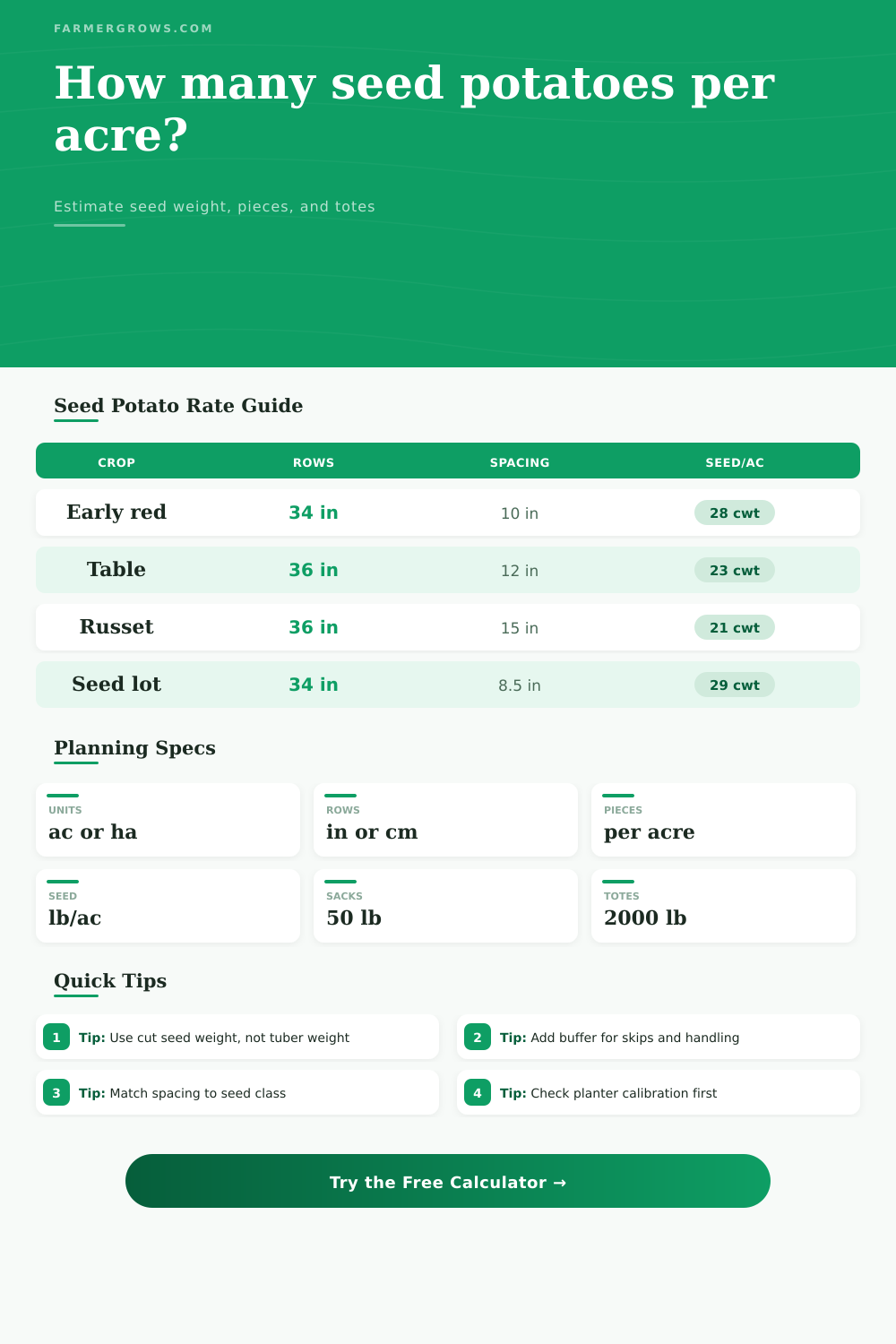
Seed potato spacing and seed rate guide
| Crop situation | Typical row spacing | Typical in-row spacing | Planning seed rate |
|---|---|---|---|
| Early red or new potatoes | 32 to 34 inches | 9 to 11 inches | About 25 to 32 cwt/ac with 1.8 to 2.1 oz pieces. |
| Yellow or white table potatoes | 34 to 36 inches | 11 to 13 inches | About 20 to 26 cwt/ac with 1.8 to 2.2 oz pieces. |
| Russet storage potatoes | 34 to 36 inches | 13 to 16 inches | About 18 to 24 cwt/ac with 2.0 to 2.5 oz pieces. |
| Certified seed increase | 32 to 34 inches | 8 to 10 inches | About 25 to 35 cwt/ac, depending on seed size and target tuber count. |
Seed piece weight effect at 36 inch rows and 12 inch spacing
| Average seed piece | Pieces per acre | Base seed weight | With 10% allowance |
|---|---|---|---|
| 1.5 oz | 14,520 pieces/ac | 1,361 lb/ac | 1,497 lb/ac |
| 1.8 oz | 14,520 pieces/ac | 1,634 lb/ac | 1,797 lb/ac |
| 2.0 oz | 14,520 pieces/ac | 1,815 lb/ac | 1,997 lb/ac |
| 2.5 oz | 14,520 pieces/ac | 2,269 lb/ac | 2,496 lb/ac |
Package conversion table
| Seed package | Weight | Hundredweight | Metric equivalent |
|---|---|---|---|
| Small seed sack | 50 lb | 0.5 cwt | 22.7 kg |
| Large seed sack | 100 lb | 1.0 cwt | 45.4 kg |
| Half-ton tote | 1,000 lb | 10 cwt | 454 kg |
| One-ton tote | 2,000 lb | 20 cwt | 907 kg |
Common seed potato planning examples
| Planting block | Area | Spacing assumption | Seed order example |
|---|---|---|---|
| Small fresh-market plot | 2 acres | 34 in rows, 10 in in-row | About 60 cwt for dense early potatoes. |
| Table potato block | 12 acres | 36 in rows, 12 in in-row | About 275 cwt with normal recovery and buffer. |
| Storage russet field | 40 acres | 36 in rows, 15 in in-row | About 850 cwt with 2.3 oz pieces. |
| Seed increase field | 25 acres | 34 in rows, 8.5 in in-row | About 730 cwt with small pieces and tighter spacing. |
Calibrate with the seed the planter will actually carry. Cut size, healing, variety shape, and cup pickup change seed flow. Run a short row, count dropped pieces, and use that measured spacing if it differs from the setting.
Order seed from usable planted pieces, not from raw tuber weight alone. Recovery after cutting and grading can move the final order by several hundred pounds per acre on tight spacing.
Potatoes are easy enough to plant. Right? But when you add up the seed weight and space between plants, they becomes hundreds of pounds worth of stuff to manage. Now you’re out in the field with a planter asking for precise inputs (a bag of certified seed potato, a map of your acreage) and standing there wondering what on earth to do next. Use the potato calculator to do the number crunching for you and convert those real-world measurements into an actual order list. But first, it requires some real work from you, because that’s where all the decisions begin.
How much waste are you comfortabley with tolerating? How tightly should you be packing your rows? Row spacing is what most growers considers first, typically either thirty-two or thirty-six inches apart. That depends on soil type and equipment. If spacing is too narrow, your plants will be crowded. They may not have as much foliage, which is bad but tubers may form better, which is good. So there’s a tradeoff between yield density and air circulation.
Using the Potato Calculator for Planting
On the page, the reference table makes it plain that sometimes early reds tend to want closer planting then a russet intended for storage use. What it boils down to: You’re making an engineered canopy when you plant potatoes. Space them too far apart and the vines get huge and cast shade onto ground surface, which invites disease. Plant too closely, and tubers competes for nutrients. This results in a crop full of small potato that are hard to sell.
Oh, and then there is that issue of the seed piece. Don’t expect to weigh your raw tubers and be done with it. The tubers need to be cut open. That will reduce their weight, so you has to account for cut recovery. That is the portion of the seed that does not fall apart during cutting or rot. It ends up surviving in one piece. This is where your budget leaks out. For example, if your seed is small and you end up chopping it into very little pieces, you may find you’ve lost ten percent (or more) of what was cut off and thrown away as trim. You also lose what turned black and rotted before it even got cut. Adjusting this recovery rate is also possible with the tool. A typical number is about ninety-two percent if the lot is relatively clean; less if harvest has been a rough one. It’s a little thing, but when you’re buying thousands of pounds, it matters. How much seed do I really need to order to put the right amount into ground?
The other very important variable is the Planter Allowance. The allowance is something that people frequently forget about until planting time. Not one planter drops without an issue. Some get skipped, some get doubled up, and others is bruised up in the mechanism. A five to ten percent buffer accounts for those mechanical facts of life. That’s the difference between having a nice even stand or running out of seed mid-way through the field. The calculator incorporates the allowance as part of your total seed order so that you don’t accidentally short-change yourself on paper. Yes, you may save a few bucks by not purchasing the allowance but down the road you will pay for it with lower yields and uneven emergence.
You get back the final seed weight, with breakouts into totes and sacks. That’s useful logistics. Are you planning on buying in two-thousand-pound totes to plant by acre, or are you looking at purchasing fifty-pound bags for hand-planting? The tool breaks out the raw weight into actual units you can work with. Avoids math mistakes made by dividing by eye. And it calculates your expected stand of emerged plants. It helps plan how big a crop you’ll be harvesting. Maybe you should of changed either the seed or the planting depth if your desired stand is less than ninety percent.
Ultimately, potato planting is a game of precision: control what you can control (spacing, seed rate) and minimize your exposure to things you can’t (weather). Let the math be handled by the calculator; let the strategy be yours. Pick your spacing according to the variety. Tweak for seed quality. Add a safety margin to compensate for the occasional imprecission of machines. It is a process that honors forethought but punishes guesswork. Go ahead and run the numbers, but believe in the reasoning they represent. If you’ve got it right, the field will tell you so.