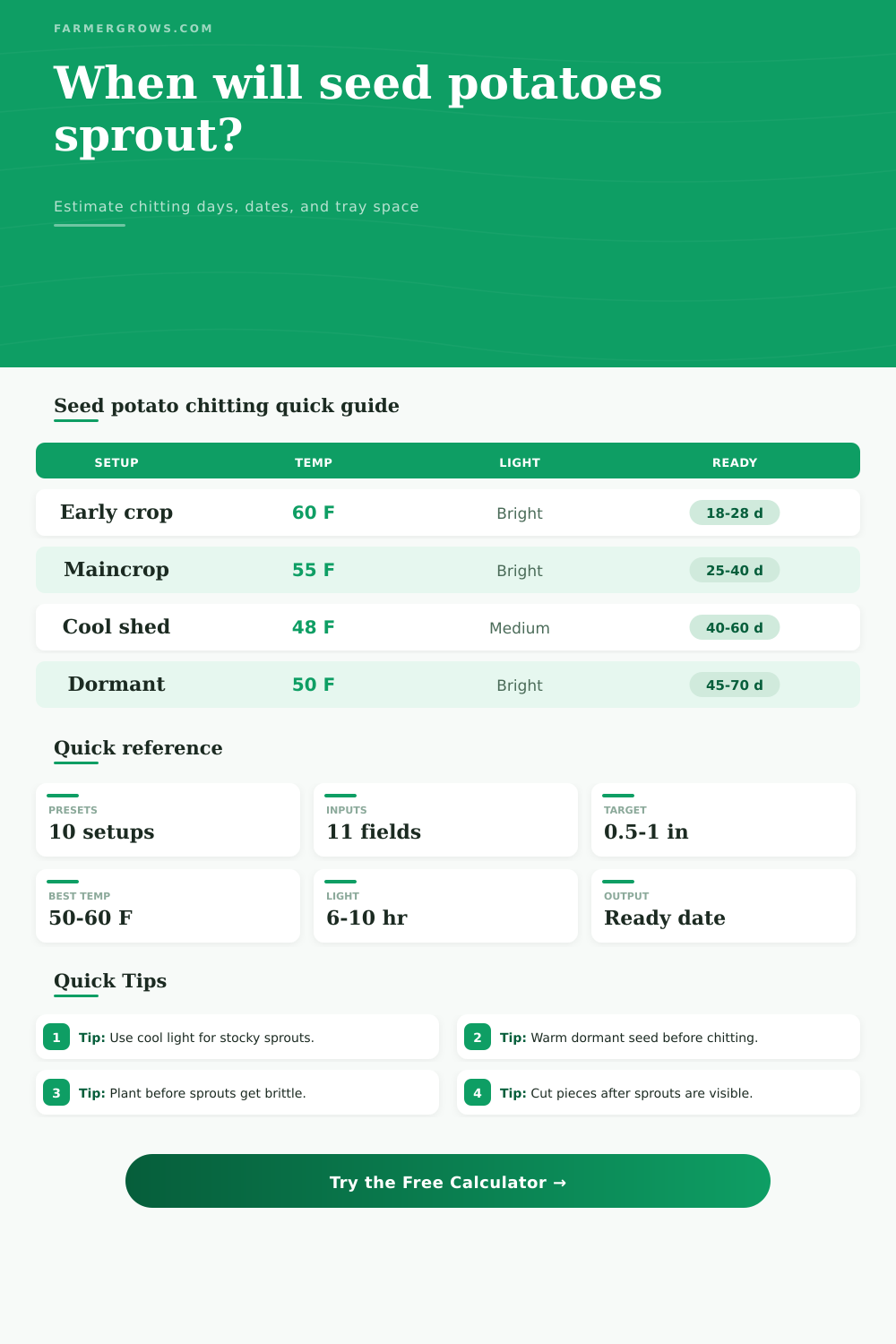
Seed Potato Sprouting Time Calculator
Estimate how many days seed potatoes need to break dormancy, form sturdy chits, reach planting length, and fit your planting date under real temperature and light conditions.
📋Named chitting presets
Choose a preset for a realistic starting point, then adjust the variety dormancy, storage condition, temperature, light, and seed count to match your potatoes.
🥔Seed potato inputs
The estimate combines a baseline dormancy period with sprout growth speed. Keep the chitting room bright and cool after eyes wake so sprouts stay short and sturdy.
Seed potato chitting estimate
Calculated results will appear after the first estimate.
Detailed sprouting breakdown
📊Chitting setup metrics
These supporting numbers help plan tray space, seed weight, and whether the sprouting environment is likely to make short green chits or weak pale shoots.
| Seed type | Typical wake-up | Best use |
|---|---|---|
| Short dormancy early potato | 7 to 14 days | Early chitting and quick planting |
| Medium dormancy table potato | 12 to 24 days | General spring planting |
| Long dormancy russet type | 24 to 42 days | Start earlier or pre-warm gently |
| Cold-stored maincrop seed | 30 to 55 days | Needs a warm wake-up phase |
| Room temp | Effect | Sprout quality |
|---|---|---|
| 40 to 45°F | Very slow | Good holding range |
| 46 to 50°F | Slow chitting | Sturdy but delayed |
| 51 to 60°F | Ideal pace | Stocky green sprouts |
| 61 to 70°F | Fast growth | Watch for stretching |
| Above 70°F | Very fast | Risk of weak sprouts |
| Condition | Adjustment | Field meaning |
|---|---|---|
| Deeply dormant | Add 8 to 14 days | No eye swelling after storage |
| Dormant | Baseline | Firm seed, no visible sprouts |
| Eyes swelling | Subtract 7 to 10 days | Buds visible but not extended |
| Pin sprouts | Subtract 12 to 16 days | Sprouts just emerging |
| Pre-sprouted | Use growth only | Measure existing sprout length |
| Tray type | Capacity | Best for |
|---|---|---|
| Egg carton or cell tray | 24 to 30 pieces | Small garden seed lots |
| Shallow nursery flat | 36 to 50 pieces | Medium lots with good light |
| Open wooden crate | 20 to 35 pieces | Large seed potatoes |
| Greenhouse bench | Single layer | Large batches and inspection |
Start early varieties about 3 to 5 weeks before planting and slower maincrop or long-dormancy lots about 5 to 8 weeks ahead.
Short green or purple sprouts usually handle planting better than long white sprouts. Add light and lower the room temperature if growth stretches.
It’s that time of year when you’re feeling tense about those seed potatoes on the windowsill in their cardboard box. They ought to be just starting to sprout; if not, perhaps they’ll rot first? Anyone who has grown seed potatoes with no sense of timing knows this angst. Timing’s all: Potato growing isn’t talent; it’s timing.
That is, when to get them out of dormancy, which is when the eyes starts to send forth short, strong sprouts. If you wait too long, the sprouts grows long and brittle, which means broken bits in the soil where they go in. Don’t do that. It takes away the guessing and replaces airy optimism with concrete deadlines. After plugging in the room temperature, variety, and storage conditions, the calculator do the rest of the work for you.
How to Time Your Potato Sprouting
Most people mistakenly believe that all chitting requires is warm temperatures. However, warmth also promotes stretching. Sprouting tubers that reaches awkward proportions while in the tub are more delicate when planted, and take longer to root in place. By including temperature, humidity, and light exposure in the equation, the device accounts for this compromise. Simply input your desired planting date; it will alert you whether your sprouting tubers will be up to speed, or if there’s a risk of wasted waiting.
The trick to it all lies in understanding the process of potato dormancy, some potato varieties needs less than others. An early variety (Red Norland) may be awake and raring to go after only two or even fewer weeks at room temperature; a maincrop type such as a Russet intended for storing will stay extra-firm and still very asleep for several weeks longer. That’s why the calculator adjusts from a base wakeup period based off each individual variety: If you assume your long-dormancy type is an early variety and get out and go too soon, you’ll have wasted time. Similarly, if you leave an early variety sitting in its chitting trays for another month or so (eight weeks), those tubers will be depleted of their internal reserves of energy, and shrivel up.
It is better to know when they are basically ready rather than just a given date, a window, if you will, that is more helpful than any one date, since nothing biological ever happens exactly on cue. One factor I didn’t expect that makes a difference in sprout quality: light. To create a stocky chit (turning green/purple) with maximum chlorophyll production, grow them under bright indirect light. Under dim conditions, they go leggy, turn white, and provide less benefit at planting time. This is where you can tinker with growth rate estimates: Enter how many hours of light you have each day.
It also takes into account the initial state of your seed: if you bought certified seed potatoes with visible pin-pricks or swelling eyes, the dormancy phase is already shortened; enter this data as carefully as possible, since it shifts the entire timeline ahead by a number of days. This is as practical as biology: How many flats, or egg cartons, should I plant? And what’s the right spacing between seeds? Overcrowded flats and egg cartons means uneven sprouting or may develop mold. To avoid such problems, the calculator sizes up your seed order, estimating how many tray will be required for each desired spacing, depending on how many seeds you’ve ordered.
What about my seed lot’s weight? That’s another factor. It is also one reason to buy bulk bags, though you should of know when to portion them out. The calculator figures that in, too. This is useful if you are ordering in bulk and need to divide it by weight. Planning to use bigger tubers, cutting them up into smaller pieces? The tool advises whether to cure such cuts first, to lower the risk of rotting later in the field. This is a vital tip, but most home gardeners overlook it and end up with soft spots that invite rot and perhaps even dissapears disease.
On the page, the reference tables lay out the range in temperatures and the resulting sprout quality. Ideal cool room temps (fiftyish to sixtyish) will yield good chits, but won’t rush them. A warmer room will do things faster. But be aware that the faster they grow, the weaker their sprouts will get.
What is the whole point of all this business called chitting? It is to have your plants ready to hit the ground running when they gets planted for a headstart, which means getting ahead of the competition and any weeds. And then there’s the day when those dark little sprouts leap up and say hello and you realize: Okay, now we’re really starting, and the season has begun. It’s that moment, that sense of preparedness, that turns a garden-nerd hoping that something works into someone who knows for sure that it does.