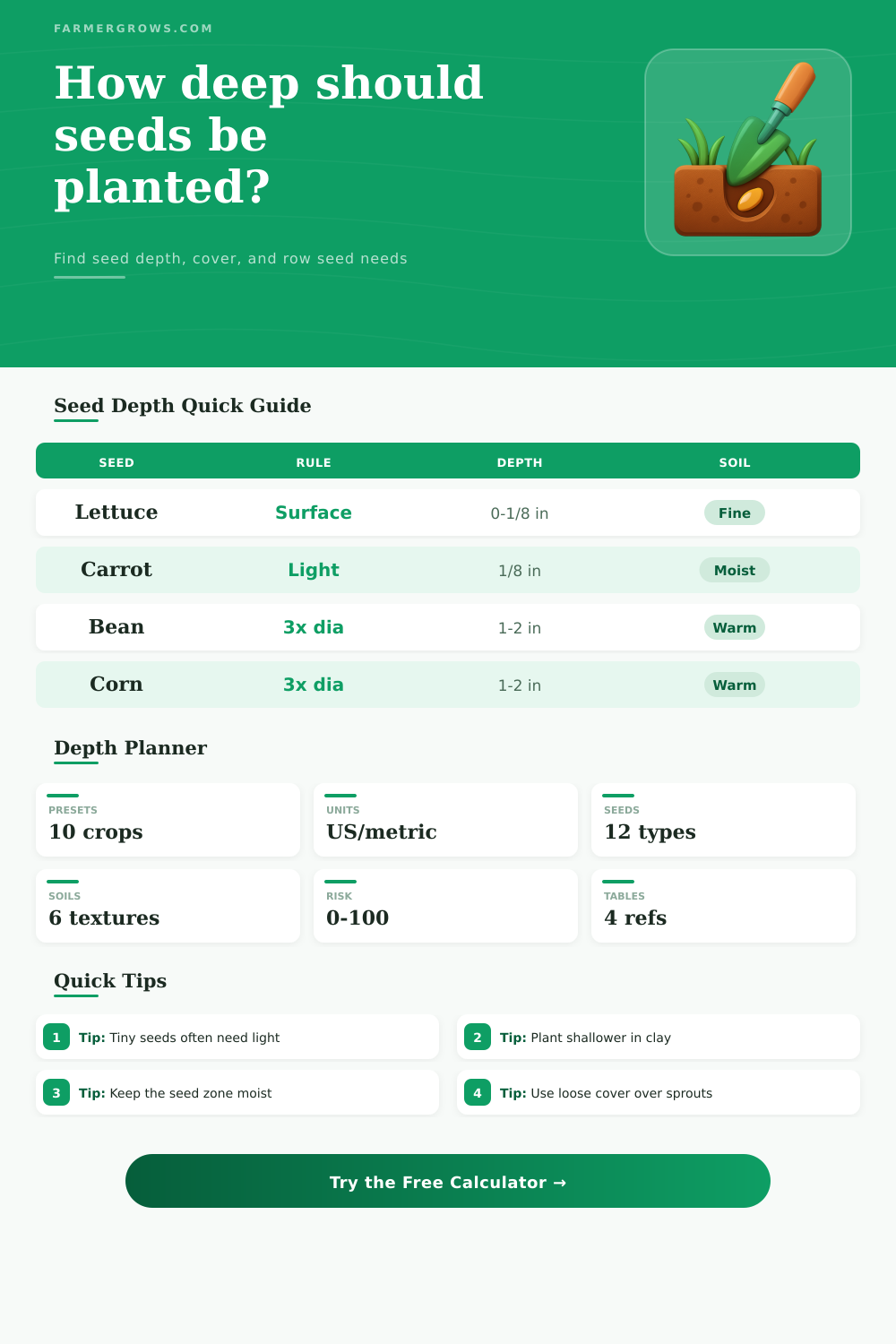
Seed Planting Depth Calculator
Estimate seed cover depth, furrow depth, seed-to-soil contact, row seed count, and emergence risk from seed size, crop type, sowing method, soil texture, moisture, seedbed quality, and soil temperature.
Most garden seeds are covered by soil roughly two to four times their diameter, but very small or light-sensitive seeds may need only a dusting. This calculator keeps cover depth, seedbed firmness, moisture, and row planning in one place.
📋Seed Depth Presets
⚖How Seed Depth Is Adjusted
Seed size creates the first estimate. Tiny seeds use shallow cover, while large beans and peas tolerate deeper placement.
Some fine seeds germinate better with light and only enough vermiculite or soil to hold moisture around the seed.
Clay and crusting soils reduce depth. Sandy beds may need a bit more cover to protect against drying.
Cold, wet, crusted, or dry seedbeds change emergence speed and the chance that seedlings break through cleanly.
🌱Seed Depth Inputs
Seed Depth Results
Depth estimate will appear after calculation.
📏Seed Depth Reference Cards
📚Reference Tables
1. Common Seed Planting Depths
| Seed group | Typical diameter | Usual cover | Depth rule | Depth caution |
|---|---|---|---|---|
| Lettuce and celery | Under 1 mm | Surface to 1/16 in | Press in or dust lightly | Needs light and steady moisture. |
| Carrot and parsley | 1 to 2 mm | 1/8 to 1/4 in | Fine shallow cover | Crusting soil can trap weak seedlings. |
| Tomato and brassica | 2 to 3 mm | 1/4 in | About 2x to 3x diameter | Do not compact cell trays after covering. |
| Spinach and radish | 3 to 5 mm | 1/4 to 1/2 in | About 2x to 3x diameter | Keep soil cool and evenly moist. |
| Cucumber and squash | 6 to 10 mm | 1/2 to 1 in | About 2x to 3x diameter | Cold wet soil can rot large seeds. |
| Beans and peas | 8 to 13 mm | 1 to 2 in | About 3x to 4x diameter | Use deeper cover only in warm loose soil. |
| Sweet corn | 6 to 10 mm | 1 to 2 in | About 3x diameter | Plant shallower in cold spring soil. |
2. Soil Texture Depth Adjustments
| Soil or mix | Depth adjustment | Moisture behavior | Best cover material | Main risk |
|---|---|---|---|---|
| Fine seed-starting mix | Standard to shallow | Holds moisture evenly | Vermiculite or fine mix | Damping-off if kept soaked. |
| Garden loam | Standard | Balanced moisture and air | Crumbled soil | Low risk when firmed lightly. |
| Sandy loam | Slightly deeper | Drains and dries faster | Fine soil plus irrigation | Seed zone drying before sprouting. |
| Loose sand | Deeper for large seeds | Very fast drainage | Compost-amended cover | Drying and poor contact. |
| Heavy clay | Shallower | Dense, slow, crust-prone | Sifted compost cover | Rot or trapped seedlings. |
| Compost-rich bed | Standard to shallow | Settles after watering | Screened compost | Uneven depth after settling. |
3. Depth Rule Conversion
| Seed diameter | 1x cover | 2x cover | 3x cover | 4x cover |
|---|---|---|---|---|
| 0.04 in / 1 mm | 0.04 in | 0.08 in | 0.12 in | 0.16 in |
| 0.08 in / 2 mm | 0.08 in | 0.16 in | 0.24 in | 0.32 in |
| 0.12 in / 3 mm | 0.12 in | 0.24 in | 0.36 in | 0.48 in |
| 0.20 in / 5 mm | 0.20 in | 0.40 in | 0.60 in | 0.80 in |
| 0.32 in / 8 mm | 0.32 in | 0.64 in | 0.96 in | 1.28 in |
| 0.50 in / 13 mm | 0.50 in | 1.00 in | 1.50 in | 2.00 in |
4. Seedbed And Emergence Checks
| Condition | Depth response | Contact check | Moisture action | Watch point |
|---|---|---|---|---|
| Fine tray mix | Use exact shallow cover | Press seed gently into mix | Mist before surface dries | Algae or damping-off if saturated. |
| Direct row in loam | Use crop depth | Firm furrow bottom lightly | Water after sowing | Birds and crusting after heavy rain. |
| Cold spring bed | Use shallow end | Avoid deep wet drills | Wait if soil is too cold | Seed rot before emergence. |
| Dry sandy bed | Use deeper end for large seeds | Firm around seed | Irrigate lightly and often | Seed zone drying below mulch. |
| No-till residue | Keep seed in soil, not residue | Close the slit cleanly | Check moisture under residue | Hairpinning and poor contact. |
💡Seed Depth Tips
Carrots, lettuce, herbs, and many flowers have little stored energy. Fine cover and steady surface moisture matter more than deep protection.
For small seeds, deeper planting often slows emergence. Improve seedbed contact, shade the row lightly, or irrigate more consistently instead.
Planting carrot seeds? Chances are good that you’ve done that once or twice. Sprinkle them on top of ground, and pat them in slightly. And then you wait, weeks, and while the neighbor’s garden comes alive, yours stays stubbornely empty.
Is it the weather? Is it the seed packet itself? Usually, something easier: It was almost certaintly depth. That number matter… Get it wrong by not enough or by too much and you’re headed for the compost heap instead of the dinner plate; get it just right, and you can look forward to crispy carrots.
Why Planting Depth Matters for Carrots
If you don’t know how deep to plant seeds, whether the cover is too much or too little; don’t guess: Plug your soil conditions (above) and crop type into the calculator. It will do math for you.
You’re supposed to cover seeds at twice to three times their size, most garden advice tell us. That’s a handy rule of thumb. It protects seeds without wasting precious energy resources. Once they sprout, the seedlings has to expend some of the reserves they carry within themselves to push upward out of the soil. Too-thick cover depletes them before they reaches the light. Heavy rains wash away seed, or dry it out, if cover is too scant. The tool finds that sweet spot, then, of being protected but not smothered.
Then there’s soil texture. A heavy clay will feel as if it is a brick wall to a weak root; rain crusts surface into an impenetrable barrier that no level of strength will overcome. Go shallower different than you normally would in such conditions. Conversely, sandy soil does the reverse: It dries out quickly and also drains fast, so seeds is parched before ever having time to think about growing. Maybe you want to tuck things a little deeper in sand, just to stabilize moisture zone around the embryo. By the way, the calculator factors in these variations, altering its suggested depth based off what you put into it. Planting a bean in loose loam require a different treatment from the same bean in clay.
Novices should also consider light. Certain seeds (celery or lettuce, for instance) need it to get going. Plant them too deeply; even just a quarter-inch, and nothing will happen at all. With these seeds, push them lightly onto surface of the soil so they make contact with moisture, but don’t bury them.
Other seeds (such as corn or peas), have the muscle to rise from deeper beds and benefit from insulation against temperature fluctuations. Where does your crop fit? Knowing which camp it’s in matters more then memorizing the precise millimeter measurement.
But there’s another factor in the equation that’s quiet but important: Temperature. Metabolic activity are slowed by cold soil. Before it begins to grow, a seed can rot in the cold and wet ground. You may wish to dig a little shallower in early spring, accessing the relatively warmer top layers. Wait until ground really thaws. Entering temperatures into the tool will tell you when the ground may be too hard for your planned digging depth. It tells you when you’re setting a trap for your seedlings.
The number of seeds is equally important. After all, what’s the use of planting them if you’re going to run out halfway down a long row? This is especially true if they germinate poorly in less-than-perfect conditions. Based on row length and desired spacing, the calculator tells you roughly how many seed to purchase, along with some extra for pests or waste. That way you avoid panic-purchasing when the planting time has come and gone. You should of planned better.
How deep? Consider planting depth a negotiation: How much do you want to protect the seed (from wind and drying out), versus how little effort are you willing to put in (as if moving a mountain)? Big seeds will tolerate a blanket; fine ones appreciates a whisper of cover. Set your baseline with the tool, then when the sprouts emerge, trust what your eye sees. If that first green shoot says no, you didn’t get it right.