Seed and Fertilizer per Acre Calculator
Plan seed pounds, population, germination adjustment, acres, fertilizer analysis, nutrient targets, soil credits, application efficiency, overage, and bag counts in one field worksheet.
Pick a crop plan to load practical seed and fertility starting values, then adjust acres, seed tag information, N-P-K targets, credits, efficiency, and overage for your field.
Field Order Estimate
Seed and fertilizer totals are adjusted for germination, soil credits, efficiency, acres, and overage.
Often planned by population with high nitrogen demand and enough phosphate and potash to support yield goals.
Usually seed-count based; fertilizer often focuses on P2O5 and K2O because nodulation supplies most nitrogen.
Small grain rates are commonly entered by pounds per acre, with nitrogen split by growth stage or local guidance.
New stands use careful germination adjustment and usually need strong phosphate and potash planning, not added nitrogen.
Forage or cover crop stands can shift widely by drilling, broadcasting, and the expected window for establishment.
Oats are normally rate-based and respond to balanced fertility without pushing nitrogen so high that lodging risk increases.
Population targets vary by moisture zone, row spacing, and hybrid, while nitrogen rates follow realistic yield potential.
Mixed grasses and legumes are easiest to order by pounds, then fertilizer is balanced around establishment and soil tests.
| Crop | Seed planning style | Typical seed target | Seeds per pound | Fertility emphasis |
|---|---|---|---|---|
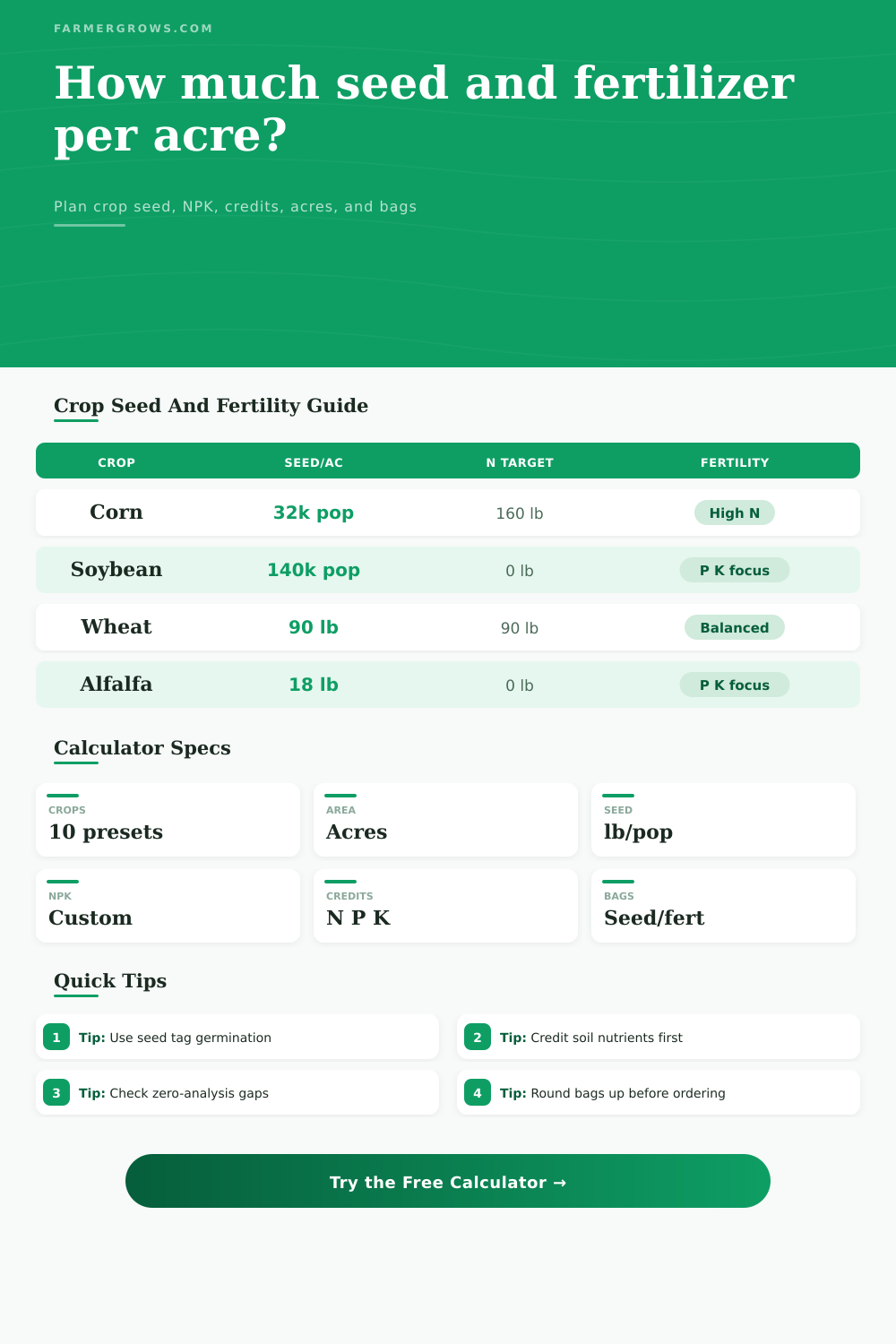
| Field corn | Population | 30000 to 36000 seeds/ac | 1200 to 1800 | Strong nitrogen program, balanced P2O5 and K2O |
| Soybean | Population | 120000 to 160000 seeds/ac | 2500 to 3200 | Usually P2O5 and K2O focused after soil credits |
| Winter wheat | Pounds per acre | 75 to 120 lb/ac | 12000 to 16000 | Nitrogen with adequate starter P and K |
| Alfalfa | Pounds per acre | 12 to 22 lb/ac | 190000 to 230000 | Phosphate and potash; little or no N |
| Annual ryegrass | Pounds per acre | 20 to 35 lb/ac | 220000 to 250000 | Moderate N with P and K as soil tests require |
| Oats | Pounds per acre | 80 to 120 lb/ac | 12000 to 16000 | Moderate N; avoid lodging from excessive N |
| Grain sorghum | Population | 50000 to 90000 seeds/ac | 14000 to 18000 | Nitrogen scaled to yield and moisture potential |
| Sunflower | Population | 18000 to 26000 seeds/ac | 7000 to 10000 | Balanced fertility without excess N |
| Analysis | Common role | N per 100 lb | P2O5 per 100 lb | K2O per 100 lb |
|---|---|---|---|---|
| 46-0-0 | Urea nitrogen source | 46 lb | 0 lb | 0 lb |
| 34-0-0 | Ammonium nitrate style N source | 34 lb | 0 lb | 0 lb |
| 18-46-0 | DAP starter phosphate source | 18 lb | 46 lb | 0 lb |
| 11-52-0 | MAP starter phosphate source | 11 lb | 52 lb | 0 lb |
| 0-0-60 | Muriate of potash source | 0 lb | 0 lb | 60 lb |
| 19-19-19 | Balanced blend for starter or maintenance | 19 lb | 19 lb | 19 lb |
| 10-10-10 | General balanced blend | 10 lb | 10 lb | 10 lb |
| 13-13-13 | General balanced blend | 13 lb | 13 lb | 13 lb |
| Item | Typical package | How calculator uses it | Planning note |
|---|---|---|---|
| Small grain seed | 50 lb bag | Total seed lb divided by bag size | Round up and keep tags separated by lot |
| Forage seed | 25 or 50 lb bag | Adjusted for germination and overage | Check coated seed because seed count can vary |
| Corn seed | 80k seed unit | Convert seeds to pounds when a unit weight is known | For unit ordering, compare total seeds separately |
| Dry fertilizer | 50 lb bag | Total product lb divided by bag size | Bulk spreading may use tender or spreader increments |
| Custom blend | Bulk lb or ton | Enter N-P-K analysis from the blend ticket | One blend may oversupply secondary nutrients |
| Example | Acres | Seed target | Fertilizer target | Best use |
|---|---|---|---|---|
| Small hay field | 8 ac | 18 lb/ac alfalfa | 0-60-180 before credits | New forage stand estimate |
| Grain corn block | 40 ac | 32000 seeds/ac | 160-60-80 before credits | Seed and dry blend order check |
| Wheat field | 25 ac | 90 lb/ac wheat | 90-45-45 before credits | Fall or spring small grain plan |
| Cover crop | 12 ac | 55 lb/ac blend | 30-20-20 before credits | Fast multi-species planning |
| Pasture repair | 5 ac | 35 lb/ac mix | 45-35-70 before credits | Renovation and overseeding |
Seed tag first: Use germination or pure-live-seed from the current lot, then add overage only after the live seed adjustment so poor lots are not under-ordered.
Soil credits first: Subtract soil-test, manure, legume, or previous crop credits before sizing fertilizer so the chosen product is not asked to supply nutrients already available.
Calculator outputs are planning estimates. Follow local soil-test recommendations, label rules, nutrient management requirements, and crop adviser guidance before spreading or planting.
A calculator that handles seed and fertilizer per acre When the ground gets soft and it’s time to pull out the planter, you’re faced with one dilemma: How much seed will you need across all of your fields?
You’ve got soil test results, the field map, and remembered what agronomist said about applying nitrogen. But there’s no time to break out calculator and figure how many pounds per acre are needed from seeds per pound, factoring in germination loss and adding a ten percent overage to account for headlands.
How to Use the Seed and Fertilizer Calculator
On a hectic morning, a seed/fertilizer per acre calculator does just that. It’s not really that hard to do the math. You can multiply a rate times acres… anybody could do that.
The trick is noticing when reality in the field differ from what the plan expected. In other words it’s different planning corn versus soybeans than it is wheat vs. Alfalfa. Corn are a population product (you think about how many seeds there are) while wheat is more a weight product (you’re thinking about pounds of material). Treat one as if it were the other and you’ll either be wasting money or end up with sparse stand.
The calculator has toggles that allow you to switch back and forth between population and pounds so you don’t have to guess what metric you should of used for the crop you’re working with.
Your seed budget matters a lot when it comes to germination. If you’re buying 92 percent, it sounds good. But that means you’re getting 8 percent fewer viable seeds than you think you are. Most of us don’t factor this in until we have a patchy field because the stand wasn’t good enough.
The tool uses the true germination rate from actual bag instead of average for that variety. It then scales that rate up to the desired population. It’s a pain to do manually, but makes the difference between whether you’ll get a crop at all or whether it will need replanting.
It’s complicated. There is fertility planning which depends on condition of your soil before you add any fertilizer. Then there is actual application of that fertilizer. And what do you know? You need to subtract soil credits for phosphorus, nitrogen, and potassium from your target before you size up your blend.
Why? This helps avoid over-applying. Subtracting the amount of credit you have (if the phosphorus test is high, if you had a legume crop last year that left some nitrogen behind) will give you your desired balance to size the fertilizer mix. In other words: Don’t just buy and apply fertilizer blindly because it’s spring.
With this tool, you can plug in your credits so you’re buying only the difference, and filling a gap. This is an efficiency-minded exercise, because not all pounds of nitrogen that are purchased end up in the plants. Placement issues, tie-up issues and volatilization losses may leave you with only eighty-five percent of nutrients going to work. Better account for that loss initially instead of feeding crop short later on.
The last area of friction is the bag counting. Sure you can calculate a rate with the best of theories, but if you order by that decimal you’ll be out of materials on final ten acres. It’s not an option, rounding up to the next unit or whole bag are just part of the game.
Knowing exactly what you are buying can be seen in the blend analysis on the page. What do 50-pound bags looks like? What about a load from the tender truck? Your logistics change more than the science. Until you limit the variables, it’s all guessing games.
You need to get to the point where you trust that the load will fill the field. You shouldn’t have to worry about dropping a zero but can just trust that what goes in comes out. This happens because you’ve locked down your efficiency, your credits, and your germination.
Finish planning, head outside and let the equipment work.