
Most growers do not think about it enough and use too much water by adding nutrients to a reservoir and hoping for the best. What happens if the pH swings up and down? What happens when all those salts builds up in the tank. Stalling the plants?
The key to growing successfully isn’t so much how much water (or nutrients) you give your plants, but rather how precisely you follow a timed schedule. That’s why a well-structured feeding chart make sense. It turns guessing into something you can do repeatedly. By making sure your roots get exactly the right things at the right times, your timing matter almost as much as the chemistry involved.
A Simple Guide to Your Plant’s Feeding Schedule
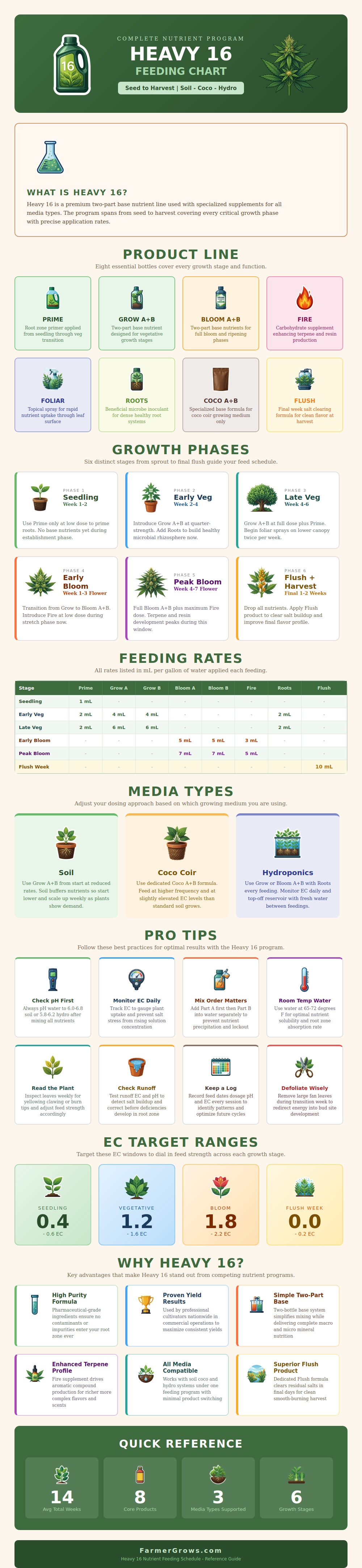
Instead of typical two-phase grow; seedling through harvest… The visual guide above depicts total lifecycle approach. It divides the grow into six phases: six distinct sets of requirements for a seedling vs. A plant is at its peak flowering stage. Why? Seedlings need different things than plants do when they are peaking on flowers, so this detail matter.
The first couple of weeks are all about establishing a strong foundation. According to the chart, a root primer during this stage is right. Root primers is mild, getting those roots growing but not blasting young plants with a bunch of salt-heavy nutrients that are overkill for them at this time. A lot of beginning growers gets impatient and toss full strength vegetative nutrients into waterway too soon. This results in osmotic stress before the plants has enough roots to cope. Be patient here. You will see larger plants and higher yields later.
During this time as the plant stretches out into vegetative mode, you change tactics: Introduce your base nutrients at reduced strengths while simultaneously inoculating soil or medium with beneficial microbes. At the same time, be sure to inoculate your growing media or soil with beneficial microbes. Your objective now is a healthy rhizosphere. These microbes will defend the plant from pathogen attacks and they will also begin breaking down organic matter (and creating a biological buffer). This results in better efficiency with chemical feeding. It’s symbiosis; something that pure hydroponic systems lacks without proper management.
The chart emphasizes adding foliar sprays later in vegetative growth. This gives plants an easier route to take up nutrients. These nutrients may not always reach the inner leaves through root transport alone.
The transition to flowering is where most programs fall apart because they fail to address specific energy demands of resin production. This schedule provides a period between early bloom and peak bloom. This enables you to increase your carbohydrate supplements gradualy. The supplement that boosts resin and terpene output are great. If you introduce it slowly as the plant stretches, it signals that it’s time to start focusing on developing flowers without shocking it in the process. This gradual ramp up mimics nature. It eliminates nutrient lockout issues common with static feed schedules.
Growing media make all the difference. Hydroponics is less forgiving and more responsive than soil. Coco coir is more responsive but less forgiving than soil. Because soil has a certain ability to hold nutrients and then release them over time, it buffers. With hydro or coco, nutrient solutions are much more critical since growing medium itself isn’t going to do any of that work for you; you have to check your EC every day and be sure to top up reservoir with fresh water accordingly. Your growing medium’s retention rate determines how often you feed. If you don’t match your feeding schedule with how fast your grow medium holds onto what you give it, something would of suffered.
Many people think that flushing means washing off pesticides. That’s not the case here. The final week is where we drop all nutrients and add an extra special flush solution to rid leftover salt from our root zone. This eliminates any harsh mineral taste in the final product which can affect your overall flavor profile. It is a little thing that makes a huge difference when smoking.
Never grow blind: Measure what you put in. Track your pH and EC every day. Tracking your pH and EC daily is non-negotiable. Make a log with each feed. Record when you make adjustments, depending on the appearance of the plants. Don’t view yellow leaves as a failure, view them as data points. View burnt leaf tips as data points. Use the information they provide to know when to adjust or scale back.
Following such a structured schedule removes the anxiety from gardening. It turns it into prevention rather than reaction. You get a harvest from careful planning, not hopeful guessing. Start small. Track everything. Let the schedule be your guide. Eventually it will become second nature.