Rye Seed Germination Time Calculator
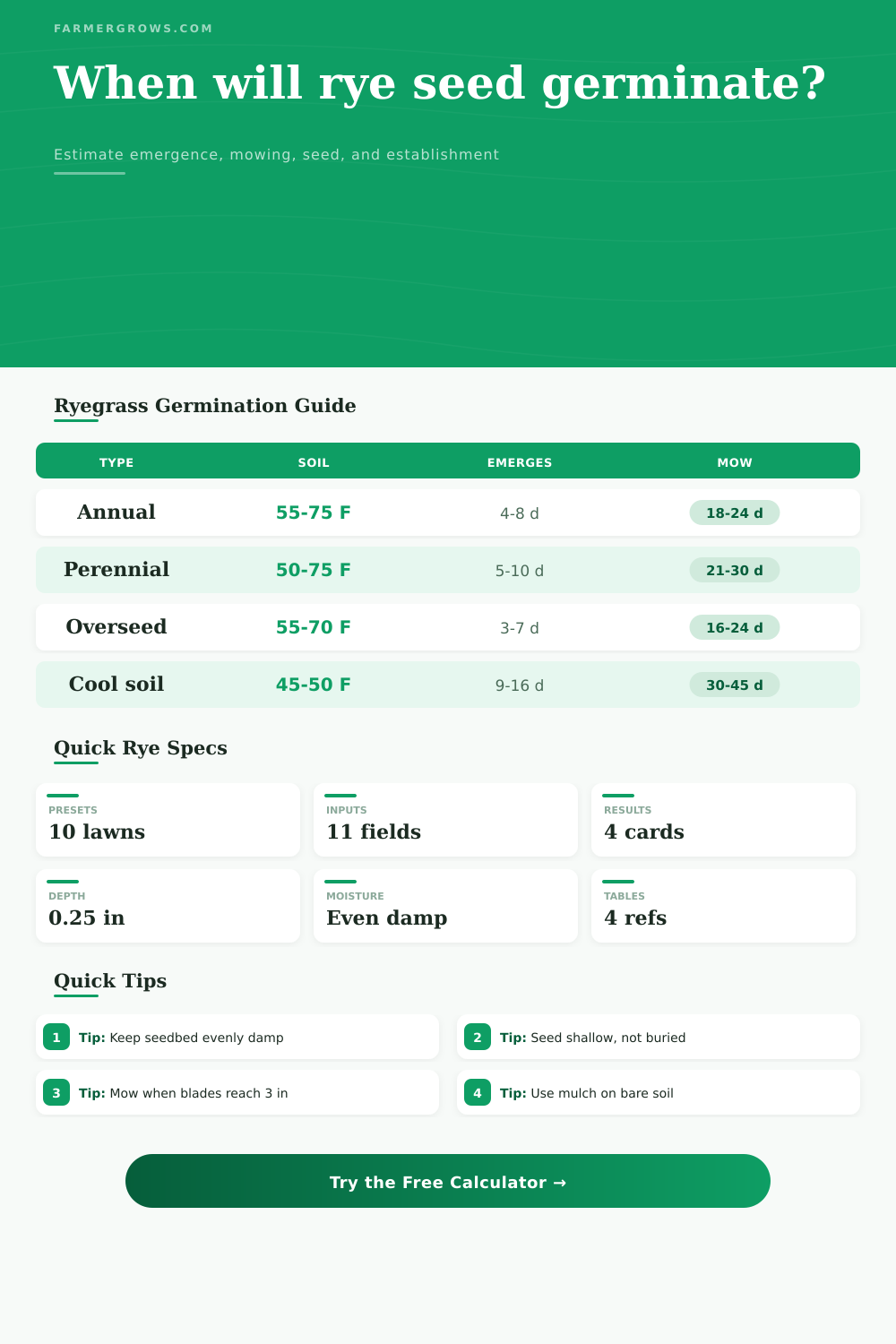
Estimate annual or perennial ryegrass emergence, first mow date, establishment window, seeding quantity, and timing risk from soil temperature, moisture, depth, rate, and lawn use.
🌱Ryegrass presets
Pick a realistic starting point, then adjust soil temperature, seeding rate, watering consistency, seed depth, area, and whether this is an overseed or new lawn.
📊Annual vs perennial ryegrass
Often chosen for quick green cover, erosion protection, and short seasonal color where long-term turf quality is less important.
Better for lawns, overseeding, and blends where fine texture, wear tolerance, and repeated mowing matter.
Existing canopy moderates soil temperature, but thatch and leaf competition can reduce seed-to-soil contact.
Requires more seed and tighter moisture control because exposed soil dries faster and washes more easily.
⚙Calculator inputs
Ryegrass germination estimate
Your rye seed timing and seed quantity will appear here.
Timing breakdown
📌Live planning checks
📚Reference tables
| Soil temp | Expected speed | Action |
|---|---|---|
| 45 to 49 F | Slow, 10 to 18 days | Use patience and steady moisture; avoid deep covering. |
| 50 to 54 F | Moderate, 7 to 13 days | Good early spring or late fall window. |
| 55 to 69 F | Strong, 4 to 9 days | Best practical ryegrass seeding range for lawns. |
| 70 to 78 F | Fast, 3 to 7 days | Water more often because warm seedbeds dry quickly. |
| Above 80 F | Fast but stressful | Watch heat, disease pressure, and shallow drying. |
| Use | Annual rye | Perennial rye |
|---|---|---|
| New lawn | 8 to 12 lb / 1,000 sq ft | 5 to 10 lb / 1,000 sq ft |
| Overseed thin lawn | 5 to 8 lb / 1,000 sq ft | 3 to 6 lb / 1,000 sq ft |
| Patch repair | 8 to 15 lb / 1,000 sq ft | 6 to 12 lb / 1,000 sq ft |
| Temporary cover | 10 to 20 lb / 1,000 sq ft | Not usually used alone |
| Condition | Effect | Best correction |
|---|---|---|
| Surface seed | Can dry or be eaten | Rake lightly and roll for contact. |
| 1/8 to 1/4 in | Ideal for most ryegrass | Keep the surface evenly damp. |
| 1/2 in | Often slower and thinner | Use only on loose, drying soil. |
| Over 3/4 in | High failure risk | Rework or add a light top seeding. |
| Stage | Typical timing | Care focus |
|---|---|---|
| Days 0 to 3 | Seed imbibes water | Short, frequent watering; avoid puddles. |
| Emergence | 3 to 14 days | Reduce washout and keep seed zone moist. |
| First mow | 2 to 5 weeks | Mow high with sharp blade on dry turf. |
| Established | 4 to 8 weeks | Shift to deeper watering and normal traffic slowly. |
💡Ryegrass germination tips
Before emergence, ryegrass needs a damp seed zone rather than deep irrigation. Several short cycles usually beat one heavy soak on bare soil.
Lawn ryegrass seed is small. Deep seed may emerge late, thin, or uneven, especially in compacted clay or crusted topsoil.
Overseed rates are lower because existing turf remains. Bare soil, repair spots, and erosion cover need more seed for quick canopy closure.
Visible blades are not fully established turf. Wait for rooting, first mowing, and steady fill before games, pets, or equipment use.
This calculator gives planning estimates for lawn ryegrass. Weather swings, seed lot age, soil crusting, irrigation coverage, disease, birds, and local cultivar differences can shift real emergence and establishment dates.
You scatter seed of rye over bare soil, then you watch. And there’s a certain type of worry that sets in: Will something happen to change things? You water; you wait. Nothing has changed on top, though; just darkness as the sun goes down. That quiet feels like failure, and yet is perfectly normal.
To cut through the unknown requires this tool, which translates soil conditions into real days. It provides a timeline, so you have a realistic idea not only of when things will emerge, but also of first mowing and full establishment. In other words, it makes the guesswork of lawn-care into a schedule you can actualy live with.
Use a Tool to Know When Your Grass Will Grow
That’s not just because ryegrass has different behavior at varying soil temperatures (the most important variable here). You’d assume it would be the air temperature that’s key, right? Nope: Seeds and their following roots only respond to what happens beneath them. Ideally, the soil at seed depth would be between fifty-five and sixty-nine degrees Fahrenheit for quick, strong growth. A handy chart in that calculator section explains those intervals, and tell you if you’re waiting almost two weeks for a cool soil, or if sprouting will occur within four days.
It makes a difference because you don’t want to rush-mow slow-to-emerge seed; that’ll tear out tender young roots before they anchor in place. Another variable is seed depth. People get this one wrong when they try too hard. The seeds in ryegrass are small… Tiny, even. No need to bury ’em deep. Why? If you do, they may waste all their energy trying to reach the surface. Or worse, they could get trapped under half an inch of soil or more which isn’t where we want them.
Keep the seed about a quarter-inch deep so it’s not so far from light that it has to waste all its time pushing its way out, but also so that it’s getting damp enough to sprout. Keep it shallow (it’s a shallow game). Treating it as something you’re planting like a tree will lead to thin patches.
The same principle applies when you’re choosing whether to sow perennial or annual ryegrass, though the time frame is adjusted accordingly. For instance, annual rye grows more quickly so it’s ideal if you really want something right now (for example as an erosion control measure or cover crop). Perennial rye will take a while to come in, but it will eventually provide a fine-textured lawn that lasts and even stands up to foot traffic. The pre-programmed plans in the tool reflect such differences in emergence period and account for your choice of which one to use. No need to understand all the biology behind it…just know what sort of thing you desire most. Do you want green temporary ground cover or a long-lasting investment? That determines how long you’ll wait, and how many seeds you purchase.
Weather doesn’t adhere to your watering schedule, so maybe the most difficult-to-manage variable out in the real world is moisture consistency. There’s a field in the calculator for moisture quality. Even moisture will result in even germination. Any dry spots will leave gaps as though there were poor seed, which may not be the case at all but rather an irrigation failure. During this stage, light watering several times a day is preferable to one big soaking, which would wash little seeds around or even form pools that rot them. That’s why the tool bases your estimated establishment date partly on the degree of reliability with which you can maintain even moisture in the seed zone.
You can mow for the very first time once the seed germinates and is roughly three inches high, which means the roots are strong enough to handle some stress. This is not just because you want to, but also because you do not want to hinder root development. The tool offers an idea of when to make this initial cut, so you don’t harvest your lawn too early. If you let the grass grow a couple weeks after germination, it will be rooted down enough that you can go from careful seedling management back into regular lawn routine and not fall behind.
It’s the difference between just hoping for the best and having a yard you can actualy walk on. Knowing when these things happen takes the guesswork out of whether we’ve watered enough or too much, and whether it is time to mow. Now, instead of battling Mother Nature, I am doing what she wants me to do, given my plot’s special conditions. The numbers lead us along; we watch closely to adjust moisture and depth as needed. And once those initial green bits poke through, there is no more stress, just a gentle rhythm of maintenance that rewards you with a thick, healthy carpet of lawn.