Rubber Trees Per Acre Calculator
Estimate rubber trees per acre, seedlings to order, productive planted area, rows, tappable trees, tapping-round workload, and hectare equivalents from real plantation spacing inputs.
Choose a clone and spacing layout, then adjust the land shape, road deduction, blanking reserve, survival, culling, and tapping system for your own block.
Rubber Tree Spacing Results
Your rubber planting estimate will appear here.
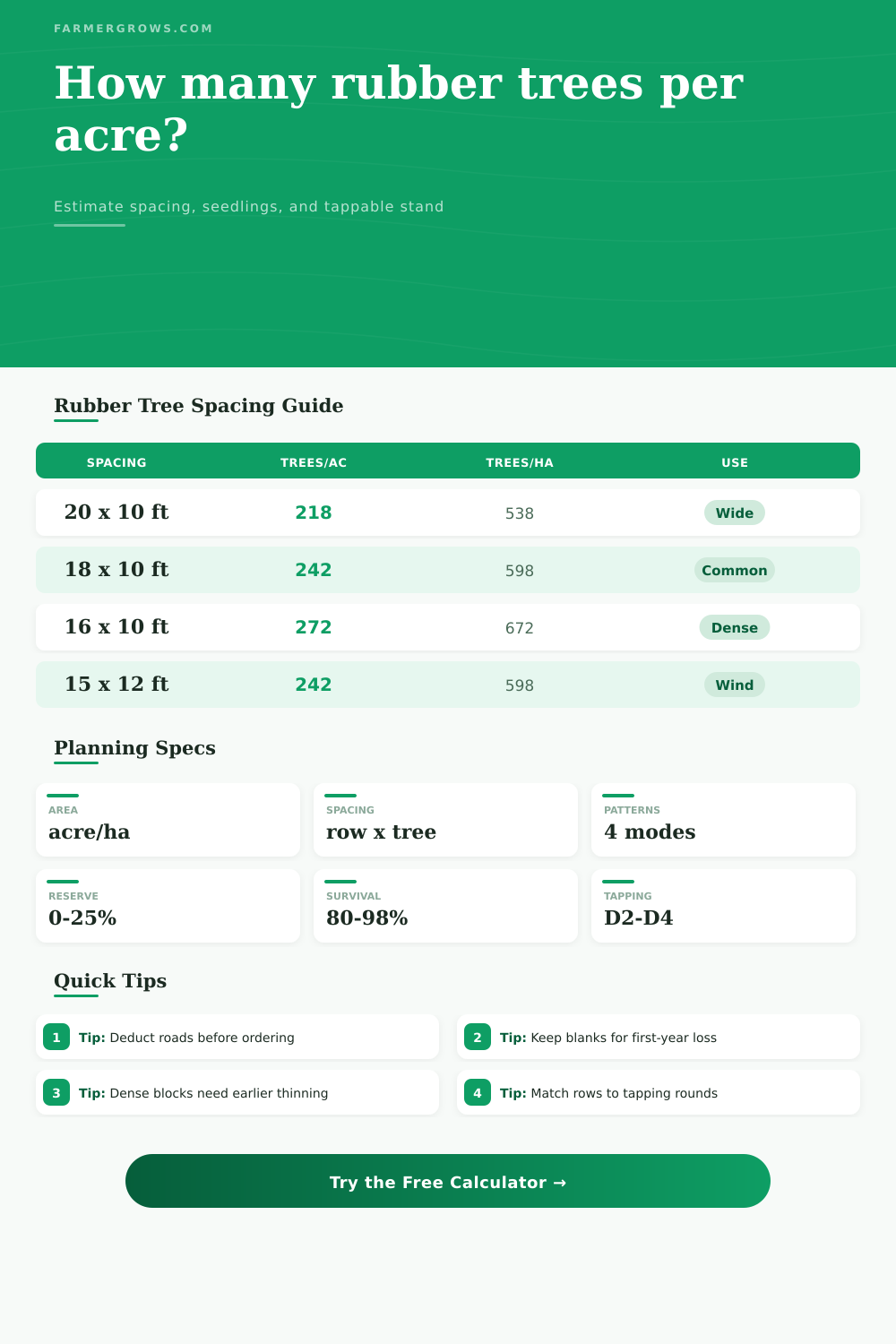
| Rubber spacing | Square feet per tree | Gross trees per acre | Common planning use |
|---|---|---|---|
| 20 ft x 10 ft | 200 sq ft | 218 | Wide rows, vigorous clones, easier access |
| 18 ft x 10 ft | 180 sq ft | 242 | Balanced rubber plantation density |
| 16 ft x 10 ft | 160 sq ft | 272 | Dense establishment with careful thinning |
| 15 ft x 12 ft | 180 sq ft | 242 | Wind-prone or mixed contour planting |
| 6 m x 3 m | 193.8 sq ft | 225 | Metric layout near 555 trees per hectare |
| Planning checkpoint | Usual range | Calculator input | Why it matters |
|---|---|---|---|
| Survival after blanking | 88% to 96% | Field survival | Converts planted spots into live stand |
| Culls before tapping | 4% to 15% | Cull percentage | Removes weak, damaged, or off-line trees |
| Tapping-ready share | 75% to 95% | Girth-ready percentage | Estimates trees that can join tapping |
| D2 tapping | 1/2 stand daily | Tapping system | Sizes daily task load and cups in rotation |
| D3 tapping | 1/3 stand daily | Tapping system | Spreads work across a longer round |
| Example setup | Gross trees per acre | After 8% roads | Expected tappable trees |
|---|---|---|---|
| 18 x 10 ft, balanced clone | 242 | 223 | 174 to 188 |
| 20 x 10 ft, vigorous clone | 218 | 200 | 156 to 170 |
| 16 x 10 ft, compact clone | 272 | 250 | 195 to 214 |
| Triangular 17 ft grid | 174 | 160 | 125 to 138 |
| Paired rows, 10 ft trees | 242 | 223 | 170 to 190 |
Use productive acres. Roads, drains, terraces, collection points, and windbreaks should be deducted before calculating rubber trees per acre.
Separate seedlings from final stand. The calculator adds blanking reserve first, then applies survival, cull, and girth-ready percentages for tapping estimates.
Planting a rubber estate demands geometry, and more than a little patience. You’re creating your own self-replicating factory tree by tree, but the first step is how closely you plant those seedling. “How many trees do I get per acre?” is the most frequent beginner’s query. Actualy, the question should of been different. How many tappable trees can I handle before one dies of disease? How many can I handle before one shade another?
The above calculator does arithmetic for you, it translates what you want to achieve (spacing) into how much it will cost you in seedling purchases, tappable stands, and time spent working the ground every day. It connects theory with practice. The first big choice is how much space to use. That determines what kind of an operation you will have.
Choosing the Right Spacing for Your Rubber Trees
Twenty by ten feet spacing allow strong clones ample room to stretch their legs. They grow broad crowns that don’t compete for sunlight, keeping understory dry (reducing fungal pressure). Maintenance costs less and tapping teams reaches every tree with ease. Though you sacrifice a couple trees/acre they’re easier to tap safely, and you get those latex-rich trunks sooner.
For pushing early yields, go dense: say, sixteen by ten feet. More trunks to cut = more latex quicker, but competition’s invited. When to thin? Know this or risk letting the trees gets spindly and tall, prone to wind damage, hard to tap.
The other thing: Latex only comes from land, so whatever doesn’t grow latex will subtract from your planted acreage. Headlands, roads, and drainage ditches will eat away at your planting space. So if you purchased five acres, you likely has only got four and a half to plant.
Before it will tell you how many trees to order, the tool help you subtract out the unproductive ground from your total planted acreage. That way you won’t make mistake most people do by counting total acres for seedling orders and end up with too few or too many trees. Over-planted is better then under-planted, since the latter leaves bare spots that erode soil and invite weeds. Better to have some extra seedlings waiting in nursery than empty spaces in the production line.
Another factor that no paper plan accounts for is the survival rate. No matter how well you plant, not all of your seedling will make it. Transplant shock, drought, pests. They’ll all take their toll in Year One. To account for this, you can plug in a reserve percentage to adjust your calculation accordingly. With this, you’re sure to have replacements on hand to fill in missing spots without panicking down the road.
There are also culls. These are the trees that live but don’t grow into tappers. Whether from damage or simply poor growth, removing them is necessary for both efficiency and safety. But these numbers will shrink your bottom line. So knowing about this drop off is key if you want an honest revenue estimate.
Your spacing plan depends partly on the type of tapping system. In a D2 (tapping every other day) system, there’s a lot of work each day. You don’t want your density so great that the tapping team can’t complete their rounds in time to beat the latex from coagulating. That means more wasted latex and poorer quality rubber.
With a D3 or D4 system, the workload is eased; you can have more density without compromising the efficiency of latex collection. Match your row layout not only to your tapping system but also to your available labor capacity. The table on the page shows the relationship. It illustrates the impact of various moddern systems on balancing tree numbers versus production per day.
Growing rubber is a balance of logistics against biology: How much to grow? You should grows enough for maximum yield, without growing so many trees that they overwhelm your people or each other. The math is what the calculator does for you while you think strategy. It translates vague ideas, “spacing between trees”, into real results, numbers of tappable stands and seedlings to order.
Whether you’re starting a smallholding or a commercial block, getting it right now will save you grief later. A plan beats a guess, because then every hole you dig will be worth digging.