Rubber Mulch Lifespan Calculator
Estimate how many usable years remain in a rubber mulch bed by matching area, current depth, target depth, traffic, sun exposure, drainage, slope, edging, and maintenance.
Load a real yard, playground, landscape bed, or farm-edge scenario, then tune the age, depth, traffic, drainage, and maintenance to match the site.
Rubber Mulch Lifespan Results
Estimate remaining years, top-up volume, bag count, and risk from your site profile.
Longest visual life when fabric is covered, edges are tight, and traffic stays out of the bed.
Wear comes from foot traffic and scatter, so annual raking usually adds more life than extra depth alone.
Top-up timing should be driven by measured depth and local safety rules, not just appearance.
Open edges, runoff, and leaf cleanup can shorten the useful life even when the rubber itself remains intact.
| Factor | Low-stress condition | High-stress condition | Calculator effect |
|---|---|---|---|
| Traffic | Decorative bed with light weeding | Play, pets, or daily walking | Can shorten service life by 10% to 30% |
| Sun exposure | Shade or part sun | Full sun near pavement or walls | Raises fading and heat stress |
| Drainage | Water drains through fabric | Ponding, mud, or fabric tears | Increases thin spots and migration |
| Edging | Contained edge above mulch line | Open edge or slope runoff | Raises annual volume loss |
| Maintenance | Rake and depth check twice yearly | No raking or depth checks | Changes risk score and top-up urgency |
| Target use | Typical depth | 1 cubic yard covers | 1.5 cu ft bag covers |
|---|---|---|---|
| Light landscape refresh | 1.5 in / 3.8 cm | 216 sq ft / 20.1 m² | 12 sq ft / 1.1 m² |
| Landscape bed | 2 in / 5.1 cm | 162 sq ft / 15.1 m² | 9 sq ft / 0.8 m² |
| Path or pet strip | 3 in / 7.6 cm | 108 sq ft / 10.0 m² | 6 sq ft / 0.6 m² |
| Heavy-use border | 4 in / 10.2 cm | 81 sq ft / 7.5 m² | 4.5 sq ft / 0.4 m² |
| Play surface check | 6 in / 15.2 cm | 54 sq ft / 5.0 m² | 3 sq ft / 0.3 m² |
| Package | Volume | Bags per cubic yard | Typical filled weight |
|---|---|---|---|
| Small bag | 0.8 cu ft / 0.023 m³ | 33.8 bags | 16 to 24 lb / 7 to 11 kg |
| Standard bag | 1.5 cu ft / 0.042 m³ | 18 bags | 30 to 45 lb / 14 to 20 kg |
| Large bag | 2 cu ft / 0.057 m³ | 13.5 bags | 40 to 60 lb / 18 to 27 kg |
| Bulk scoop | 1 yd³ / 0.765 m³ | 1 cubic yard | 540 to 810 lb / 245 to 367 kg |
| Site condition | Depth check | Rake or redistribute | Top-up trigger |
|---|---|---|---|
| Decorative bed | Once each spring | After leaf cleanup | When depth is 0.5 in below target |
| Tree ring | Spring and late summer | Pull back from trunk flare | When fabric shows near edges |
| Path or pets | Every 3 to 6 months | Rake traffic lanes flat | When lanes lose 1 in of depth |
| Play area | Follow local inspection schedule | Redistribute under swings and slides | When impact-zone depth is short |
Depth tip: Rubber mulch often looks present even when the functional layer is thin. Measure in several locations and calculate top-up volume from the average shortfall, especially under play equipment, gates, steps, and path turns.
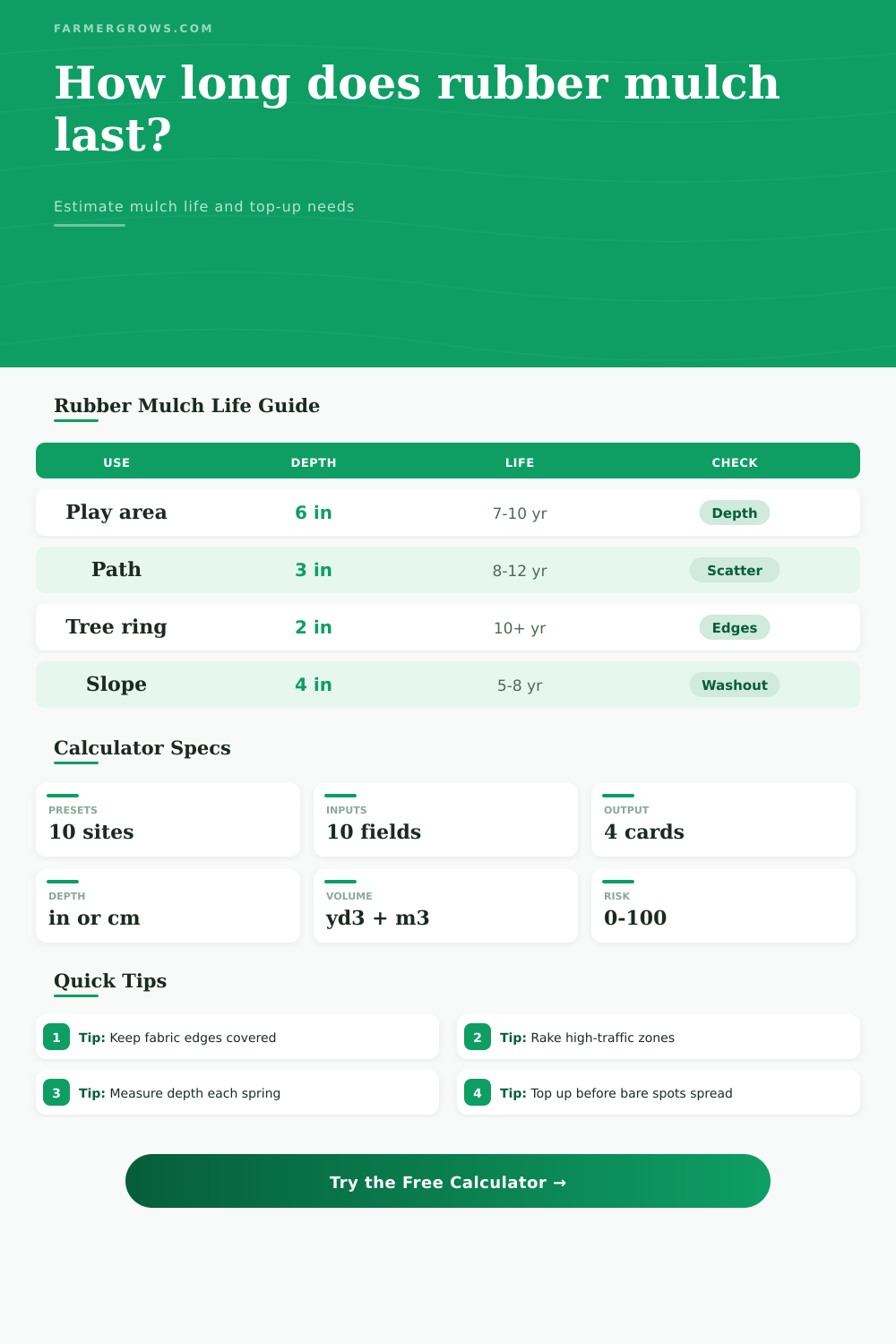
Life tip: Replacement is usually driven by color fade, exposed fabric, scatter, and depth loss rather than rubber breaking down completely. Better edging and routine raking can delay full replacement by several seasons.
The stuff doesn’t rot (like wood), but gradualy the colors bleed out and it frays at the edges and thins in coverage. And there you are, pouring all that rubber mulch on a bed, believing it to be forever, only to find yourself doing it again.
That’s when the calculator above come into play. It bridges gap between what you think will happen and what actualy happens. It turns that vague “I’m worried I’ll have bare spots” anxiety into solid numbers about how much to order, when to order it, and where risks are greatest. Before your eyes see the need for maintenance, you can already be planning ahead.
Why Rubber Mulch Needs Maintenance
The rubber mulch pieces is tough, most people assume that means they last forever. Nope: Not the same thing. They’re durable, but not long-lasting in terms of covering things. Rain moves them downhill, wind blows away lighter bits, and traffic (yes: people walking on it) pack down the layer.
To account for these natural actions, the tool ask whether your beds have foot traffic. It asks if they are flat or sloping, as rain will run off if there is a slope. Finally, it asks if they drain into another area or stay put. A flat-surface bed with snug edging holds mulch better than one that slopes and drains. This means you will top it up less often to keep uniform look, which makes big difference.
One data point matter most: depth. Unless it’s thick enough, rubber mulch doesn’t do what it was meant to do. What’s that? Insulate? Does it absorbs impact? It holds moisture in. You enter your existing average depth into the calculator, and then choose a target depth based off how you’ll be using it. For example, safety dictates six inches for a play surface; two may suffice for a decorative landscape bed. It isn’t all about aesthetics. It’s also about function.
Measure where things is shallow. The calculator tell you how much to add to bring everything back to the right level. Then, add a little extra for spillage or waste. When you spread it around, you’re going to lose some. Plan for that loss and avoid having to buy short. Frustration is not fun.
Another variable that impact the estimate is how old the installation is. If it’s a brand new bed, you’ll see virtually no wear; if it’s a five-year-old bed, you may be approaching the maintenance window. To consider the remaining life span of what’s under there, the tool take into account how many seasons the mulch has spent exposed to the elements (and to sunlight).
Rubber changes color well before it start crumbling, but that fading is usually just a sign to replace it rather than a sign that it is breaking down. Maybe your bed has full depth but a washed-out gray color that doesn’t match the plants anymore. The visual decline is part of the risk score calculated by the tool, and helps you know when the bed will begin to look like a neglectful afterthought.
The timeline gets much longer with maintenance habits: Regularly raking the bed (twice yearly) will redistribute the material and maintain an even layer. This will prevent compaction. It will also stop deep hollows from forming in high traffic areas and keep bare spots from spreading to nearby spots. Leaving it alone shortens its life; neglect speeds up compaction and scatter.
Time vs. The cost of replacing mulch is a trade-off. A little effort now would of saved a major overhaul later… Or so most people find. On that page they have all their data broken out into reference tables. The breakdown is based off depth and bag size. How much area does a standard bag cover? How thick do you want to put it on? Those conversion charts are handy for figuring out your budget.
Need more bags for a thin spot? Now you know exactly how many bag you’ll be lifting and carrying. Turn that random estimate into a shopping list. Know what you’re getting before you step out of the store. Weight, volume, and cost.
In the end, rubber mulch is a low maintenance option, but not a no maintenance one. Edges matter; so does depth. Use the calculator to help stay on the right side of the curve. Top up in advance before the problem becomes visible. Plan for color fade, before the wrong color steals your joy. It turns guessing into scheduling.
By treating it as something that changes over time, you get the best of both worlds. It is easy to care for and looks clean. Just watch the depth.