Round Bale of Hay Weight Calculator
Estimate as-fed bale weight, dry matter tons, total stack weight, storage shrink, and truck loads from round bale size, density, hay type, moisture, core tightness, wrap loss, bale count, and scale adjustment.
Choose a common bale size and crop profile, then edit the measurements and field conditions. Presets are named by diameter x width, baler density, hay crop, and typical handling situation.
Round Bale Weight Estimate
Results combine cylinder volume with crop, density, moisture, core tightness, storage shrink, wrap loss, bale count, and scale adjustment.
These multipliers help adjust a measured density target for different crops. Actual weight still depends most on bale size, baler pressure, moisture, and storage condition.
Easy to handle with smaller tractors. At 9 lb/ft³, expect roughly 450 lb before crop, moisture, and core adjustments.
Common livestock bale. Same diameter as a 4x4, but the extra width adds about 25% more volume.
A frequent full-size hay bale. At moderate density it often lands near 850 to 1100 lb.
Large field bale for higher tons per trip. Tractor, loader, spear, and trailer ratings matter.
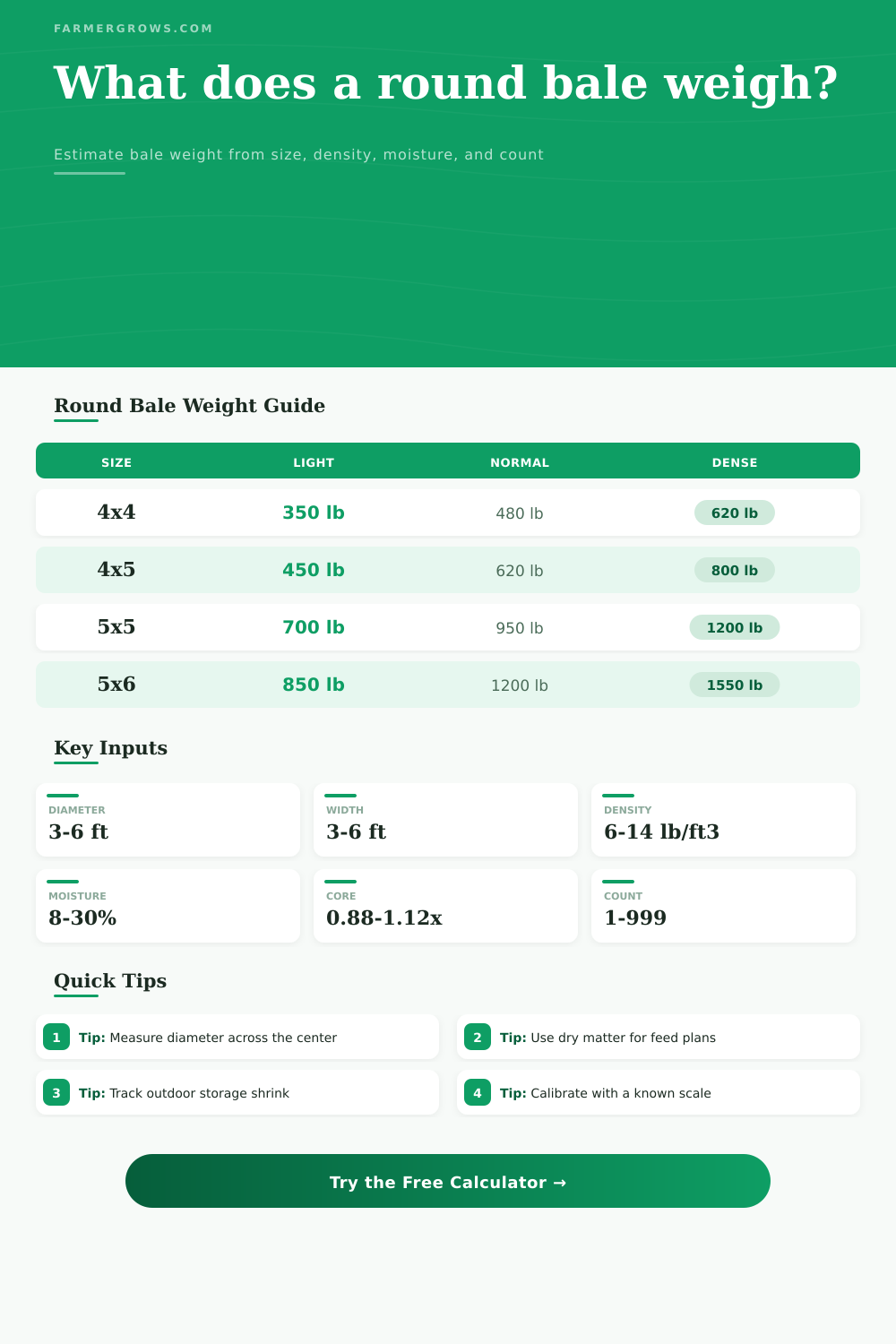
| Bale size | Volume | Light 7 lb/ft³ | Medium 9.5 lb/ft³ | Dense 12 lb/ft³ |
|---|---|---|---|---|
| 4 ft x 4 ft | 50.3 ft³ | 352 lb | 478 lb | 603 lb |
| 4 ft x 5 ft | 62.8 ft³ | 440 lb | 597 lb | 754 lb |
| 5 ft x 4 ft | 78.5 ft³ | 550 lb | 746 lb | 942 lb |
| 5 ft x 5 ft | 98.2 ft³ | 687 lb | 933 lb | 1178 lb |
| 5 ft x 6 ft | 117.8 ft³ | 825 lb | 1119 lb | 1414 lb |
| 6 ft x 5 ft | 141.4 ft³ | 990 lb | 1343 lb | 1696 lb |
| Moisture | Dry matter | Weight factor vs 15% | Best use in calculator |
|---|---|---|---|
| 10% | 90% | 0.94x | Very dry hay, lighter as-fed weight |
| 15% | 85% | 1.00x | Baseline dry hay density setting |
| 20% | 80% | 1.06x | Borderline damp hay, monitor heating risk |
| 30% | 70% | 1.21x | Wet hay or low-moisture wrapped forage |
| 45% | 55% | 1.55x | Baleage range, compare on dry matter basis |
| Storage condition | Shrink setting | Effect on usable weight | Notes |
|---|---|---|---|
| Barn stored, dry floor | 0% | Minimal storage loss | Best for feed value and outside layer quality |
| Covered outside | 3% | Small shrink allowance | Useful for tarped rows or wrapped dry hay |
| Well drained pad | 7% | Moderate outside loss | Leave air space and keep rows off wet soil |
| Outside on ground | 12% | Higher bottom spoilage | Common when bales sit through wet weather |
| Weathered long storage | 18% | Large feed loss | Use when outer shell is visibly damaged |
| Hauling target | Approx bales at 800 lb | Approx bales at 1200 lb | Use |
|---|---|---|---|
| 7000 lb utility load | 8 bales | 5 bales | Small trailer or short farm move |
| 14000 lb gooseneck | 17 bales | 11 bales | Check axle, tire, and tongue ratings |
| 20000 lb hay load | 25 bales | 16 bales | Typical larger farm hauling target |
| 48000 lb semi payload | 60 bales | 40 bales | Legal load depends on route and rig |
Measure the bale, not the baler decal. A few inches of diameter change can move the estimate sharply because cylinder volume uses radius squared.
Compare feed on dry matter. Wet bales look heavy, but animal feed planning is cleaner when the total is converted to dry matter tons.
Stand in the center of a field piled with round bales and you’re staring at a geometry problem masquerading as agronomy. Each cylinder appear similar but may weigh more if it’s been rained on for months, or differ based off the crop type and how it was baled. Before feeding that hay to cattle, or loading it onto a trailer, youd better know precisely how much you’ve got. By midwinter, a fuzzy estimate will result in either a disgruntled herd or a flipped pickup truck.
Fortunately, the math that makes that calculation, the volume plus the density… Can be done by calculator above. But what those inputs mean is where the money comes in. That’s what takes a heap of hay and converts it into something you can keep track of: an inventory item.
Why You Need to Know the Weight of Your Hay Bales
First and foremost, realize that volume drive the weight more than anything else. It may seem like common sense to say “a 5’x5’ bale weighs more then a 4’x4′ bale”, but there are two important points: one is a dramatic difference in weight between those two sizes and the second is a huge leap in volume. When it comes to cylinders (the shape of most hay), the volume increases with the square of the radius. This is why a bale that is really 5.5 ft instead of 5 will shoot your weight estimation sky high. The point being, don’t guess at how big the bales are by eye comparison and don’t trust the sticker on the baler.
The second big variable is density, which also isn’t always consistent. The thing folks often overlook is that a tighter core can weighs more while not altering its outer dimensions. While two bale might appear equal in size, the one that’s hard in the middle will be heavier for its size than a softer one. And the crop itself matters slightly as well: Alfalfa is denser (on average) than grass, due to both how it grows and the makeup of stems and leaves. Mixed hay is somewhere in between, and the tool actualy takes this into account with the base density for each crop you choose. So it doesn’t treats a heavy alfalfa bale like a light grass bale.
Another secret weight ingredient is moisture. The wetter your hay, the more weight you’re hauling and storing, but that’s just water, not food, so you’re shelling out money to carry and keep water when you purchase wet bales. To plan, the smart move is to convert all of the weight to dry matter tons, which removes the weight of the water from the equation and gives you an idea of how many tons of real nutrition you’re looking at. If you store your hay outside, you must also factor in shrink, as outdoor bales will lose some of the outside layer (due to wind and rain). The calculator allows you to enter the percent shrink of the storage area and estimate how much of the feed remains, very important if you want to do any kind of budgeting! You could assume you bought twenty tons, but once you remove the wrap and factor in spoilage, maybe you actualy only got eighteen.
Overloading trailers is not only unsafe but expensive, and there’s a hard limit to hauling capacity. How much do each of these bales weighs? Knowing this lets you load up safely. Can you figure out about how many bale will fit into your trailer without going past the axle rating? That’ll keep you mechanically safe and avoid any fines. It’ll also help when you’re negotiating purchases: if you know they generally weigh a thousand pounds or something, and you’re buying by the ton, then you won’t get ripped off paying more than necessary because your bales aren’t as heavy.
Those handy charts on the page gives you an instant sanity check of what those bales should be weighing. This is good for a quick reality check if things don’t add up. Keep good records of how much you have on hand. Knowing the amount of feed that’s available also makes those feeding decisions go smoother. Winter is long enough to not be thinking about running out of something in February, so knowing that you’ll have what you need for the month helps make the planning process go smoothly.
Figuring out weights accurately turns guessing into scheduling… Know when to buy more hay now, adjust your feed schedule, etc. It stops being about reacting to a shortage and becomes managing resources. It’s simple math, just enter a handful of variables (volume, density, moisture, loss factor) and instantly see your weight and inventory numbers for that pile of hay. You don’t need exact accuracy here…a couple percent under on the guess won’t hurt. But fifty percent will hurt bad.
This tool fills the void between eyeballing it and knowing exactly how much you have. Measure a bale. Adjust for the conditions and the crop. You would of ended up with a number you can bank on.
In short, managing hay with a yardstick is a money saver, both time and cash-wise. It’s something you know for sure in your operation; you can weigh it, count it and determine just how long it’ll last. The cylinder out in the field isn’t a mystery anymore, it’s something you can bank on. And that peace of mind is worth the several minutes it takes to do the math.