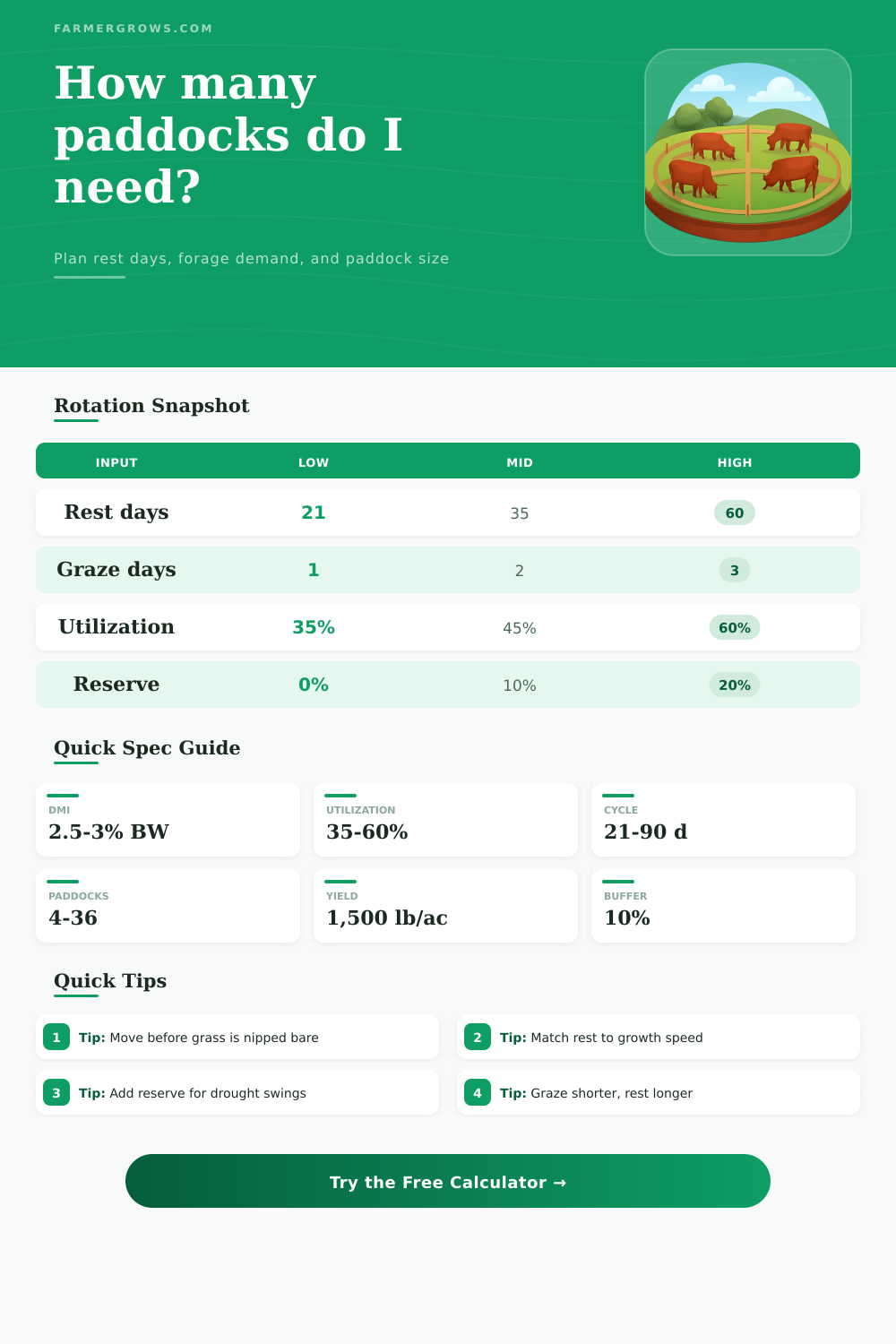
🌱 Rotational Grazing Calculator
Balance herd demand, rest days, paddock count, and forage supply so every move has a clear grazing target.
| Livestock class | Weight | DMI | Daily DM |
|---|---|---|---|
| Beef cow | 1,200 lb | 2.5% | 30 lb/day |
| Stocker calf | 650 lb | 3.0% | 19.5 lb/day |
| Sheep | 150 lb | 4.0% | 6 lb/day |
| Goat | 120 lb | 3.5% | 4.2 lb/day |
| Growth phase | Rest window | Move pace | Use when |
|---|---|---|---|
| Fast spring | 20-30 d | 1 d moves | Lush flush |
| Normal summer | 30-45 d | 1-2 d | Steady regrowth |
| Drought stress | 45-70 d | Short graze | Slow recovery |
| Stockpiled | 60+ d | Long rest | Fall carryover |
| Pasture condition | lb DM/ac | kg DM/ha | Grazing note |
|---|---|---|---|
| Short | 1,000 | 1,120 | Light pressure |
| Moderate | 2,000 | 2,241 | Balanced use |
| Strong | 3,000 | 3,361 | Good cover |
| Heavy | 4,000 | 4,482 | Short moves |
| Grazing days | Rest days | Min paddocks | Cycle length |
|---|---|---|---|
| 1 | 21 | 22 | 22 d |
| 1 | 35 | 36 | 36 d |
| 2 | 45 | 24 | 48 d |
| 3 | 60 | 21 | 63 d |
Rotational grazing is a land management method that involve dividing a pasture into paddocks. Animals is moved from one paddock to the next, allowing each paddock to rest and regrow its forage while the animals graze in another paddock. Rotational grazing is used because rotational grazing allow the plants to regrow and allows the roots of the plants to deepen into the soil.
Additionally, rotational grazing can increase the amount of forage that can be produced on a given amount of lands. It also help to improve the soil and the health of the grazing animal. The time that the animals are in each paddock is critical to the process of rotational grazing.
How to set up rotational grazing
If the animals are in one paddock for too long, the plant will be grazed down to the ground. If the plants are grazed too low, the plants will not be able to recover from grazing the animals. Therefore, short period of grazing, such as one or two days, should of be used.
The paddocks should be allowed to rest long enough for the plants to grow back. The length of the time that paddocks are allowed to rest can vary depending on the weather and the time of year. For instance, if the plants are being rested during a drought or if the weather is particularly hot during the growing season, longer periods of rest should be provided to the paddocks so that the grasses do not grow too slow.
In order to set up a rotational grazing system, the daily appetite of the animals must be calculated. The appetite can be calculated using the dry matter intake of the animals. For instance, many animals eat a certain percentage of their body weights in dry matter each day.
Stocker calves may eat 3 percent of their body weight in dry matter each day. Sheep may eat 4 percent of their body weight in dry matter each day. Because animals has different appetites, rotational grazing plans must be adjusted according to the different species of animals being managed in the rotational grazing system.
Another factor to consider in the rotational grazing system is the utilization rate of the pasture. The utilization rate is the amount of forage that the grazing animals eat. The utilization rate can never be 100 percent.
Some of the forage gets trampled by the animals, and the animals do not eat all of the forage in the paddock. A utilization rate of 35 to 60 percent of the forage in each paddock is target. The remaining 35 to 60 percent of the forage can remain on the ground to protect the soil and provide food for the microbes in the soil.
Additionally, 10 percent of the paddock can remain ungrazed to provide forage for the animals should there be a dry spell. The number of paddocks that are use in rotational grazing can be calculated by dividing the number of days that paddocks are to rest by the number of days that paddocks are to be grazed. For instance, if the plants require 30 days of rest but the animals spend 2 days grazing a paddock, many paddocks will be required to allow the rotational grazing system to function correctly.
Paddocks should not be used before the plants have rested and regrown there forage. If paddocks are used too soon, the plants will not be able to regrow and will eventually become weak and unhealthily. Some types of grass require different periods of rest than other.
Cool-season grasses, such as fescue or ryegrass, require 25 to 45 days of rest if the weather is average. However, cool-season grasses require 60 days of rest if it is particularly hot outside because the heat slows the growth of the grass. The grower should observe the growth of grass within the paddocks to ensure that rotational grazing is occurring at the appropriate rate.
If the residuals of the plants are too short, the animals should be move to a new paddock. Plant residuals are the parts of the plant that remain after the animals has grazed on it. The amount of leaf material on the plants should be maintained to a certain amount, such as 2 inches of leaf material.
If there is too little leaf material on the plants, the plants will take longer to regrow. Additionally, bare ground created by grazing the plants too low will lead to weeds and soil erosion within the paddocks. Fences can be used to contain the grazing animals to the paddocks.
Portable electric nets can be used to enclose the paddocks and allow for adjustments in paddock size if grazing animals or weather conditions changes. If there is a drought in the pasture, adjustments must be made to rotational grazing. The utilization rate of the paddocks should be decreased, and the rest periods for the paddocks should be increased.
Additionally, forage buffers within the paddocks should be increased to provide more forage for the grazing animals in case of a dry spell in which forage availability decreases. By following these suggestion if there is a drought in the pasture, the plants can be protected and the animals will have enough forage to eat. Overall, rotational grazing requires an understanding of the appetite of the grazing animals.
The number of paddocks in which the animals graze can be calculated by the rest and grazing periods of each paddock. The plant residuals within each paddock should be monitor. Additionally, adjustments should be made to rotational grazing according to the time of year and the weather.
By managing rotational grazing correctly, the plants will regrow, the soil will be improved, and the animals will have enough forage to eat.