Fruit Tree Spacing Calculator
Estimate tree count, rows, in-row spacing, pollinizer trees, replacement trees, orchard density, canopy fill, and mature harvest from a real planting block.
📋Named orchard presets
Use a preset as a realistic starting point, then adjust the spacing, buffers, pollinizer share, and replacement allowance for your site.
🌿Planting block inputs
Block dimensions are measured outside edge to outside edge. The calculator subtracts headlands and side buffers before counting tree positions.
Orchard layout results
Calculated for a 420 ft x 240 ft block with 12 ft rows and 4 ft in-row spacing.
Detailed spacing breakdown
📊Orchard metric grid
🔀Spacing comparison grid
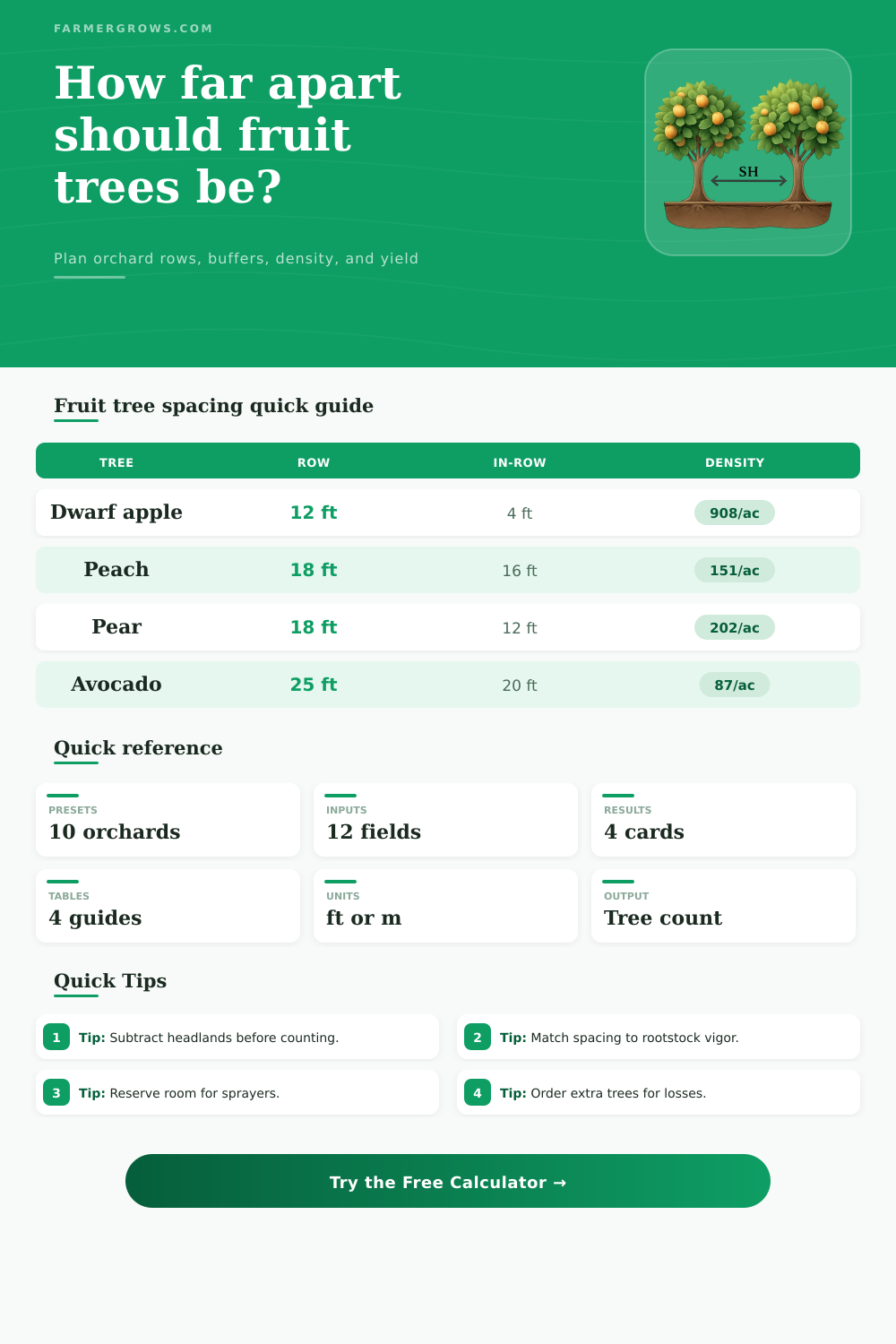
Compare the current layout against tighter, species-reference, and wider patterns. Density uses the center-to-center spacing formula: 43,560 divided by row spacing times in-row spacing.
Keep headlands outside the tree count when tractors, sprayers, bins, or mowing turns need clear space. Counting trees right to the fence usually overstates the order.
Dwarf, semi-dwarf, and standard rootstocks can change canopy width more than the fruit variety itself. Let the mature canopy and training system guide final spacing.
📘Reference tables
| Tree type | Row spacing | In-row | Typical use |
|---|---|---|---|
| Dwarf apple on M.9 | 10-12 ft | 3-5 ft | Tall spindle trellis |
| Semi-dwarf apple | 16-18 ft | 10-14 ft | Central leader |
| European pear | 16-20 ft | 10-14 ft | Central leader or trellis |
| Peach or nectarine | 16-20 ft | 14-18 ft | Open center |
| Sweet cherry | 18-22 ft | 16-20 ft | Standard or Gisela systems |
| Avocado | 20-30 ft | 15-25 ft | Hedgerow or wide canopy |
| Row x tree | Trees/ac | Trees/ha | Best fit |
|---|---|---|---|
| 12 x 4 ft | 908 | 2,244 | High-density apple |
| 14 x 6 ft | 519 | 1,282 | Compact trellis fruit |
| 18 x 12 ft | 202 | 499 | Pear or semi-dwarf apple |
| 18 x 16 ft | 151 | 374 | Peach, plum, apricot |
| 25 x 20 ft | 87 | 215 | Avocado or citrus |
| 30 x 25 ft | 58 | 143 | Mango or large canopy |
| Crop situation | Pollinizer share | Pattern | Note |
|---|---|---|---|
| Self-fruitful peach | 0% | Main cultivar block | Bees still improve set |
| Many apples | 5-10% | Every 3rd or 4th tree | Bloom overlap matters |
| Sweet cherry | 10-15% | Compatible rows or inserts | Check S-alleles |
| Pear blocks | 10-15% | Alternating rows or inserts | Varieties must overlap |
| Avocado A/B types | 10-20% | Mixed flowering type | Regional climate matters |
| Mango or citrus | 0-10% | Usually cultivar dependent | Local cultivar advice wins |
| Feature | Typical allowance | Why it matters | Calculator input |
|---|---|---|---|
| Headland | 15-30 ft | Turns, bins, gates | Headland buffer |
| Side fence | 8-20 ft | Canopy spread, mowing | Side buffer |
| Service alley | Every 8-12 rows | Harvest and spray access | Alley interval |
| Trellis setback | 3-6 ft | End posts and anchors | Headland buffer |
| Canopy clearance | 2-5 ft | Light and airflow | Spacing choice |
| Replacement trees | 2-10% | Losses after planting | Replacement buffer |
Spacing guides are planning references. Local rootstock performance, soil vigor, irrigation, pruning, slope, equipment width, and disease pressure can change the final layout.
When planning an orchard, one must plan for the size that the trees will reach in the future rather than the size of the trees when the growers purchased the trees. Many who begins there orchard with this second idea often find themselfs dealing with numerous problem that result from this initial mistake. For instance, if the trees are planted too closely together, the trees will begin to crowd one another as they mature, leading to stunted growth for those crowded trees.
Furthermore, the crowding of those trees will also lead to poor airflow to each tree, which can lead to the development of numerous fungal disease within the orchard. It is essential, therefore, that the grower finds a balance between the need for the orchard to contain many trees to provide a high yield of fruits, while also allowing for the trees to breathe and grow. The spacing within an orchard is not standardized to every type of orchard.
How to Plan Tree Spacing in an Orchard
Instead, the rootstock of each tree will determine how large the trees will grow. For instance, dwarf trees will remain small, while standard trees will grow into large trees. As such, the rootstock will dictate the spacing of the orchard.
Each leaf on the trees contain the chlorophyll necessary to perform the process of photosynthesis, which requires sunlight. If the tree’s canopy is too close to other trees canopy, the lower leaves will not receive the sunlight necessary to perform the process of photosynthesis. As a result, those leaves will cease to produce the fruit that they would of produced, leading to there eventual demise.
A mathematical calculation of the orchard can assist in determining the correct spacing for the orchard, avoiding guesses about the number of trees that should be planted into the orchard. While it is likely that the orchard will be divided into different area, the size of those areas is not the same as the number of trees that will be planted into that orchard. Divide the area of the orchard by the space that each tree needs to grow, and the result is likely to be an error.
A headland is the area within the orchard that is left open in the ends of the rows of trees. If the orchard is too narrow, there will not be enough space within those headlands to turn the orchards tractor or mower. Additionally, alleys are created within the orchard to allow for equipment movement between rows.
These alleys can be wider than those created by dividing the orchard into rows by dividing the size of the orchard by the space that each tree requires to grow. Without allowing for these alleys, the orchard’s equipment may not be able to move through the orchard. Another consideration of orchard planning is the consideration of pollinizers for the trees.
Many trees that are planted into orchards are not self-fruitful, meaning that each tree must contain a pollinizer tree to produce the fruits of that orchard. Therefore, both types of trees must be planted into the orchard. Additionally, many orchards will plant the pollinizer into one end of the orchard.
However, it is more efficient to distribute the pollinizer trees throughout the entire orchard. This way, the bees will be able to reach the flowers of the non-pollinizer trees. Furthermore, there must be a balance between the number of pollinizer trees and the number of non-pollinizer trees; too many pollinizer trees will reduce the yield of fruits from the orchard.
Another consideration for orchard planning is accounting for the fact that some of the trees will die. Trees may die from numerous factors, such as pests, bad grafts, or harsh winters. Therefore, if the orchard is ordered to contain the number of trees that the orchard will require, there will be no trees to replace the dying trees.
Ordering an additional buffer of trees that can die and be replaced will ensure that the orchard can maintain its professional appearance and remain complete with the orchard’s resources. Another factor in the growth of an orchard is the density and coverage of the canopy. The more trees that are included within the orchard, the more fruit that orchard can produce; however, too dense a canopy will lead to problems.
One problem of too dense a canopy is that the orchard will become a greenhouse for the trees; too much humidity will lead to diseases such as powdery mildew and aphids. Additionally, another issue with too dense a canopy is that the leaves will not be able to receive enough sunlight to perform the process of photosynthesis. Furthermore, if the orchard owner is aware of the mature diameter of the trees that will be planted into the orchard, the owner can analyze the canopy to ensure that the trees will not become too dense within the orchard.
If the trees become too dense, the owner will have to perform frequent pruning of the trees to allow the inner portions of those trees to receive enough sunlight to perform photosynthesis. As discussed, orchard planning requires the use of spatial geometry to find the number of trees that will be planted into the orchard, while accounting for the survival of those trees. Beyond accounting for rootstock, pollinizers, and buffers, the orchard owner is engineering the orchard.
An orchard that is planned with mathematics and logic will contain open headlands and alleys, with the proper spacing between the trees of the orchard. Furthermore, an orchard that is planned in such a manner will allow each tree within the orchard to reach its full potential.