Raspberry Plant Lifespan Calculator
Estimate how long a raspberry planting will stay productive from summer-bearing or fall-bearing habit, cane renewal, root crown age, trellis support, winter injury, disease pressure, and current productivity.
Load a realistic raspberry row profile, then adjust plant type, crown age, pruning system, cane renewal, trellis, disease pressure, winter injury, and observed yield decline.
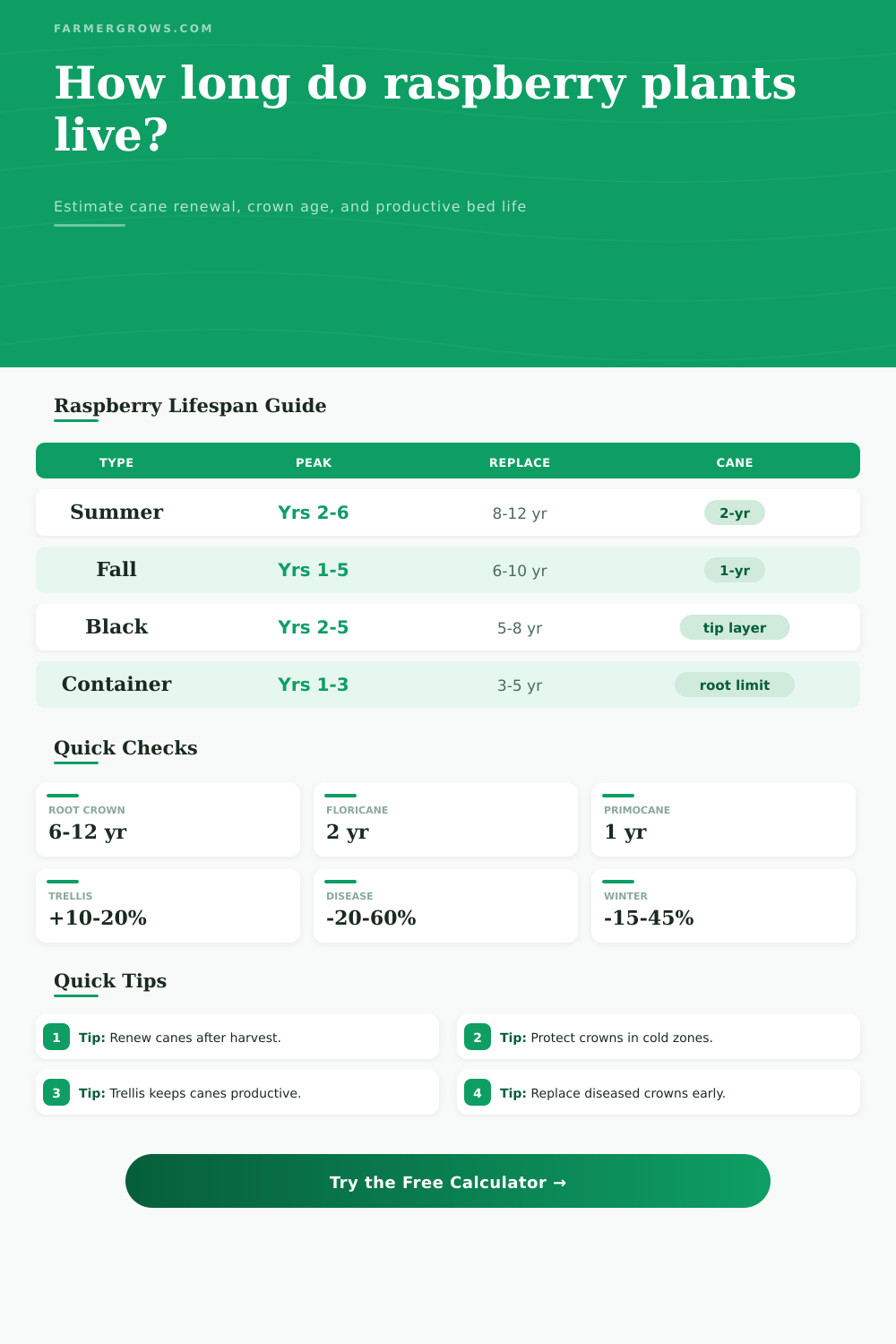
Individual canes fruit in their second year, but clean root crowns can keep a row productive for about 8 to 12 years.
Annual mowing simplifies renewal and disease cleanup, often giving 6 to 10 productive years when crowns stay healthy.
Canes need tipping, spacing, and airflow. Patches often decline earlier when anthracnose, cane blight, or winter damage builds.
Roots and crowns are exposed to heat, drought, and freeze swings, so useful life is usually shorter than an in-ground row.
Raspberry Lifespan Estimate
Adjust the inputs and calculate to estimate useful productive life.
| Raspberry type | Typical productive crown life | Main bearing cane | Lifespan notes |
|---|---|---|---|
| Summer-bearing red or yellow | 8 to 12 years in clean rows | Second-year floricanes | Needs spent-cane removal after harvest and steady primocane renewal for next year. |
| Fall-bearing red | 6 to 10 years | Current-year primocanes | Annual mowing lowers disease carryover and makes the row easier to reset. |
| Fall-bearing double crop | 5 to 9 years | Primocanes plus overwintered lower cane | More harvest windows, but more winter and cane-disease exposure than annual mowing. |
| Black raspberry | 5 to 8 years | Tipped canes with laterals | Usually shorter lived because cane diseases and winter injury build faster. |
| Container raspberry | 3 to 5 years | Depends on cultivar | Root restriction, hot pot walls, drought swings, and freeze exposure shorten useful life. |
| System | Remove | Keep | Why it affects lifespan |
|---|---|---|---|
| Summer-bearing | Spent floricanes after summer harvest | Strong new primocanes for next year | Old fruiting canes no longer produce and can hold disease. |
| Fall-bearing annual crop | Mow all canes dormant or very early spring | New primocanes from crowns | Simple reset reduces overwintered cane disease and winter-damaged fruiting wood. |
| Fall-bearing double crop | Remove fruited tips, then spent cane after summer crop | Lower cane for early crop plus new primocanes | Useful where winter injury is low, but more complex and disease-prone. |
| Black raspberry | Remove spent floricanes and weak canes | Tipped primocanes with spaced laterals | Airflow, tipping, and lateral spacing are essential for productive cane renewal. |
| Factor | Low risk | Moderate risk | Replace sooner when |
|---|---|---|---|
| Disease pressure | Clean canes and crowns | Some spotting or dieback | Cane blight, anthracnose, crown gall, or root rot is spreading. |
| Winter injury | Only light tip dieback | Some cane kill after cold snaps | Floricanes repeatedly die before fruiting or crowns heave out. |
| Row density | Open, thinned, and trellised | Hedge row getting thick | New primocanes are thin, shaded, or weak at the base. |
| Root zone | Well-drained loam | Occasional wet feet or compaction | Roots stay wet, containers overheat, or crowns rot. |
| Row condition | Keep one more year | Renovate and overlap | Replace now |
|---|---|---|---|
| Healthy summer-bearing row | Age under 6 years, strong primocanes, clean floricanes | Age 7 to 10 years with moderate thinning needs | Age 11 plus, disease, weak new canes, or repeated winter kill |
| Fall-bearing annual crop | Strong primocanes and clean crown line | Yield declining but crowns still pushing canes | Weak emergence, crown disease, or a row no longer filling space |
| Black or purple raspberry | Good laterals, open row, low cane disease | Moderate dieback but healthy renewal canes | Cane blight, anthracnose, poor tipping response, or severe winter damage |
| Container raspberry | Roots vigorous and mix drains well | Repot, root prune, or layer a replacement plant | Rootbound crown, freeze damage, or poor cane renewal |
Separate cane age from crown age. A raspberry cane is short-lived, but the root crown can keep producing new canes for years if disease stays low.
Prune by bearing habit. Summer-bearing rows need spent floricanes removed. Fall-bearing annual systems can be mowed to reset the cane cycle.
Trellis for longevity. Supported canes dry faster, break less, fruit more evenly, and are easier to thin to the right density.
Do not extend a diseased row. If crown or cane disease is active, start clean plants in a new site rather than layering infected material.
This calculator estimates useful productive row life, not the maximum age of every raspberry crown. Cultivar, local climate, soil drainage, rotation, pest pressure, irrigation, fertility, and winter exposure can move the result.
Raspberry rows are like trees: Most gardeners apply fertilizer each spring to these woody plants, yet only pay attention when harvest diminishe, as if to say, “Oh, I see; those canes have weakened.” What’s misunderstood (which isn’t exactly negligent) is how a raspberry plant lives it’s life: its stems turn over on a tight cycle, with roots remaining in place. It is the separation of short- and long-living parts, and a lot of folks gets lost counting down from 10.
You don’t have to guess whether your row is dying or peaking; just set your own growing conditions in the calculator above, and let it do math for you. It breaks down what percentage of plant is the age of its crowns (which may still push strong new canes each year, making it vigorous even at a decade old) versus the age of the wood bearing fruit, which does have a finite shelf life. Floricane summer-bearing raspberries fruits on two-year-old wood, while primocane fall-bearing varieties are most commonly on one-year-old wood. Prune incorrectly, and you’ll have stripped your crop long before harvest time rolls around.
How to Grow Healthy Raspberries
Think not only of protection, but also renewal. Planting a thick hedge of raspberries sounds like a good idea. However, it become unproductive when the interior turns dark and damp. This creates a space for disease that love shady conditions. Because close planting forces moisture on the canes from both sides, the tool looks at airflow and row density. It create a microclimate that promotes fast spread of cane blight and anthracnose.
Your soil may drain poorly, killing root growth despite all your perfect fertilizer applications. Just like drought is to succulents, wet feet is fatal to raspberries; the crown wants air. On top of all this, there is the variable of winter injury, which varies from one place to another. Canes that live through the winter produce in next summer (summer-bearing). If those canes gets killed back, you’re out that year’s fruit.
Those meant to produce in the fall (fall-bearing) can be mowed off in early spring or late fall. This resets the disease cycle and removes the worry about winter injury. It turns a several-year bet into something you decide every year. You give up some fruit potential but gain a healthier, cleaner-crowned plant. For many growers, that simplicity win.
Trellising is another optional factor. Without it, picking become a challenge. With it, supported canes holds up better when loaded with heavy fruit, and they also dry off more quickly after irrigation or rain. But perhaps most important, if you have no support, how do you possibly thin out well? You can’t manage what you can’t see. A thicket creates a space for pests and hides weaker canes from view. The longer the whole planting stands erect, the longer its productive life, which keeps things hostile to pathogens.
It’s never one date: It’s a sliding window of decline leading to replacement time. You’re noticing less bright flavor; the fruit itself may get smaller, or yields simply diminishes gradually over multiple years. That’s when the calculator comes in. It considers rates of winter survival and disease pressure to tell you when that gradual decline becomes a collapse. By then, you have probably had your head in the sand, planting in blind spots where the old root system is choked with virus or rot, causing new plants to fail.
RASPBERRY: If a row’s getting too old to fight for, plant alongside… And start again. Better that than fighting a losing battle in the row itself. With sweet fruit, renewal comes at a price of admission. Pay now and enjoy a hearty harvest, or pay later. Keep those canes young and the air circulating, and your roots will remember. Let them work for you. Thank yourself later, when your berry harvest is thick and red once more.