Raspberry Cutting Root Time Calculator
Estimate when raspberry cuttings will callus, show first roots, and become pot-up ready from cane type, cultivar group, media temperature, mist, hormone rate, and cutting quality.
Pick a real nursery-style start, then tune the cane condition, temperature, humidity, and hormone details to match your tray or bench.
Estimated Raspberry Cutting Rooting Timeline
Enter cutting and bench details to estimate the propagation window.
Best for late winter work with firm canes, bottom heat, and patient bench space.
Roots earlier under mist, but wilts quickly if humidity or sanitation slips.
Useful in late summer when shoots are firm but not fully dormant.
Uses root pieces from healthy plants and avoids leafy wilt during rooting.
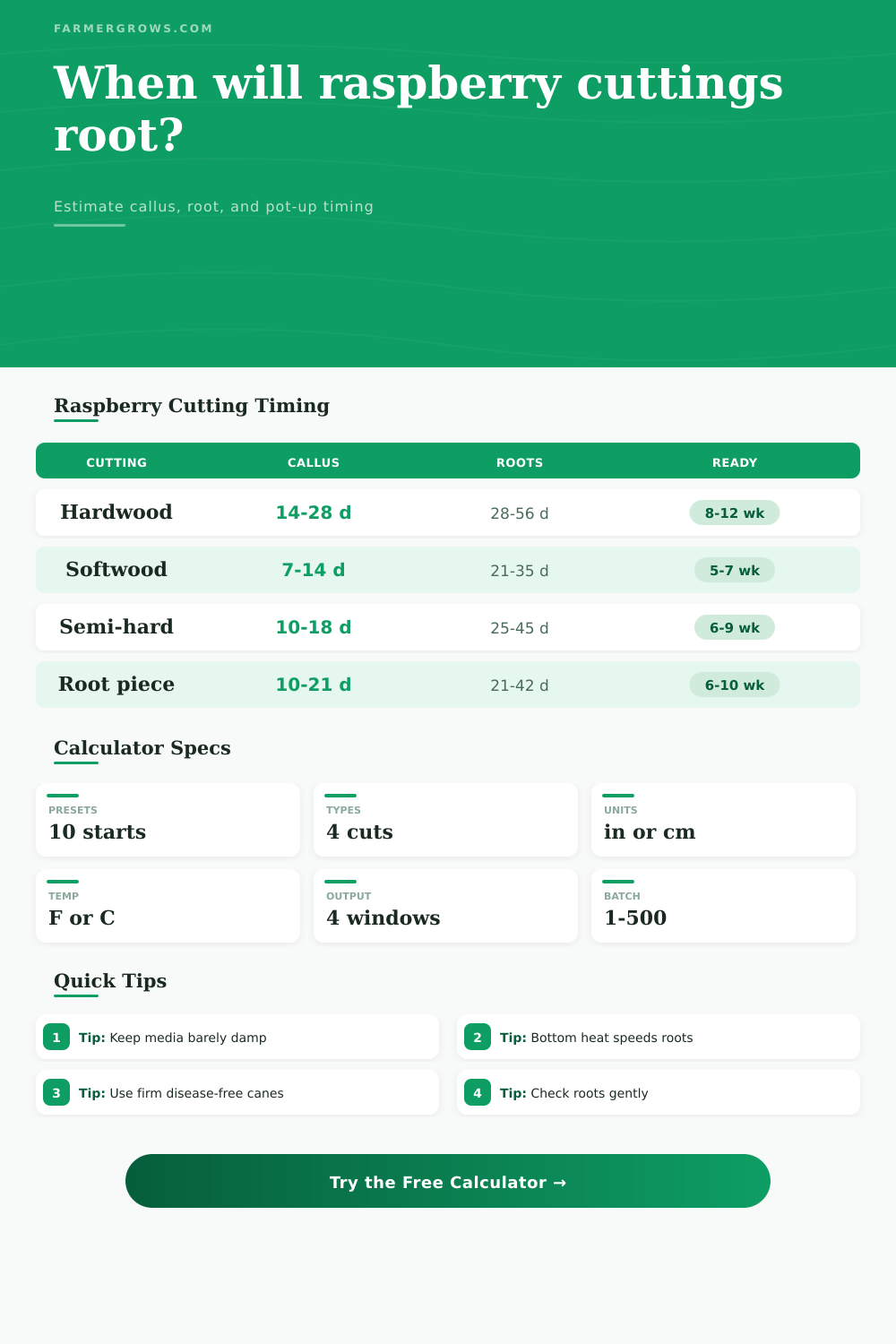
| Cutting type | Best collection stage | First root range | Pot-up range |
|---|---|---|---|
| Dormant hardwood cane | Late winter before budbreak | 28 to 56 days | 8 to 12 weeks |
| Softwood leafy tip | Spring to early summer active growth | 21 to 35 days | 5 to 7 weeks |
| Semi-hardwood cane | Late summer firm green cane | 25 to 45 days | 6 to 9 weeks |
| Root cutting segment | Dormant crown or nursery division | 21 to 42 days | 6 to 10 weeks |
| Media temperature | Rooting speed effect | Percent effect | Bench note |
|---|---|---|---|
| Below 60°F / 16°C | Add 12 to 18 days | Lower by 20 to 30% | Callus may stall before roots form |
| 60 to 67°F / 16 to 19°C | Add 4 to 10 days | Lower by 5 to 12% | Acceptable for dormant hardwood |
| 68 to 75°F / 20 to 24°C | Baseline or faster | Raise by 3 to 8% | Best general propagation target |
| 76 to 82°F / 24 to 28°C | Add 1 to 5 days | Lower by 5 to 15% | Watch rot and soft growth |
| Hormone and media choice | Where it fits | Rooting effect | Risk if pushed |
|---|---|---|---|
| 500 ppm IBA with softwood | Leafy spring tips | Moderate speed boost | Too much can blacken stems |
| 1,000 ppm IBA with semi-hardwood | Firm green cane pieces | Good all-around setting | Low risk in sterile media |
| 3,000 ppm IBA with hardwood | Dormant cane bases | Improves uniform rooting | Excess powder can burn tissue |
| No hormone with root cuttings | Root segments with buds | Usually adequate | Wet media matters more |
| Raspberry group | Typical response | Timing adjustment | Practical cue |
|---|---|---|---|
| Red summer-bearing | Moderate to good cane rooting | Baseline | Use pencil-thick dormant canes |
| Red everbearing | Often slightly stronger vigor | 1 to 3 days faster | Choose healthy primocane material |
| Black raspberry | Tip layering is usually easier | 3 to 7 days slower | Keep humidity high for leafy tips |
| Purple raspberry hybrid | Variable but workable | 2 to 5 days slower | Warm media helps even rooting |
Use the calendar as a check window. Raspberry cuttings often callus before they show usable roots. Inspect gently at the suggested interval so new roots are not torn from the basal end.
Change the inputs when the tray changes. A small shift in media temperature, leaf wetness, or cane diameter can move the rooting window by a week or more, especially with hardwood pieces.
Growing raspberries is mechanical work. Encourage the growth of new canes, then encourage those canes to grow roots. Tools like heat mats and calculators can be helpful, but success realy comes down to managing temperature and having patience.
If you’re impatient, as many raspberry growers are, checking too early will mean failure. Why? Because it takes time for the tissue to knit itself together into a root network.
How to Grow Raspberry Cuttings
By using a calculator, you can realisticly see how long something should of take. It accounts for factors that influence biological speedometer. No more guesswork! Now you can plan your space without worrying about it every day.
The most important variable that you have control over is the growing medium’s temperature. Since the roots grows upward from the ground, the temperature need to be warm enough to support enzyme action. A cutting might make it, but it won’t root if the bench temp is fifty degrees. For most types of canes, shoot for seventy-two degrees Fahrenheit. You can get that warmth from heat mats and they’re cheap.
Because this number is a key input for the calculator, it calculates the rooting window around it, showing you how many days you gain (or lose) depending on what you’ve got going. That translates thermal energy into calendar days so you can plan accordingly.
Roots take time to make their way into the growing medium; meanwhile, leaves face drying wind and sun. Because softwood cuttings have leaves, they easily dehydrates via transpiration. In dry air they will shrivel before roots ever take up water. To avoid this, high humidity stops evaporation. But never let them sit soaking wet: That’s a recipe for rot. They need to be humid but ventilated. Air matters (not drowning).
This balance is reflected in the tool. See where your humidity solution falls on the time scale. See why misting intermittently is less risky then an unventilated dome. Know why you shouldn’t seal up cuttings in plastic with no air circulation.
The type of wood matters just as much as the environment. That’s where the variety comes in. Hardwood cuttings are slow but tough; they will callus and then root slowly. Softwood tips is fast but tender; they root quickly but are fickle, failing at the slightest missed watering or exposure to hot sun. Semi-hardwood cuttings are a compromise between the two, striking a good balance between toughness and quickness.
Also consider your choice of hormones. Too low a dose won’t do anything; too high a dose burns tissue. According to references, you should match the amount of hormone used to the age of the wood so that the rooting trigger is provided without harming it.
Sanitation avoids infection. Sterile media and clean blades prevent fungal growth. Crushed tissue invites pathogens, so dull blade are bad. Sharp cuts heal cleanly. Reusing dirty trays reduces the success rate. Many growers do this but don’t realize why they get fewer results.
This figures out your estimated success percentage (based off all of the above). How many cuttings can you expect? It helps set realistic expectations for your number of plants. It is wise to start with a few extras since not every cutting survives.
There’s an art to knowing when to inspect: Tugging on a cutting to see if it resists means tearing new roots out of it. By waiting until the recommended interval, you’ll do less damage. When potting up, hold the cuttings by their white roots, which should be tightly anchored in the medium. Hurrying result in puny transplants. Letting the roots have time to grow strong leads to healthy plants.
The calendar will tell you exactly when to expect that to happen. It turns the uncertain wait into a well-planned schedule. No more guesswork; now it’s managed.
Growing raspberries from cuttings is all about energy management. There’s only so much energy in the stem. It has to fuel leaf growth, then start roots, and finally form callus. If one part stalls, no more gas in the tank, goodbye cutting.
To increase your chances, minimize stress. Keep things clean and the right humidity and temperature. Let the tool handle that for you. Follow the timeline, and let the roots form. Then watch a cane turn into a plant, and eventually you reap a bounty of new bushes.