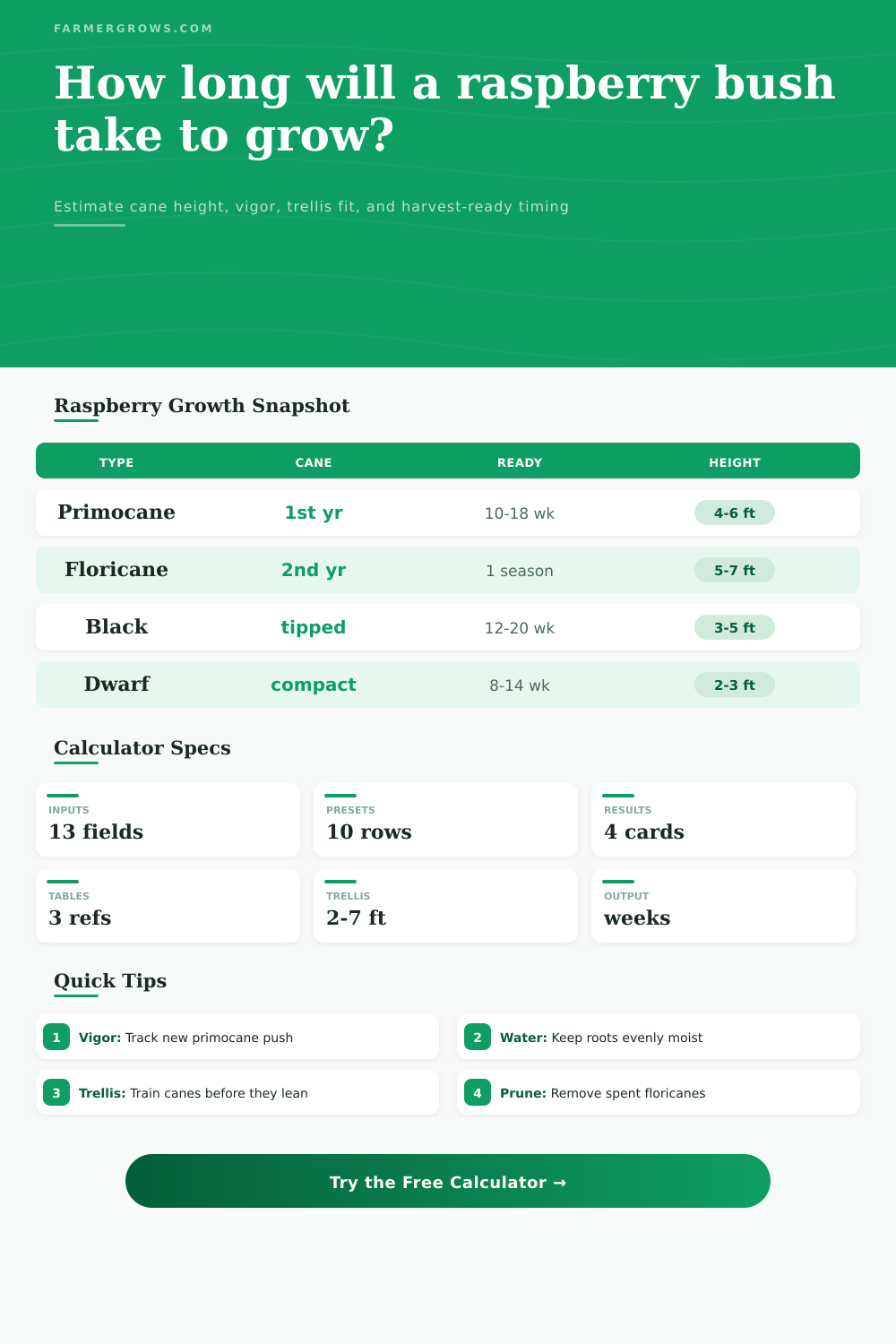
Raspberry Bush Growth Time Calculator
Estimate how long raspberry canes need to reach a harvest-ready height from current cane height, primocane vigor, cultivar, trellis height, soil moisture, fertilizer, pruning system, sunlight, and target cane readiness.
Load a realistic raspberry row, then tune cane height, cultivar, primocane vigor, trellis height, moisture, fertilizer, pruning, sunlight, and the target harvest-ready cane.
The calculator measures remaining cane extension from the current cane height to the chosen harvest-ready height.
Strong primocanes with good leaf color and thick bases grow faster than thin, pale, crowded, or drought-stressed canes.
A target taller than the trellis can still grow, but lodging and broken cane tips may reduce harvest-ready confidence.
Even soil moisture and steady fertilizer support cane extension; excess nitrogen can make tall canes less winter-ready.
Estimated Raspberry Bush Growth Time
Adjust the inputs and calculate to estimate harvest-ready cane timing.
| Raspberry type | Typical cane height | Growth pace | Harvest-ready signal |
|---|---|---|---|
| Fall-bearing red | 4 to 6 ft when vigorous | Fast primocane extension in warm weather | Sturdy upright canes with laterals or flower clusters near the tips |
| Summer-bearing red | 5 to 7 ft on floricanes | First season builds canes, second season fruits | Overwintered canes are tied, alive, and near trellis height |
| Black raspberry | 3 to 5 ft before tipping | Moderate, with arching canes | Canes are tipped, branched, and supported without crowding |
| Dwarf or container | 2 to 3 ft in compact forms | Shorter but often earlier to fill the target | Canes are firm, leafy, and matched to container support |
| Care factor | Fast growth condition | Slow growth condition | Calculator effect |
|---|---|---|---|
| Soil moisture | Evenly moist soil with mulch and drainage | Drought swings or waterlogged roots | Adjusts weekly cane extension and readiness confidence |
| Fertilizer | Balanced spring nitrogen plus organic matter | Low fertility or excessive soft nitrogen | Changes growth speed and cane-strength score |
| Pruning | Spent floricanes removed and primocanes thinned | Crowded row, late cuts, or heavy renovation | Adds delay or reduces confidence after severe pruning |
| Trellis | Top wire is close to target cane height | Target exceeds support height by a wide margin | Flags lodging risk and lowers harvest-ready confidence |
| Growth stage | Usual timing | What to watch | Management note |
|---|---|---|---|
| New shoots | Spring to early summer | Thin or uneven emergence | Keep roots moist and remove weak extras after strong canes are clear |
| Rapid primocane push | Late spring through midsummer | Daily wilting, wind lean, or pale leaves | Tie canes early and maintain mulch before heat stress arrives |
| Harvest-ready cane | Often 10 to 18 weeks after active growth | Height, diameter, bud formation, and support | Do not chase height alone if canes are too soft or crowded |
| Post-harvest renewal | After summer or fall picking | Spent floricanes and weak primocanes | Remove finished canes and leave the best new canes for the next cycle |
Measure the tallest usable cane, not a weak whip. A harvest-ready target should describe strong canes that can be tied, flower, and hold fruit without collapsing.
Keep moisture steady during cane extension. Raspberry roots are shallow, so drought during rapid primocane growth can add weeks even when the cultivar is normally vigorous.
Match pruning to the cane habit. Mowing works for a single fall crop on primocane types, but it removes next summer's floricane crop on summer-bearing rows.
Use trellis height as a practical ceiling. Canes may grow above the top wire, but unsupported tips are more likely to bend, snap, or shade neighboring canes.
This calculator estimates cane growth windows for planning. Local cultivar strain, soil depth, root disease, pests, winter injury, heat waves, and irrigation reliability can shift real raspberry timing.
When you plant raspberry canes, do you get worried that maybe it was too late to plant them in time for this seasons crop? Or perhaps you didnt prune back the mess of last years vines soon enough? When all those green shoots is up, staring you in the face, do you wonder if they’ll ever develop enough strength to bear fruit before flopping over and giving up the ghost from too-heavy fruit load?
Enter the calculator, above, where you simply insert your current measurements and let math be done for you. Plug in the numbers; no need to figure out any conversions or coefficients. Then determine: Is it worth waiting longer until they’re taller, or should I begin training the canes already?
When to Train Your Raspberry Canes
Because raspberries dont all grow alike, the tool requires you to feed it some variables. First: choose your cultivar. That establishes what to expect from base. A vigorous primocane type such as Caroline will take off at top speed and be sprinting toward the six-foot mark in no time. A heritage summer-bearing variety develops its structure gradually and may reserve its finest fruiting wood for year two. This genetic variation goes into the math and sets the calculators internal clock to match.
Rushing a fast grower? The wood will be weak and snap in the breeze. Chasing height with something that grows slow? Waste of energy, right?
The other input, the one most gardeners dont think about. Is vigor. Are they thin, pale canes? Or are they thick and luscious? Those that is actively photosynthesizing well will grow faster, of course. These have strong primocanes with solid bases and good leaf color. Choose weaker strength, and again, the tool adjusts the estimate upward to reflect: Plants grown under stress grow slowly and carefully. That’s what makes the difference between an eighteen-week cane and one ready to harvest in ten, sometimes. It helps you set your expectations appropriately without letting yourself get falsely hopeful on a struggling specimen.
Another big variable is that watering and feeding schedules change the timing dramatically. Because raspberry roots grows fast and shallow, they require steady moisture while they’re extending; every time yours dry out between drinks, growth stops in its tracks. Dryness or any other spotty water will be marked on the calculator as a negative that slows the expected pace of progress. Too much Nitrogen, meanwhile, may promote superfast canes upward, but create succulent tender tissue that’s structurally weak. The calculator factors in another tradeoff by alerting you that “tall is not necessarily ready.”
If its projection shows the canes has reached a height beyond what your trellis can hold, it warns, “These tips could be lodged (shading nearby crops) or unsupported.” This situation is less than ideal.
The pruning decision further narrows down the guesswork. Did you mow the whole row last fall to make harvesting easier? Now you’re starting from zero this spring. The calculator knows: Renovation means it’s back to square one. Or perhaps you allowed some floricanes to stand for a summer crop? In that case, the tool assumes you want to protect what you have in place… Not predict how tall it will get. And switches gears to calculating when existing wood is ready. All you have to tell it is whether you are dealing with overwintered canes or new ones, and it recalibrates the “ready” signal to account for that.
This does not mean it tries to fruit wood that hasn’t hardened yet. That’s all laid out nicely in the reference tables on the page. These tables list the typical height and timing for each type of raspberry. Most reds will be trained when they get up to three to five feet tall, which is about the time their laterals start forming properly. The dwarves gets there quicker, but dont go much beyond three feet no matter how well tended. Knowing what to expect keeps you from coaxing a dwarf as if it were going to get to seven. Instead you’ll appreciate the natural architecture of whatever variety you have and stop forcing it by watering and fertilizing more than necessary.
Timing, it turns out, boils down to confidence: confidence that this structure will hold up to a full crop. That’s where a readiness score comes into play, to confirm that not just the height but also the density of the cane is sufficient to bear weight. If canes are still so soft as to be floppy in the row (or crowded), you’ll do better by waiting for more height rather than chasing height at all cost.
Tie them early (before they’re leaning) and keep moisture constant throughout the push. Harvest promptly, removing any spent wood quickly. You want strong, self-standing growth, growth that proves itself on its own merits. Stop obsessing over the clock; watch the real thing and the schedule will take care of itself.