Rainbow Carrot Growth Time Calculator
Estimate harvest windows, mixed-color maturity, root diameter, thinning pressure, soil depth fit, and fall sweetness for rainbow carrot beds after the seed has emerged.
This planner is for rainbow carrot growth after establishment. It is intentionally different from a carrot seed germination calculator because it focuses on days to maturity, root size, thinning, soil depth, spacing, harvest size, and frost-sweetened flavor.
Rainbow carrot harvest plan
Enter bed details to estimate color mix maturity, root size, and fall sweetness.
| Color or variety type | Typical days to maturity | Color maturity note | Best harvest size | Soil depth fit |
|---|---|---|---|---|
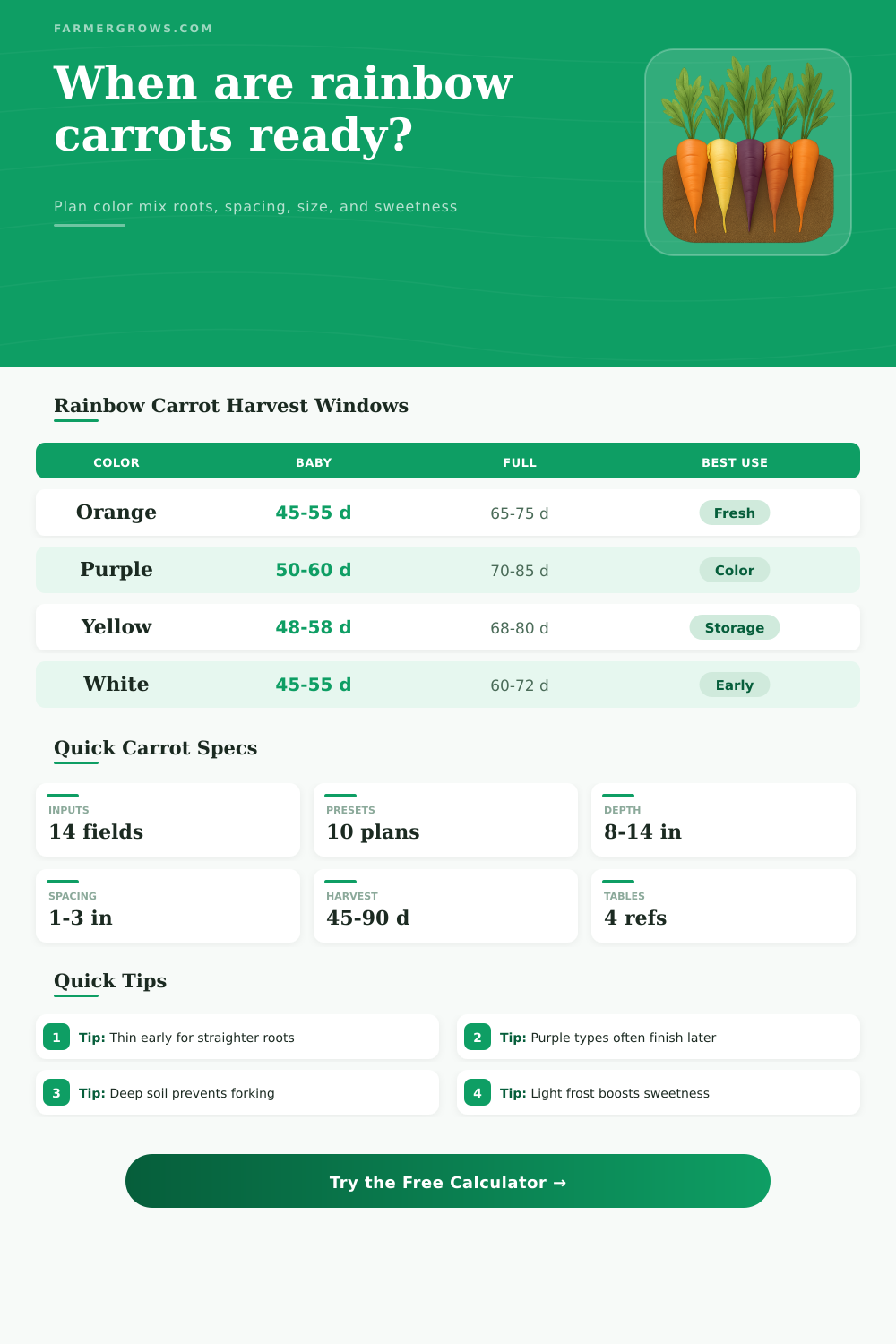
| Orange Nantes | 65 to 75 days | Steady orange color, dependable baseline. | 0.75 to 1.25 in shoulders | 9 to 12 in loose soil |
| Purple Haze / Cosmic Purple | 70 to 85 days | Outer purple color improves with full maturity. | 0.8 to 1.4 in shoulders | 10 to 14 in loose soil |
| Yellowstone / Solar Yellow | 68 to 80 days | Yellow roots hold well for storage pulls. | 0.9 to 1.5 in shoulders | 10 to 14 in loose soil |
| Atomic Red | 72 to 85 days | Red tone develops better with warm days and full sizing. | 0.8 to 1.3 in shoulders | 10 to 13 in loose soil |
| White Satin / Lunar White | 60 to 72 days | Fast pale roots can be pulled before slower colors. | 0.7 to 1.2 in shoulders | 8 to 12 in loose soil |
| Final spacing | Best use | Root diameter effect | Timing effect | Thinning note |
|---|---|---|---|---|
| 1 to 1.5 in | Baby rainbow roots | Small, tender roots | Harvest 10 to 18 days earlier | Thin early so roots do not twist together. |
| 1.5 to 2 in | Bunching carrots | Moderate shoulders | Near normal maturity | Good compromise for mixed colors. |
| 2 to 3 in | Full color mix | Best color and size balance | Normal to slightly later | Best for purple and yellow roots to finish. |
| 3 to 4 in | Storage roots | Large shoulders | May need 5 to 10 more days | Use only where soil is deep and moisture is steady. |
| Skipped thinning | Not ideal | Forked, thin, or tangled roots | Uneven harvest | Pull small roots first to open space. |
| Growth stage | Typical timing | What to check | Rainbow carrot action |
|---|---|---|---|
| Established seedlings | Day 14 to 25 | Even rows and weed pressure | Begin gentle thinning where clusters are obvious. |
| Pencil-leaf stage | Day 25 to 38 | First root swelling | Thin to target spacing before roots press together. |
| Baby harvest | Day 45 to 60 | 0.4 to 0.7 in shoulders | Pull whites and small orange roots first if crowded. |
| Full color | Day 65 to 85 | 0.8 to 1.4 in shoulders | Wait for purple and yellow roots if color balance matters. |
| Fall holding | After maturity | Soil moisture, frost, shoulder exposure | Mulch crowns before hard freeze and harvest as needed. |
| Fall condition | Sweetness effect | Harvest effect | Best move | Watch point |
|---|---|---|---|---|
| No frost yet | Mild, fresh flavor | Harvest by size | Pull baby and bunching roots freely. | Hot soil can dull flavor and texture. |
| 1 to 3 light frosts | Noticeably sweeter | Good final harvest window | Leave full-size roots a few extra days if soil drains. | Protect exposed shoulders. |
| Cool soil, no hard freeze | Best storage flavor | Roots can hold in bed | Mulch and pull through the window. | Wet soil can split roots. |
| Hard freeze risk | May damage tops and crowns | Harvest before deep freezing | Lift storage roots before the crown freezes solid. | Frozen shoulders lose quality. |
| Warm fall stretch | Less sweet, faster tops | Roots keep sizing | Water evenly and harvest once target diameter is reached. | Overmature roots can get woody. |
Color mix tip: Pull white and small orange roots early if the row is crowded, then give purple, yellow, and red roots more room to reach full color.
Root shape tip: Loose, stone-free soil matters more as harvest size increases. Deep beds reduce forking, especially for long purple and red carrot types.
Carrots are prone to being forked (not straight) if there is any stones in soil or if the ground is just plain compact. This is generally not your fault; it is usually caused by condition of the root-zone. A loose soil that will let taproot go straight down, without encountering an obstacle, is what’s needed. If the way are barred, the carrot still grows…but it turns this way or that, finding room to continue its growth. And what happens? It take an irregular form.
Plan ahead before planting seeds. Decide when to sow and how far apart to sow. Planning ahead is better then wishing you’d had better luck once they sprout. When you know what size bed(s) you have and plug those numbers into the calculator at top, it will do all the math for you, but if you understand why limits exist, you’ll be able to adjust accordingly if circumstances don’t perfectly align.
How to Grow Straight Carrots
While most gardeners obsess over the day of sowing, they ignore the fact that window for harvesting closes after first hard frost. In the time between planting and freeze, you want some number of cool nights, enough to transform starches into sugars while still leaving roots unharmed. That’s the sweet spot, and it depends on how long each color combination you’re growing take to mature at current soil temperatures. For example: White tends to beat out purple for getting its anthocyanin pigment up fast, so a single cut-and-come-again harvest date won’t suit the whole row of roots.
How deep is your soil? That’s another key variable. You know those long Nantes or Purple Haze types won’t work if you’re growing them in half a foot of dirt. No matter how gently you thin them, they will curl up into crescent shapes instead. By calculating soil depth against possible forkedness and anticipated root size, the tool takes that into account. Fine, deep loamy soil lets the taproot extend and fatten uniformly. Heavy clay or compact subsoil make it impossible for the root to reach down; it has to seek out air pockets, causing secondary roots to forms.
Since the soil is shallow, the calculator shows you might be better off planning for small plants instead of waiting until they are fully grown; this shift in expectations prevents disappointment when it is time to harvest.
This is where everyone gets nervous: Thinning. “But wait,” you say, pulling healthy green shoots, “the math say I’m too crowded.” True, but getting enough air between your plants is not just a matter of math; it’s also a matter of form. Crowded root vegetables will never get big, and the shape of their roots won’t be right either. Because their roots touch while growing, twisting or flattening against each other will cause them to grow misshapen.
How close should you plant? The chart on the page shows that the closer together they are, the later the harvest date… It depends directly on how much space you allow. Two or even three inches isn’t being generous; it’s structural. Roots want a place to expand to become rounded shapes we love, and if they can’t push away from each other, they’ll end up tangled at harvest time, which is not only messier than what you pulled out but harder to wash off.
How much (and when) it gets moist in the sizing period is just as important. Carrots has one major taproot that runs deep, and shallow side roots near the crown. When the subsoil remains moist, but topsoil dries out thoroughly, plants stress and might not grow, or even bolt. And if there has been a long dry spell followed by heavy rain again, the quickly expanding root can split from within, starting at the tip once more. Even moisture ensures a smooth and even cell expansion.
The moisture patterns you enter into the calculator will tell you whether your snacks will be brittle or if your storage roots will be clean. Carrots are sweeter when harvested in fall, no marketing-speak, but physiology. As the plant reacts to a slight frost (“Winter is coming, pump some sugar down into my roots,” it says; they act as antifreeze), they become significantly tastier than carrots pulled in summer. But there’s a difference between a damaging freeze and a sweetening frost: Ice forms in the carrot’s crown (or the soil gets too cold), and things go downhill fast. If you know the date of your earliest possible frost, you can plan to harvest right before it to get best flavor without damaging the quality.
With rainbow carrots, more so than anything, it’s not about waiting; it’s about both waiting…and not waiting: About having some patience, and also knowing when to move aside and make some room for something else. Because each of the various hues takes a little longer (or shorter!) to come on, they’re best staggered, not all pulled in one fell swoop. Early-pulling white ones may leave behind enough space for slowly coming-on reds and purples to catch up with their color, for example. Staggering the harvest means keeping that bed productive. It also means ensuring no roots outstay their welcome and get woody.
Use one simple sowing date and then a more careful harvest schedule; the difference comes in what you do between the two. Give the carrots enough room. They’ll know just what to do.