Rain for Garden Calculator
Convert a measured shower into gallons, liters, useful infiltrated water, target coverage, and remaining irrigation for vegetable beds, raised beds, rows, and small garden plots.
Choose a common garden rain situation, then adjust the rainfall, bed shape, soil, mulch, crop stage, runoff, infiltration, and weekly target to match your plot.
Garden Rain Results
Measured rain converted to useful garden water.
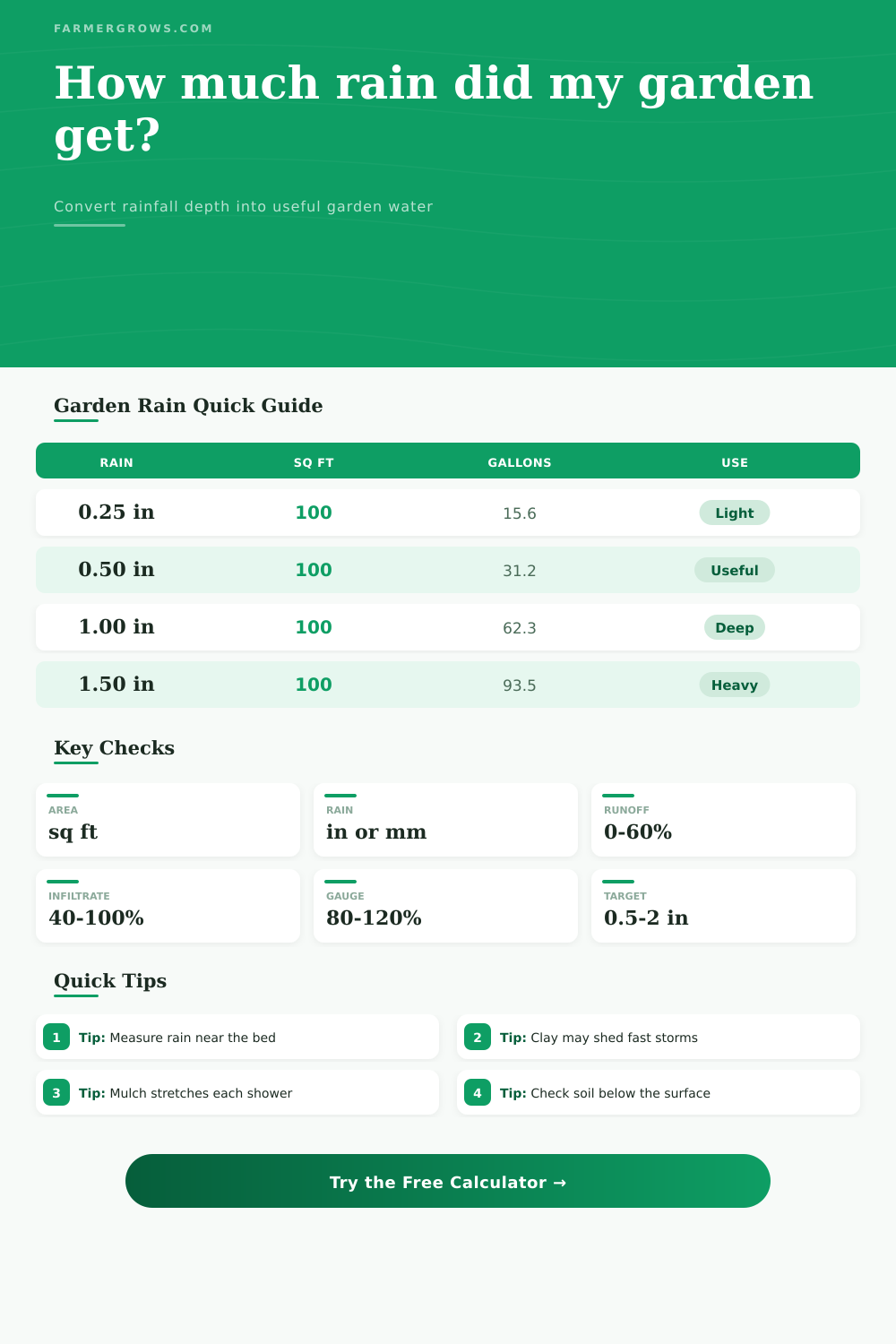
A depth of 1 inch over 1 square foot equals about 0.623 gallons. Use this grid to compare common rainfall depths before soil losses.
About 6.2 gallons per 100 sq ft. Usually wets leaves and mulch more than the deeper root zone.
About 15.6 gallons per 100 sq ft. Helpful for seedlings but often short for fruiting crops.
About 31.2 gallons per 100 sq ft. Often enough to delay irrigation when infiltration is good.
About 62.3 gallons per 100 sq ft. Close to a common weekly target for many vegetables.
| Condition | Typical runoff | Root-zone infiltration | Calculator note |
|---|---|---|---|
| Flat raised bed, loam, gentle rain | 0 to 8% | 85 to 95% | Most rainfall can be counted if soil was not already saturated. |
| Freshly planted bare soil | 5 to 15% | 70 to 90% | Surface sealing or crusting can reduce how much reaches roots. |
| Sloped bed or compacted path edge | 15 to 35% | 55 to 80% | Use higher runoff when water visibly leaves the bed. |
| Clay soil during a fast storm | 25 to 60% | 40 to 70% | Heavy rainfall can exceed intake speed even when total rain is high. |
| Sandy bed after dry weather | 0 to 10% | 65 to 85% | Water enters quickly but may move below shallow roots sooner. |
| Input choice | Useful water effect | Best use | Watch for |
|---|---|---|---|
| Sandy soil | Counts less for shallow roots | Herbs, carrots, early beds | Fast drainage after rain ends |
| Loam or silt loam | Balanced storage and infiltration | Mixed vegetable gardens | Surface crust if left bare |
| Clay loam or heavy clay | Stores water but sheds fast rain | Established crops with mulch | Runoff during hard storms |
| Medium organic mulch | Reduces weekly top-up need | Tomatoes, peppers, cucurbits | Dry mulch can absorb first light rain |
| Plastic or fabric cover | Rain may miss the root zone | Drip-irrigated production rows | Edges collect water unevenly |
| Crop stage | Target multiplier | Typical weekly depth | Rainfall interpretation |
|---|---|---|---|
| Seedlings or new transplants | 0.70x | 0.5 to 0.8 inch | Frequent small rains help, but surface drying still matters. |
| Leafy vegetative growth | 1.00x | 0.8 to 1.1 inches | A 1 inch week is usually a good planning baseline. |
| Flowering or fruit set | 1.15x | 1.0 to 1.4 inches | Moisture swings can reduce fruit set and quality. |
| Heavy fruiting or bulking | 1.30x | 1.2 to 1.8 inches | Tomatoes, squash, melons, and potatoes often need more. |
| Mature or finishing crop | 0.85x | 0.7 to 1.0 inch | Some crops can taper water near harvest. |
| Garden size | 0.25 inch rain | 0.50 inch rain | 1.00 inch rain |
|---|---|---|---|
| 4 x 8 ft raised bed, 32 sq ft | 5.0 gal, 18.9 L | 10.0 gal, 37.7 L | 19.9 gal, 75.5 L |
| 10 x 10 ft bed, 100 sq ft | 15.6 gal, 58.9 L | 31.2 gal, 117.9 L | 62.3 gal, 235.8 L |
| 10 x 20 ft vegetable plot, 200 sq ft | 31.2 gal, 117.9 L | 62.3 gal, 235.8 L | 124.7 gal, 471.5 L |
| 20 x 30 ft garden, 600 sq ft | 93.5 gal, 353.6 L | 187.0 gal, 707.3 L | 374.0 gal, 1414.5 L |
Gauge placement: Set the gauge in an open spot near the garden, away from roof drip lines, shrubs, fences, and sprinkler overspray.
Root check: After rain, push a trowel 4 to 6 inches deep. If soil is dry there, count less of the storm toward the weekly target.
Rain is A possible source of water for your garden, but unless you know how much you’re getting on the ground where plants’ root zones are, you can’t count on it at all. You don’t need to stand out in the rainstorm to know if your soil is soaked: It might have run off; it might have evaporated from open ground. Knowing the difference between how much rain falls and how much water actualy reaches your garden will help you decide when to water it yourself.
When you input your rainfall data and bed dimensions, the calculator does the rest of math for you. No need to guess at the infiltration rate. Begin by inputting size and shape of your bed. If you have a typical rectangular raised bed, that’s fine. If you are working with a triangle or a circle (a tree ring perhaps?), area will be different. Input these dimensions, as it’s the surface area that determines how much water you’re working with.
How to Check if Rain Helps Your Garden
Sixty-two gallons of water weighs as much as a full bathtub, so you know what? It’s a lot of water if it doesn’t infiltrate in the soil. Most home estimates fail to take into account mulch and soil type adjustment. Clay soils holds onto water very well, but repel large volumes of rain fast. Sandy soils allows water to soak right in and drain down to groundwater before shallow roots get time to grab it. The tool corrects for this by allowing you to adjust infiltration percentages. Bare soil… Particularly if it’s been parched out, will seal over, creating a crust so that when it rains, it simply runs off rather than soaking in. Mulch serve as a buffer to break the force of falling raindrops and keep topsoil porous. Organic mulch at an intermediate thickness (not too thin or thick) reduces runoff loss and increases amount of water actualy available to plant.
Why? Water requirements varies throughout the season. A tomato seedling want a steady supply of very shallow watering to get its footing, while a mature fruiting tomato likes deep regular drinks to avoid blossom end rot and other troubles. Depending on the phase of growth (vegetative or fruiting), the calculator knows to modify each week’s goal accordingly. One-quarter inch of rainfall may be sufficient for the seedling, but won’t come close with a summer squash at midseason. Know what your crop demands that week.
Runoff means less water actualy reaches your plants’ roots. Water may also run off edges, even into flat beds, though this happens less often. It can also be lost through compaction on a path. However, the problem is much worse if there is a lot of runoff based off a slope. You won’t see a drop of that runoff coming down a hill hit your plants’ roots. By increasing the runoff percentage in the tool you’ll get a real-world approximation of how little remains. Better to overestimate runoff than to presume all gets absorbed perfectly. On page is a table of typical percentages of loss for various types of soils, so that you can judge if your parameters seem believable.
The other thing is where to place gauges. You don’t want to use one positioned beside a high fence or beneath a roof eave with its own rain bucket. That’s not representative of what falls on the garden, because the structure blocks or funnels around some rain. You’re aiming for an open space that catches sky overhead. If you depend on the local station data, keep in mind that there is microclimates. In your back yard, you may have gotten a half-inch of rain; across the street at the neighborhood’s data-gathering gauge, they got a whole inch. The tool lets you correct for that so your baseline is right.
There’s nothing like free irrigation in the form of rain, but only if you can catch it. The conversion of inches of depth to gallons, then adjustment for the physics of the soil, turns off the guesswork. Suddenly, you begin to see your garden as a system (of input and output). You’re watering with intention, trusting what the tool says you’ll need to add, even when it says you’ll need to water another half-inch yet. You’ve factored in the runoff, the mulch, and the clay. The next time it rains, you’ll know exactly how much water your plants held onto.