Radish Seed Viability Calculator
Estimate usable radish seed from a fast germination test, packet age, storage, target bunches, succession row length, final spacing, seed count per gram, and bolting-season risk.
📋Radish sowing presets
Choose a radish seed lot and harvest plan: fresh spring rows, weekly market bunches, old seed rescue sowing, daikon spacing, micro succession beds, and hot-season bolting pressure.
🌱Seed lot and fast germination test
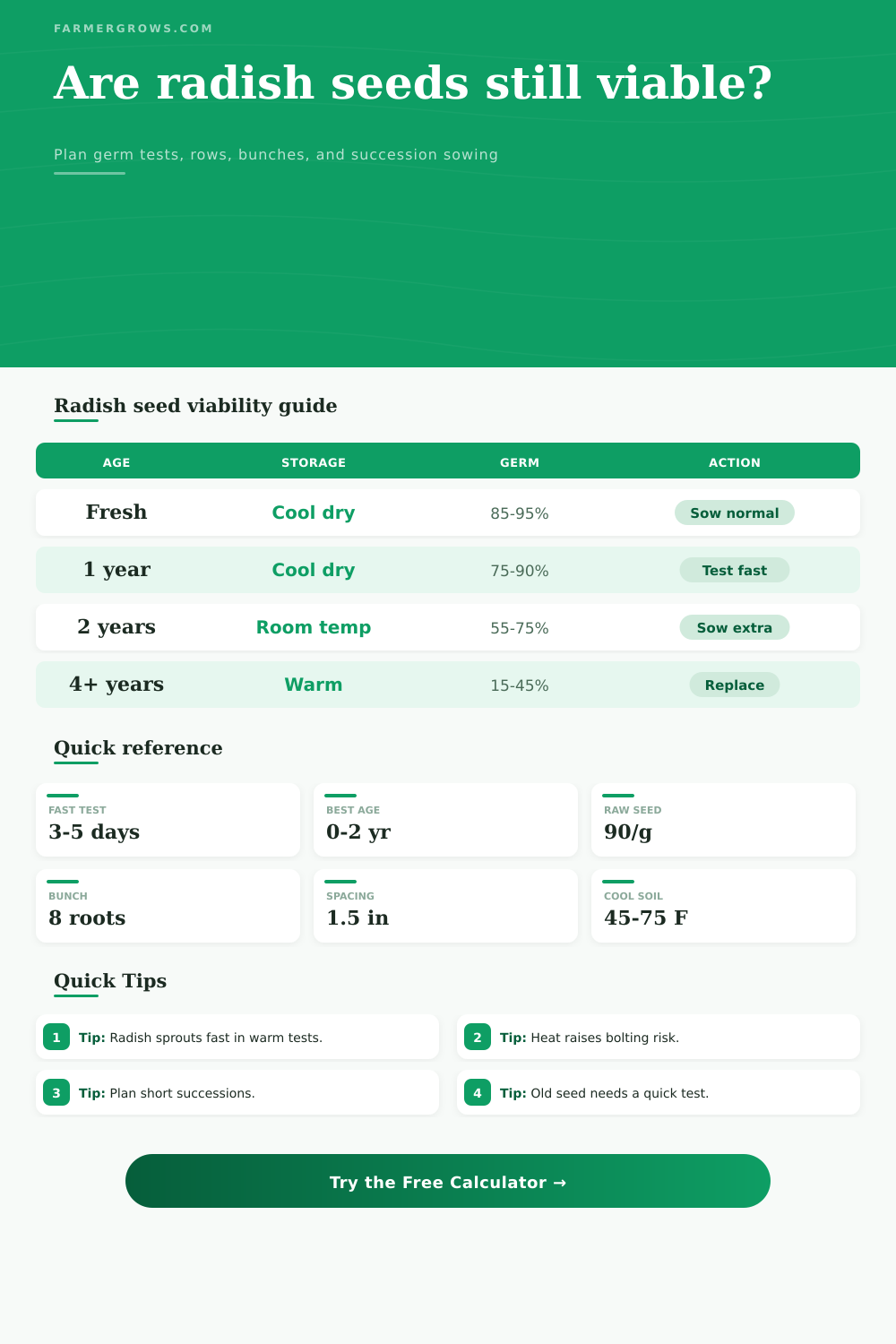
Radish seeds usually reveal viability quickly. Use a towel test or tray test for 3-5 days, then combine the result with seed age and storage condition.
📏Bunch target and succession row length
Plan radish rows from the harvest backward. Enter target bunches, roots per bunch, number of sowings, row length, and final spacing after thinning.
⛅Field emergence and bolting season
Radish seed germinates fast, but hot or lengthening days can send plants to tops, pith, or bolting before roots size evenly.
Radish seed viability results
Calculated from your fast germination test, seed age, storage, bunch target, row length, spacing, successions, and bolting season.
Calculation breakdown
📊Succession and harvest summary
📘Radish seed reference tables
| Seed age | Cool dry | Room temp | Warm or humid |
|---|---|---|---|
| Fresh | 85-95% | 80-92% | 70-85% |
| 1 year | 75-90% | 65-82% | 50-70% |
| 2 years | 60-82% | 45-70% | 25-55% |
| 3 years | 40-65% | 25-50% | 10-35% |
| 4+ years | 20-45% | 10-30% | 0-18% |
| Radish type | Thin to | Rows | Bunch roots |
|---|---|---|---|
| Round spring | 1-2 in | 6-8 in | 8-10 |
| French breakfast | 1.5-2 in | 6-8 in | 8 |
| Elongated salad | 2-3 in | 8-10 in | 6-8 |
| Daikon | 4-6 in | 12-18 in | 1-3 |
| Mixed bunch | 1.5-2 in | 6-8 in | 8 |
| Condition | First check | Final count | Meaning |
|---|---|---|---|
| Warm towel | 2 days | 4 days | Fast vigor |
| Cool tray | 3 days | 6 days | Spring soil |
| Old packet | 3 days | 7 days | Use final |
| Daikon lot | 2 days | 5 days | Large seed |
| Weak sprouts | 4 days | 7 days | Add buffer |
| Season | Factor | Risk | Adjustment |
|---|---|---|---|
| Cool fall | 0.95 | Low | Sow normal |
| Cold winter | 0.88 | Low | Slow growth |
| Late spring | 0.78 | Medium | Short rows |
| Hot long days | 0.60 | High | Skip or shade |
| Greenhouse | 0.85 | Medium | Vent early |
Radish seed that fails to sprout strongly in a short warm test is unlikely to make an even market row without extra seed.
Heat can ruin radish quality even with good emergence. Use smaller successions or pause sowing when hot long days arrive.
Calculator results are planning estimates for direct-seeded radish. Variety, seed treatment, soil temperature, irrigation, pests, day length, and harvest timing can change actual stands.
Sow radish seed? Two weeks later, nothing but bare ground. It was garden heartbreak. Again. Each year, you reach into a drawer or a warm shed and pull out a couple of packets; from two seasons past, and hope they will cooperate. Radishes aren’t immortal seed; in fact, their vigor fade gradually over time. This usually happens long before its sell-by date on the label.
A little test of viability now will spare you the sight of your bare soil when everyone else’s is producing crisp roots. The easiest way to determine exactly how many seeds will sprout is to run a quick germination test. You do not need laboratory. Simply take a known number of seed, fifty will do, and lay them out on a damp paper towel and keep them warm. Within four days, count the ones that sprouted; if it’s forty-four, you’ve got about eighty-eight percent viable seed, that’s a good beginning.
How to Test Your Old Radish Seeds
But there is more to the story. The germination test doesn’t account for the details of where your seed has been stored. Seed left in a hot garage won’t behave the same way as seed stashed in a cool dry cabinet. A seed that appear plump and healthy to the naked eye may be nearing the end of its shelf life, but its decline will only speed up once heat are applied.
To plan out your sowing strategy, think backwards from what you want to harvest: For salad greens, most of us want either a succession of rows (or even just one longer row), or smaller bunches. How much space do you have for growing them? Will you be sowing more than once during the season?
Radishes develop quickly, which is both a blessing and a curse. They may bolt by sending up a flower stalk or become pithy if the days becomes too long or the soil temperatures gets too warm as the crop develops.
The tool factors in the number of sowings, desired plant-to-plant spacing and desired row length, then tells you how much seed to order, in total, with a buffer for losses in the field, since lab germination doesn’t translate directly into actualy dirt. And then there are the inputs. When sowing radish seed, do you want wide-spaced ones (like daikon), or compact ones (round spring radishes)? The number of seeds per foot will be quite different than.
If you plant a large seed, like a long white root type, using the spacing meant for smaller seeds, you’ll have a whole bunch of stunted little plants instead of anything resembling their true potential. The calculator knows about such things. It takes into account the season, too. A later-planted crop faces more chance of heat stress and following bolting than an earlier one. To make up for that potential problem, it suggests you sow a little more seed or make your rows slightly shorter.
Start growing now. Not all old seed is bad seed. If it’s cool and dry, radish can last up to four years, for instance. But old seed will sprout more weakly and slowly; once it loses its strength, it also loses its consistency. Gaps and tiny survivors populates your row, creating a mess. To see what happens to viability over time under various storage conditions, check out the reference tables on the page. Seed in a sealed fridge lasts longer than that in an open packet left at room temperature, for example.
Before committing your garden beds to it, its worth checking your old stock. The numbers reassure you: Yes, there’s plenty for this week and next and yes, I’ll have to reorder, etc.; how many rows do I need to plant, how many seeds do I need? They’re not guesses anymore; they’re a plan.
You won’t have to second-guess whether the seed is still good or if it is time to reorder. The math answers that question with a yes, still good, go grow, or no, toss, time to order more. Planning also saves seed, saves space, and best of all, keeps us from feeling let down at the end of the season when everybody else was picking something out of their empty beds. You should of checked sooner.