
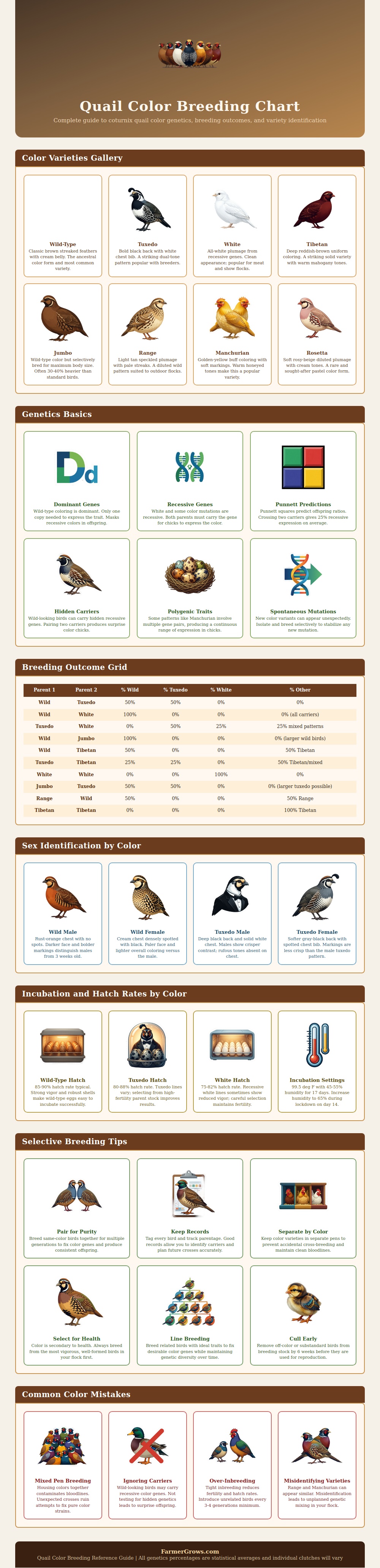
Quail color breeding seems straightforward initially, yet once you realize how many possibilities sits inside a single pair of birds, it quickly evolves into an elaborate endeavor. The motivations is pride in establishing a particular appearance, improved marketability for meat or egg sales, and diversity among your herd for visual interest.
It’s not random. As you can see from the chart (above), this has an effect on offspring created when parents mate. For example, it explains why mating two wild-type birds typically results in mostly wild-type babies. It also explains why mating one wild-type bird with one carrying a recessive color (such as white), will result in hidden carriers. These is birds who appear normal except that they have passed along the recessive color. When you mate two carriers, about a quarter of the babies will be the recessive color. (That’s the basic pattern of recessive genes.)
How Quail Colors Work
It also explains why some patterns are unpredictable based off what they’re mated with, like Tuxedo. Others always turn out the same, whether you mate them with themselves or someone else, such as solid colors like Tibetan. There’s no need to commit all the rows in the grid to memory, just know the general principle. Recessive genes is hidden but get expressed if both parents carry the gene. Dominant genes express themselves easy. Knowing the difference makes the rest of it much more strategic.
Most birds in a mixed flock will have wild-type coloring (which is the dominant gene), and they’ll carry whatever else under there (but unless you keep records), you may never know what’s lurking. Good if you’re trying for really vigorous birds, not so good if you don’t want your birds wandering into weird coloration. Most people miss this: even if a heterozygous bird looks normal, it still passes on recessive genes. Again, the genetics section spells this out.
The same applies to sex identification. In terms of color patterns (the chart), males and females displays the same pattern in different ways, most notably in their chests: Males develop a rust-orange chest without spots; females show dense black speckling on a cream background. Same for tuxedo birds, only more pronounced. Knowing this sooner means you don’t set up a breeding pair that will fail to yield what you hope for.
Incubation success can also differ between colors. Some recessive colors has lower vigor because of the extra color genes, so they occasionally have a slightly lower hatch rate than wild type eggs. So what does that mean? Don’t rule out Tuxedo birds or white birds for example. Just pay closer attention to picking your breeding stock if you are using one of those color lines. Choose from parents who has demonstrated fertility, rather than assuming all birds in a particular color grouping hatch equally.
How do you maintain the flock over time? That’s where the real discipline kicks in. Color varieties should be kept in their own pens to prevent accidental mixtures that can reverse your years of selections. Keeping track of parentage (tagged birds) allow you to know who is carrying what before it surprises you. Prioritize breeding birds for good health first and color second; this helps keep the line strong so you can maintain whatever pattern you are trying to fix.
You could of easily get lazy with shortcuts like over-inbreeding. This will eventually cost you your fertility. Bringing in unrelated birds every once in a while is worth some extra planning. It explains statistically what might happen with certain combinations, but every time you make a new clutch, things will be slightly different in your incubator. The pattern stays consistent.
As soon as you know which characteristics has a dominant trait or need both parents to express them, you stop randomizing and begin to choose thoughtfully. Suddenly, your mixed flock becomes more like a designed flock.