PVC Pipe Size Calculator
Choose a PVC pipe size from target GPM, allowable velocity, pressure-loss limit, run length, Hazen-Williams C factor, pipe schedule, pump pressure, fittings, and application type.
The calculator checks each listed PVC size against velocity, Hazen-Williams friction loss, and remaining pressure after fittings and the selected application reserve.
Recommended PVC Pipe Size
Enter your flow and pipe limits to size the line.
The grid compares nearby nominal sizes from the selected schedule. A size can fail from velocity, pressure loss, or pump-pressure margin.
| Application | Typical velocity target | Pressure reserve used | Sizing note |
|---|---|---|---|
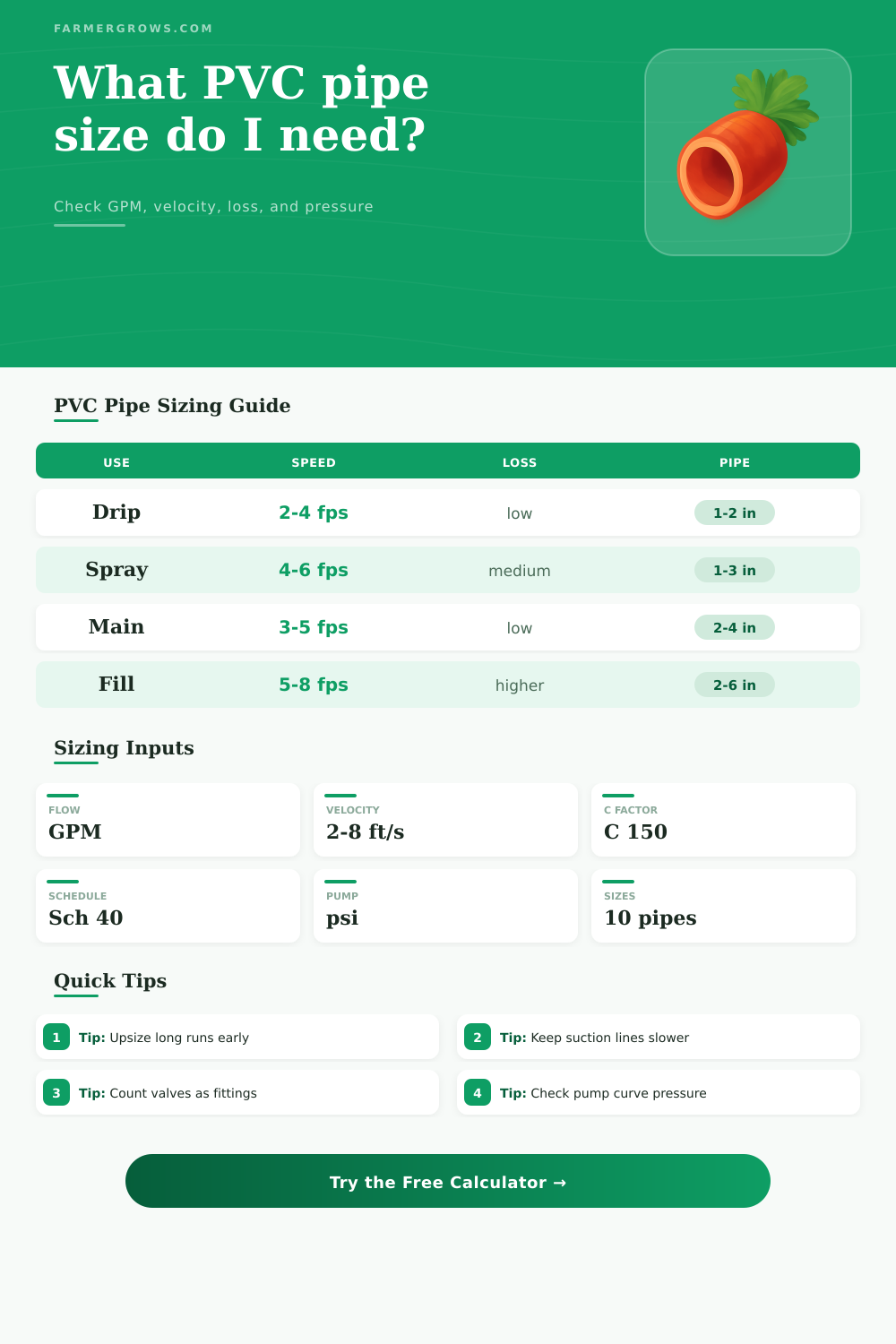
| Drip irrigation zone | 2 to 4 ft/s | 10 psi | Low friction protects pressure-compensating emitters. |
| Sprinkler or spray zone | 4 to 6 ft/s | 25 psi | Leave enough pressure for nozzles at the far end. |
| Irrigation mainline | 3 to 5 ft/s | 15 psi | Upsize long mains because every zone uses this run. |
| Tank fill / water transfer | 5 to 8 ft/s | 5 psi | Higher velocity can be acceptable for short fill runs. |
| Washdown or hose supply | 4 to 7 ft/s | 30 psi | Keep pressure margin for hose-end tools and valves. |
| Pump suction line | 2 to 4 ft/s | 2 psi | Slow suction lines reduce priming trouble and cavitation risk. |
| Item | Formula | Units | What it checks |
|---|---|---|---|
| Velocity | v = 0.4085 x GPM / ID^2 | ft/s | Whether water moves under the velocity limit. |
| Minimum ID | ID = sqrt(0.4085 x GPM / v limit) | inches | First-pass diameter from target flow and velocity. |
| Friction head | hf = 4.52 x L x Q^1.85 / (C^1.85 x ID^4.87) | feet | Hazen-Williams loss through the effective pipe length. |
| Pressure loss | psi = hf x 0.433 | psi | Converts feet of water loss into pressure drop. |
| Pressure margin | margin = pump psi - friction psi - reserve psi | psi | Checks whether useful pressure remains at the outlet. |
| Fitting load | Equivalent length factor | Best use | Examples to count |
|---|---|---|---|
| Light | 0.75 x base allowance | Sweeping layout | Long sweeps, couplers, gentle offsets. |
| Average | 1.00 x base allowance | Normal farm line | Standard elbows, tees, unions, reducers. |
| Heavy | 1.45 x base allowance | Valve-heavy run | Ball valves, check valves, filters, tight tees. |
| Suction note | 1.20 x extra allowance | Pump intake side | Foot valves, strainers, reducers, elbows. |
| Reference | Typical value | Use in calculator | Field note |
|---|---|---|---|
| New PVC | C 150 | Clean, smooth pipe | Good default for new glued PVC systems. |
| Older PVC | C 140 | Aging or mixed fittings | Use lower C when scale, biofilm, or repairs add roughness. |
| Schedule 40, 2 in | 2.067 in ID | Common branch main | Balanced choice for moderate farm irrigation flows. |
| Schedule 80, 2 in | 1.939 in ID | Higher pressure fittings | Thicker wall raises friction for the same nominal size. |
| Class 200, 2 in | 2.193 in ID | Low-loss mainline | Larger ID lowers friction when pressure rating is suitable. |
| SDR 21, 2 in | 2.149 in ID | Pressure-rated lateral | Check local pressure rating and burial conditions. |
Inside diameters are representative sizing values. Always confirm the exact manufacturer dimensions and pressure rating before installation.
Choosing the correct size for an PVC pipe is a necessary step in building a water system. Choosing the correct size for the PVC pipe will ensure that the water pressure at the end of the line is consistent with the pressure at the start of the line. If the size of the PVC pipe is too small, the water pressure at the end of the line will be too low.
Too low a water pressure will cause the pump to work harder then it should of to push the water through the PVC pipe. To select the correct size for the PVC pipe, an understanding of three different factor that relate to the pipe: flow rate, velocity, and friction loss. The flow rate of the water moving through the PVC pipe is the measurement of the amount of water that pass through the pipe in a period of time.
How to Choose the Right PVC Pipe Size
The unit of measurement for flow rate is gallons per minute. Once you have determined the flow rate of your system, you must determine the velocity at which the water move through the PVC pipe. If the velocity of the water is too high, it can create noise and vibrations in the system, and it could damage the components of the PVC pipe over time.
Irrigation systems typically require the velocity of the water to be between three and six feet per second. Suction lines for irrigation systems, however, require a lower velocity in the system to avoid the intake of air into the system. A sizing tool will calculate the velocity of the water in the system and tell you if the velocity will be in the safe range based off the flow rate you enter into the tool.
The second concept to consider when sizing a PVC pipe is the concept of friction loss. Friction loss is the reduction in the water pressure in a system as the water moves through the PVC pipe. The longer the length of the PVC pipe, the more greater the friction loss.
Additionally, if there are many fittings in the PVC pipe, there will be a greater loss of water pressure than if there were fewer fittings. You can calculate friction loss using the Hazen-Williams equation. This equation considers the length of the PVC pipe, the inside diameter of the pipe, and the roughness of the interior of that PVC pipe.
The rougher the pipe, the more friction loss there will be in the system. If the PVC pipe is new and smooth, it will have a higher flow efficiency than an old PVC pipe with rough interior walls. Additionally, the older the PVC pipe, the more friction loss there will be compared to a new PVC pipe.
Every elbow or valve in the PVC pipe adds to the equivalent length of the PVC pipe, which increase the friction loss in relation to the length of the pipe. The third factor to consider is pump pressure. Pump pressure is the force of the pump pushing the water through the PVC pipe.
The pump pressure must overcome the friction loss in the PVC pipe. Additionally, there must be enough pressure in the system to provide an application reserve. This application reserve is the pressure that is needed at the outlets of the system to ensure that they function properly.
Drip irrigation zones will require a small amount of application reserve, whereas sprinkler systems will require a much larger application reserve to ensure that the sprinklers are able to properly throw the water to the areas that need the water. To determine if the PVC pipe size is correct, subtract the friction loss and the application reserve from the pump pressure. If the result is a negative number, then the PVC pipe size is too small to provide the necessary pressure to the end of the line.
The thickness of the wall of the PVC pipe will change the inside diameter of the pipe. For instance, if the PVC pipe is a Schedule 80 pipe, its walls will be thicker than Schedule 40 PVC pipe. If the thickness of the wall of the pipe is increased, the inside diameter will be decreased.
Therefore, a Schedule 80 pipe will have a smaller inside diameter than a Schedule 40 pipe of the same nominal size. A smaller inside diameter will create an increase in the velocity of the water, as there is less area for the water to move through the pipe. Additionally, because there is a smaller area for the water to move through, there will also be an increase in the friction loss of the water moving through the pipe.
It is essential to select the correct schedule of PVC pipe because the schedule will determine the amount of water that can move through the pipe at a given velocity. Real-world considerations will affect the sizing of the PVC pipe. Regardless of the size calculations for the PVC pipe, the system should be sized for the worst-case scenario.
Factors to consider include temperature changes and soil movement. In areas where the soil is subject to movement, or where the temperature will change the joints of the PVC pipe, the PVC pipe will experience stress. In these situations, it is best to select a PVC pipe size that will allow for more room for the water to move through the pipe.
If the calculated size of the PVC pipe produces a very thin pressure margin, select a larger diameter for the PVC pipe. This is true regardless of the calculation results. It is also essential to select a larger pipe size for suction lines on pumps because suction lines too small in diameter will cause pump damage.
The type of application that you intend to use your water system for will determine the amount of pressure and velocity that the water will have in the PVC pipe. Lines such as tank-fill lines will allow for higher velocities in the system than, for instance, the mainline of the irrigation system. A sizing tool will calculate the velocity and pressure reserve for different types of application.
When you choose the type of application for which the PVC pipe will be used, the sizing tool will automatically calculate the appropriate velocity and pressure reserve for the system. Some common mistakes in sizing PVC pipes include failing to include all the fittings in the system when calculating the size of the pipe, and not accounting for the length of the PVC pipe properly. Many people forget that, for example, ten 90-degree elbows will create the same resistance to the flow of water as many feet of straight PVC pipe.
Using a sizing calculator that considers the effect of the fittings will help to avoid these common mistakes. Using a sizing calculator will help to see how using a larger diameter for the PVC pipe will increase the pressure margin of the system. By using a larger diameter for the PVC pipe, you can make the system more reliably, and the water pressure will be sufficient for the requirements of the system.