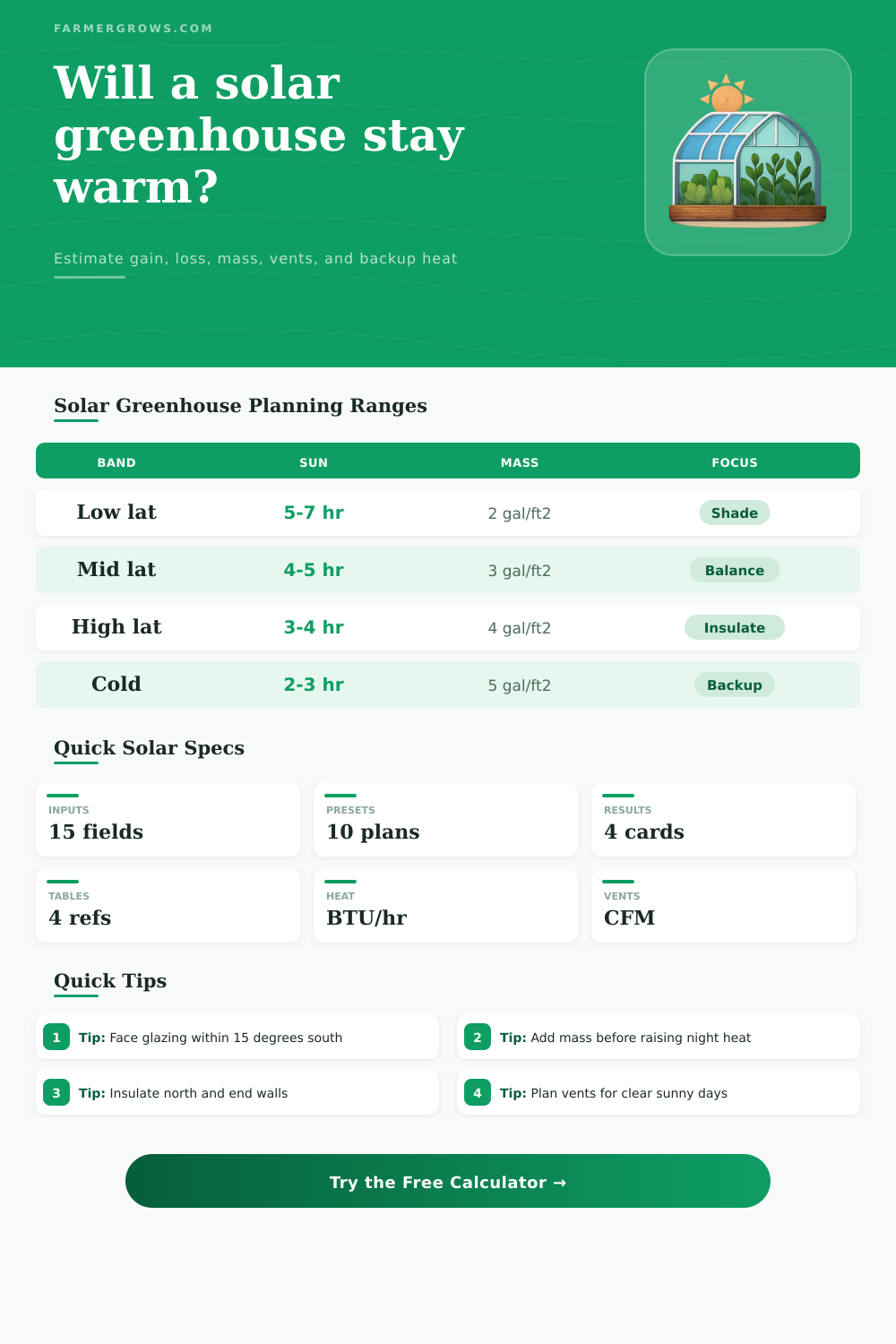
Solar Greenhouse Calculator
Estimate passive solar gain, night heat loss, thermal mass storage, venting airflow, and backup heat for a solar greenhouse using glazing area, orientation, latitude band, sun hours, insulation, and temperature targets.
Use this as a planning estimate for passive solar greenhouse design. Final designs should still be checked against local climate data, code requirements, wind exposure, snow loads, crop needs, and backup heating equipment.
Solar Greenhouse Estimate
Results combine south glazing gain, orientation, latitude band, sun hours, night heat loss, water thermal mass, venting load, and backup heat allowance.
| Glazing | Solar transmittance | U-value | Passive greenhouse note |
|---|---|---|---|
| Single poly film | 0.82 to 0.88 | 1.15 to 1.25 | High gain, high night loss, best for seasonal use or mild climates. |
| Inflated double poly | 0.68 to 0.76 | 0.65 to 0.75 | Common balance of winter gain and lower conductive loss. |
| Twin-wall polycarbonate | 0.72 to 0.80 | 0.52 to 0.60 | Good for durable solar houses where insulation matters. |
| Triple-wall polycarbonate | 0.58 to 0.68 | 0.35 to 0.45 | Lower heat loss but less winter light reaches the mass. |
| Double glass | 0.68 to 0.78 | 0.45 to 0.60 | Useful for sunspaces and lean-to structures with careful sealing. |
| Condition | Solar factor | Common range | Design meaning |
|---|---|---|---|
| True south orientation | 0.95 | 0 to 10 degrees off | Strong winter capture with the least glazing penalty. |
| Near-south orientation | 0.88 | 15 to 25 degrees off | Usually workable if mass and insulation are strong. |
| Off-south orientation | 0.76 | 25 to 45 degrees off | Expect lower winter gain and larger backup allowance. |
| High latitude winter | 0.68 | Short, low sun | Prioritize insulation, curtains, and lower night targets. |
| Partly shaded exposure | 0.52 | Trees or buildings | Solar design may need major backup heat on cloudy nights. |
| Mass level | Water per glazing area | Best use | Planning note |
|---|---|---|---|
| Light buffer | 1 to 2 gal per sq ft | Seedlings, mild nights | Helps smooth swings but does not replace backup heat. |
| Balanced passive mass | 2 to 3 gal per sq ft | Winter greens | Common target when glazing faces south and is not shaded. |
| High mass wall | 3 to 5 gal per sq ft | Cold clear nights | Needs good sunlight and dark exposed mass surfaces. |
| Aquaponic or tank mass | 5 plus gal per sq ft | Water systems | Large mass changes slowly, so monitor crop root temperature. |
| Low-mass tunnel | Under 1 gal per sq ft | Season extension | Expect fast overheating by day and fast cooling at night. |
| Design item | Planning range | Calculator link | Field check |
|---|---|---|---|
| Fan ventilation | 8 to 12 CFM per sq ft floor | Peak gain and setpoint | Derate for shutters, screens, and dirty louvers. |
| Natural vent area | 15% to 25% of floor area | CFM divided by opening flow | Pair high exhaust openings with low intake openings. |
| North wall insulation | R-12 to R-30 | Insulated area and R-value | Insulate opaque surfaces before adding extra winter glass. |
| Air leakage | 0.3 to 1.5 ACH | Night infiltration load | Seal doors, fan shutters, baseboards, and curtain gaps. |
| Night curtain | 15% to 35% loss cut | Not included directly | Model the effect by raising effective R-value or lowering U-value. |
Thermal mass: Put water barrels, tanks, or masonry where winter sun actually reaches them. Hidden mass helps less than exposed mass with a clear solar path.
Backup heat: Size backup for the cloudy design night, then use the passive balance to reduce runtime. Crops still need protection when sun and mass fall short.
A greenhouse made from solar heat succeeds or fails according to how the solar greenhouse balance incoming heat with outgoing heat from the greenhouse. A solar greenhouse must be constructed to allow heat to enter the greenhouse during the daytime, but must also prevent that heat from leaving the greenhouse after the sun sets. Many peoples can build a greenhouse that is warm within the solar greenhouse during the peak heat of the noonday sun, but their solar greenhouses may become to cold for the plants that they wish to grow within the greenhouse after the sun sets.
The three factors that determine if a solar greenhouse succeeds are the amount of south facing glass that is used in its construction, the insulation of the greenhouse, and the amount of thermal mass that is include within the greenhouse structure. The amount of south-facing glass that the builder includes in the greenhouse will impact both the amount of sunlight that enters the greenhouse, as well as the amount of heat that can exit the greenhouse structure after the sun sets. Using a single layer of film to line the greenhouse allow for a great deal of light to enter the greenhouse, but also permits the heat to exit the greenhouse very quicky.
How to Keep a Solar Greenhouse Warm
Using double glazing or triple glazing for the greenhouse will reduce the amount of heat that can exit the greenhouse, but will also reduce the amount of light that can enter the greenhouse. A greenhouse heat calculator can help to balance these two variables; the calculator takes into account the glazing area of the greenhouse, the U-value of the greenhouse glazing, and the orientation of the greenhouse to calculate the amount of heat that will enter and leave the greenhouse. The heat calculator also considers the target greenhouse temperature and the lowest outside temperature that is expected during the growing season to determine whether the solar greenhouse will produce a surplus or deficit of heat.
One of the components of a solar greenhouse that many people underestimate is the importance of use a thermal mass within the greenhouse. The thermal mass will allow for heat to be moved from the afternoon into the nighttime portion of the greenhouse. Thermal mass, like water barrels or masonry flooring within the greenhouse, will not produce the heat that are necessary to warm the greenhouse, but will allow the greenhouse to store heat during the daytime and then release that heat after the sun sets.
Using too little thermal mass will cause the temperature within the greenhouse to quickly rise during the day and drop just as quick after the sun sets. Using too much thermal mass can prevent the greenhouse from reaching the necessary temperature to allow for proper venting of hot air during daytime hours, and may also result in stagnant air within the greenhouse which can lead to the development of plant diseases. The heat calculator can help test various volumes of water within the greenhouse to determine how much heat that the thermal mass will store during the daytime.
Ventilation within a solar greenhouse allow for the management of the heat that is produced within the greenhouse, but can also be a problem if the amount of heat that exits the greenhouse becomes too great. During bright winter days, the heat that enters the greenhouse through the glazing can become too hot for the plants that are growing within the structure. A greenhouse heat calculator estimates the amount of airflow that is necessary to provide for venting to the determined setpoint for the greenhouse, and displays that amount of airflow as the area for the greenhouse vents.
The area of the vents must be provided so that the plants do not overheat during the daytime. The factor of the latitude at which the greenhouse is to be build and the orientation of the greenhouse impacts the amount of sunlight that enters the greenhouse. Regions at higher latitudes receive sunlight at a lower angle than regions at lower latitudes, and regions at higher latitudes experience a longer heating season then regions at lower latitudes.
Each of these factors reduce the amount of heat that can be provided by the south-facing glazing panels that are included in the greenhouse. If the greenhouse is shifted from its south-facing orientation towards other points on the horizon, it will capture less heat from the sun during the winter months. The greenhouse heat calculator adjusts for these variables in that it calculates the heat requirements for each greenhouse at various latitudes and orientations.
Insulating the greenhouse at the north-facing wall and the end walls of the greenhouse is an investment that many people can make that will have a more greater impact upon the performance of the solar greenhouse than adding more south-facing glass. Once the greenhouse is well-insulated on its north-facing wall, any additional glass that is added will not have as great of a benefit to the solar greenhouse structure. The greenhouse heat calculator determines the envelope UA value of the greenhouse, which can help people to understand the benefits of adding either more glass or insulation to their greenhouse structure.
The final number that is produced by the greenhouse heat calculator is referred to as the backup heat rate for the greenhouse. The backup heat rate is used to calculate the amount of heat that will be required of the greenhouse after the thermal mass of the greenhouse has released all of the heat that it stored during the daytime. If the greenhouse contains too little thermal mass, the backup heat rate will be greater than if the greenhouse contains more thermal mass.
Similarly, the higher the rate at which heat can leave the greenhouse, the higher the backup heat requirement. If night curtains are added to the greenhouse, or if the seals on the doors of the greenhouse are improved, the backup heat requirement will decrease. Overall, this heat calculator allows the greenhouse grower to make decisions regarding the construction of the greenhouse prior to ordering the glazing panels for the greenhouse or pouring the footings for the foundation.