Pumpkin Plants Per Acre Calculator
Estimate pumpkin population from row spacing, in-row hill spacing, plants per hill, usable field area, establishment, seed needs, row feet, and expected harvest.
Use center-to-center spacing. For hills, enter the distance from one hill to the next in the row and the number of plants left after thinning.
Pumpkin Acre Plan
Spacing results will appear here.
| Row Spacing | In-Row Spacing | Plants Per Hill | Plants Per Acre |
|---|---|---|---|
| 3 ft | 4 ft | 1 | 3,630 |
| 4 ft | 4 ft | 1 | 2,723 |
| 5 ft | 5 ft | 1 | 1,742 |
| 6 ft | 6 ft | 1 | 1,210 |
| 8 ft | 8 ft | 1 | 681 |
| 8 ft | 8 ft | 2 | 1,361 |
| 10 ft | 10 ft | 1 | 436 |
| 12 ft | 12 ft | 1 | 303 |
| Planting Method | Typical Entry | Why It Matters | Calculator Treatment |
|---|---|---|---|
| Direct seeded hills | 2 to 4 seeds per hill | Allows thinning to the strongest vine | Multiplies hills by seeds per hill |
| Precision seeder | 1 to 1.4 seeds per station | Uses fewer seeds but needs good soil contact | Applies germination and order buffer |
| Transplants | 1 cell per hill | Best for early markets or poor stands | Uses survival plus field loss |
| Backup seed | Cell plus spare seed | Covers misses in gaps or row ends | Adds row-end and buffer allowances |
| Project | Net Area | Spacing Plan | Approx Plants |
|---|---|---|---|
| Roadside mini patch | 0.25 acre | 4 ft rows, 4 ft spacing | 681 plants |
| CSA pie pumpkin block | 0.50 acre | 5 ft rows, 5 ft spacing | 871 plants |
| One-acre jack field | 1 acre | 6 ft rows, 6 ft spacing | 1,210 plants |
| U-pick wide lanes | 2 acres | 8 ft rows, 6 ft spacing | 1,815 plants |
| Large fruit patch | 1 acre | 8 ft rows, 8 ft spacing | 681 plants |
| Giant pumpkin trial | 0.10 acre | 12 ft rows, 12 ft spacing | 30 plants |
| Pumpkin Class | Fruit Per Plant | Typical Weight | Planning Note |
|---|---|---|---|
| Mini or decorative | 4 to 8 | 0.5 to 2 lb | Dense stands can still yield many small fruit. |
| Pie pumpkin | 2 to 4 | 3 to 8 lb | Moderate spacing balances count and size. |
| Jack-o-lantern | 1 to 2 | 10 to 25 lb | Good airflow helps handles and fruit finish. |
| Large or prize type | 0.5 to 1.5 | 30 lb plus | Wider spacing supports vine and fruit growth. |
Stand checks: Count surviving plants after thinning and after the first serious weather event. Pumpkin hills can look full at emergence but still lose stand later.
Usable acreage: A full field acre rarely plants like a full net acre. Deduct turn rows, sprayer lanes, irrigation headers, wet corners, and display paths.
The myth is that more seeds mean more pumpkins. The reality: Squash vines is big animals, and when they’re planted to closely, they’ll hurt one another. If you put your seed into the ground without first planning where to space those hill, you’re wasting your time. The calculator does math for hill spacing and row width.
Total Acreage: Most growers do this. But in many cases you don’t have as much usable area. Subtract the lanes where nothing grows, those not plantable due to tractor turning. And headlands. Also take out areas that get flooded. Too often people will plant right up to edge of gross acre with poor results. Adjust for usable percentage based off the tool. That way when you place a seed order it’ll match what’s on the ground that you actualy can farm.
How to Space Your Pumpkin Plants
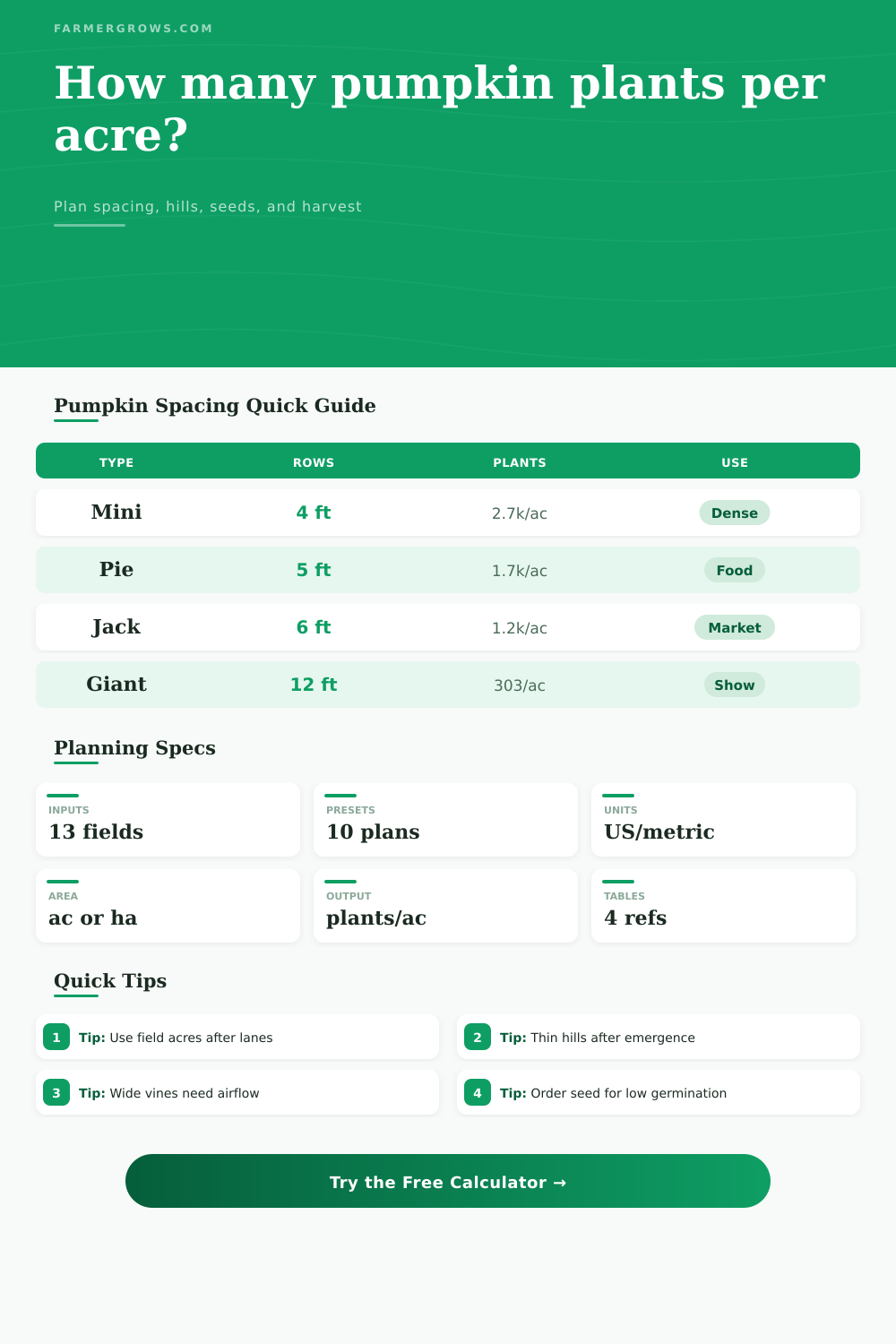
Some types of pumpkin like it closer than others. For instance, mini pumpkins can be planted closely together and even in same row without problems. The bigger varieties (like jack-o’-lanterns) wants a little elbow room so they can grow fat fruit and stout stems. Small is not good when you’re trying to squeeze big ones into narrow areas; you’ll end up with puny, deformed gourds. Depending on the variety, spacing at six feet apart produce approximately twelve hundred plants per acre (as shown in reference grid). At twelve-foot spacing, the giants will drop that count down to three hundred plant per acre. Pick your poison: Do you want lots or do you want big? Rarely does one get both.
Yield predictions is also based off germination. Although seed companies might say you’ll get 90 percent of what they ship, it can be less in the field. Factors like cold soils and bad planting can realy cut down germination. Your assumed germination rate is another parameter of the calculator. If you figure that half don’t sprout (perhaps because of bad weather when sowing), that’s added to account for those missing link. Better to have a few more seedlings than skips in row. Remember to thin the plants, as this also affects final count. Sow multiple seeds per hill as insurance against no germination. Too many vines? All those vines will choke out the ones you want. Time to thin, and leave just one or two vigorous plant. Enter that into tool to calculate final stand.
There’s a wildcard in the mix: weather. Heavy rains or late frosts can reduce expected crops. You create that cushion by building a safety margin into your field loss. That reduces some of the risk.
You’re considering bottom line when calculating what will be harvested. More plants with less fruit aren’t productive; who wants to haul around tiny pumpkins that don’t sell? Better air flow minimize fungal problems; wider rows accomplish this. Even if there are only half as many fruits, the clean ones sells better. Space management is critical in planning a pumpkin patch. How many plant can you fit, without compromising their health and therefore quality of your final products? Enter calculator, which offers a way to make decisions. Avoid wasting money on errors. Know how much space your vines will require and order seed accordingly, plus some extra for any losses that may occur. With this system, what was once field becomes a reliable harvest.