Pothos Root Growth in Water Time Calculator
Estimate how long pothos cuttings need in water before first roots, target root length, and soil transfer readiness using nodes, cultivar, warmth, light, water changes, and cutting size.
Use this for rooted pothos vine cuttings, not seed starting or soil-only cuttings. The estimate assumes at least one healthy node is underwater and the cutting is kept away from cold drafts and direct hot sun.
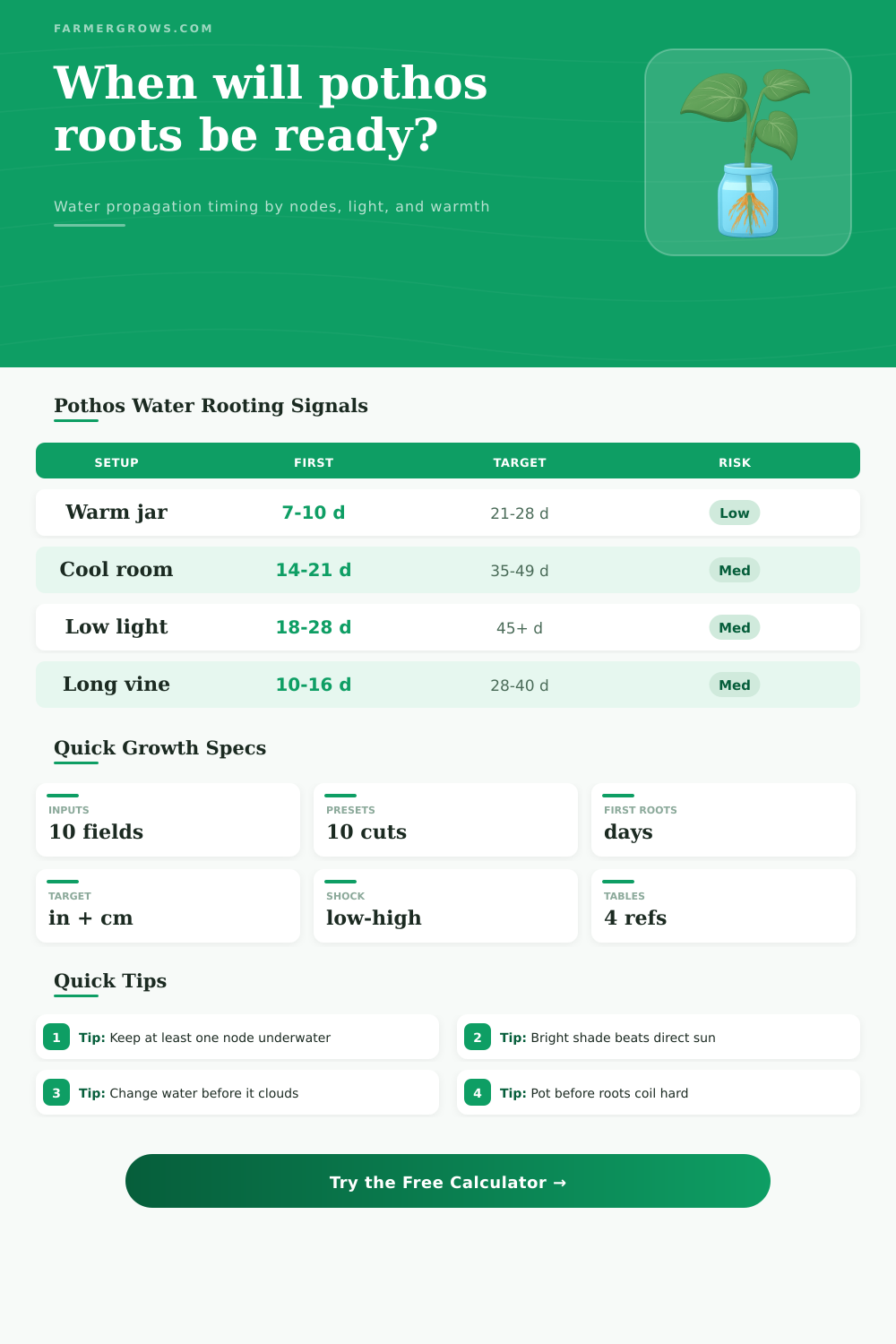
Pothos Water Rooting Estimate
The timeline uses the visible node count, cultivar vigor, water temperature, light, water freshness, cutting length, root target, and likely transfer shock.
| Cultivar group | Typical first roots | 2 in target | Best light | Water note |
|---|---|---|---|---|
| Golden, Jade, Hawaiian | 7 to 14 days | 21 to 30 days | Bright indirect | Weekly is often fine if water stays clear |
| Neon pothos | 9 to 16 days | 24 to 35 days | Bright indirect or LED | Avoid cold water swings after changes |
| Cebu Blue pothos | 10 to 18 days | 28 to 40 days | Medium to bright indirect | Long vines benefit from more than one node |
| Marble Queen, N'Joy, Pearls and Jade | 14 to 24 days | 35 to 52 days | Bright indirect | Fresh water helps slower variegated nodes |
| Manjula pothos | 16 to 28 days | 40 to 60 days | Bright indirect, no direct sun | Watch soft stems and cloudy water closely |
| Water temperature | Timing effect | What changes | Stem risk | Grower action |
|---|---|---|---|---|
| 60 to 64°F | Much slower | First roots may lag by 40% or more | Medium | Move away from cold windows at night |
| 65 to 69°F | Slightly slower | Roots form steadily but target length takes longer | Low to medium | Use room-temperature replacement water |
| 70 to 78°F | Best range | Balanced node activity and oxygen demand | Low | Keep jar in bright shade or under gentle LED |
| 79 to 84°F | Can be quick | Roots may start fast but water fouls sooner | Medium | Change water every 2 to 3 days |
| 85°F and up | Unstable | Heat stress can offset faster growth | High | Remove from direct sun or hot glass |
| Node and cutting setup | Rooting odds | Speed effect | Transfer note | Best use |
|---|---|---|---|---|
| One node, 2 to 4 in cutting | Fair to good | Average | Pot carefully once roots branch | Small jars, tidy propagation shelves |
| Two nodes, 4 to 7 in cutting | Good | Faster and steadier | Usually ready near 1.5 to 2.5 in roots | Most household pothos cuttings |
| Three or more nodes | Very good | Faster first signs | Remove lower leaves from water | Rescue vines and fuller starter pots |
| Long 10 in or longer vine | Good if firm | Slight drag from extra foliage | Higher wilt risk if many leaves remain | Trailing cuttings with multiple nodes |
| Old woody or bruised stem | Mixed | Slower | Inspect before potting | Backup propagation when pruning |
| Root length target | Water time | Soil shock risk | What to watch | Transfer style |
|---|---|---|---|---|
| 0.5 to 1 in | Short | Medium | Roots are tender and sparse | Very moist, airy mix and gentle light |
| 1.5 to 2.5 in | Balanced | Low | White roots with tiny side branches | Moist mix, no hard drying first week |
| 3 to 4 in | Longer | Low to medium | Roots adapt but may be water-soft | Spread roots lightly when potting |
| Over 5 in | Extended | Medium | Coiling and algae can increase | Transition gradually and keep humidity stable |
| Permanent water culture | Ongoing | None to soil | Nutrient fade and algae over time | Refresh water and feed lightly when established |
For faster clean rooting: Keep the node underwater, remove any submerged leaves, and place the jar in bright indirect light where water stays warm but not hot.
For lower transfer shock: Pot before roots become a tight coil, use evenly moist mix, and keep the cutting out of harsh sun while water roots adjust to soil.
So you got a cutting from something that appears to be healthy: it has leaves; it has nodes; you think it’s got what it takes. And so you plop it into some water in a jar…for three weeks…and then nothing happens. Did you kill it? Probably not. The problem isn’t you or even the plant (that’s why it hasn’t died yet).
The problem is usually the invisible factors that control how fast roots develops. Propagation isn’t magic, it’s biology. Biology is just slow math based off factors such as light, temperature, and oxygen levels. That’s the math that the calculator on this page do for you. It’s not guessing. It accepts details of your set-up, and spits back an estimate based in reality, not hope.
Why Your Plant Cuttings Are Not Rooting
The typical advice most growers rely on are vague: it takes a few weeks. Great, but then what? When you’re in the middle of a wilting vine or timing a gift to be ready, “a few weeks” won’t do. Too much precision is better than too little, too soon means shock; too late, rot.
Water temperature is the first variable that moves the timeline. At the node, cell activity are slowed in cold water. And it’s not just a little delayed, but it can actualy cut your rooting time in half. Because of this, the degree input will adjusts the baseline days to account for this. So if your jar is up against a cold window, you’re fighting against physics. Pull it into a warmer location and the roots shows up quicker, as the plant wastes less energy trying to stay warm. This is also why the sweet spot matter so much; you don’t want heat stress but do want warmth.
Light: Next, you get light. To promote root development below, you want the leaves above to be doing their thing by driving photosynthesis. Bright indirect light is a gold standard and is best for water propagation. Direct sun will stresses the tender new tissue and heat up the water, while low light will starve the cutting. The calculator takes into account your light selection and weighs it accordingly to tweak the estimated date when you’ll see those first white nubs. With patterned pothos such as Marble Queen, which have more white than green, there’s even more attention required in this regard; the white doesn’t photosynthesize. It depends solely on the green bits for its energy. It is a slower starter by nature.
The action take place on the nodes. A long vine with no nodes underwater is simply a stick that won’t ever root. Each time you submerge a node, there’s an opportunity for roots to take hold. How many nodes you have determines how confident the tool thinks you are, and the more nodes, the greater redundancy (if one fails). Greater redundancy equals more surface area for oxygen exchange. That’s why keeping at least one node underwater is not negotiable. Nodes need to swim; leaves needs to be kept dry.
Water quality is a quiet assassin. Roots needs dissolved oxygen to push through the stem, but cloudy water indicates either bacteria growth (which uses oxygen) or algae growth. How often do you change the water? If it turns pond scummy-looking by the time you get around to changing it, you’re suffocating the cutting long before the roots even begin to form. Regular water changes maintains a healthy and clean environment with plenty of dissolved oxygen.
What happens when the tool says “here’s your target date?” Nothing. Absolutely nothing. Well, that’s not true. It is providing an estimate of your highest chance of success based on the ideal conditions you fed into the tool. This means if you’re lucky, you’ll see first signs sooner, but if you cut from a stressed-out plant, it may be later.
How ready is the root system for the transition? That’s the shock risk metric, and that lets you know whether the roots are ready now for the dry mix or whether you need to give them time to develop a substantial, branched root system. Weak roots in a dry mix will kills plants right then and there. It’s not so much a matter of force as it is a matter of logic and patience.
With propagation you are in charge of setting up the conditions, and then letting nature take over. When you realize that the rate is dependent on the temperature and that it all comes down to getting to that next node, the waiting game isn’t such an anxious one. It becomes a process to trust instead of something you just watch anxiously. Conditions will eventually be right for growing and breathing, and then the roots will follow. You should of waited for better weather.