Potatoes Per Acre Calculator
Estimate potato plants per acre, marketable yield, harvested field weight, seed requirement, culls, shrink, truckloads, and storage bins from real row spacing and crop assumptions.
Choose a potato crop pattern, then fine tune stand survival, tubers per plant, average tuber weight, row recovery, cull pressure, and storage shrink.
Potato Yield Snapshot
Potato field yield estimate.
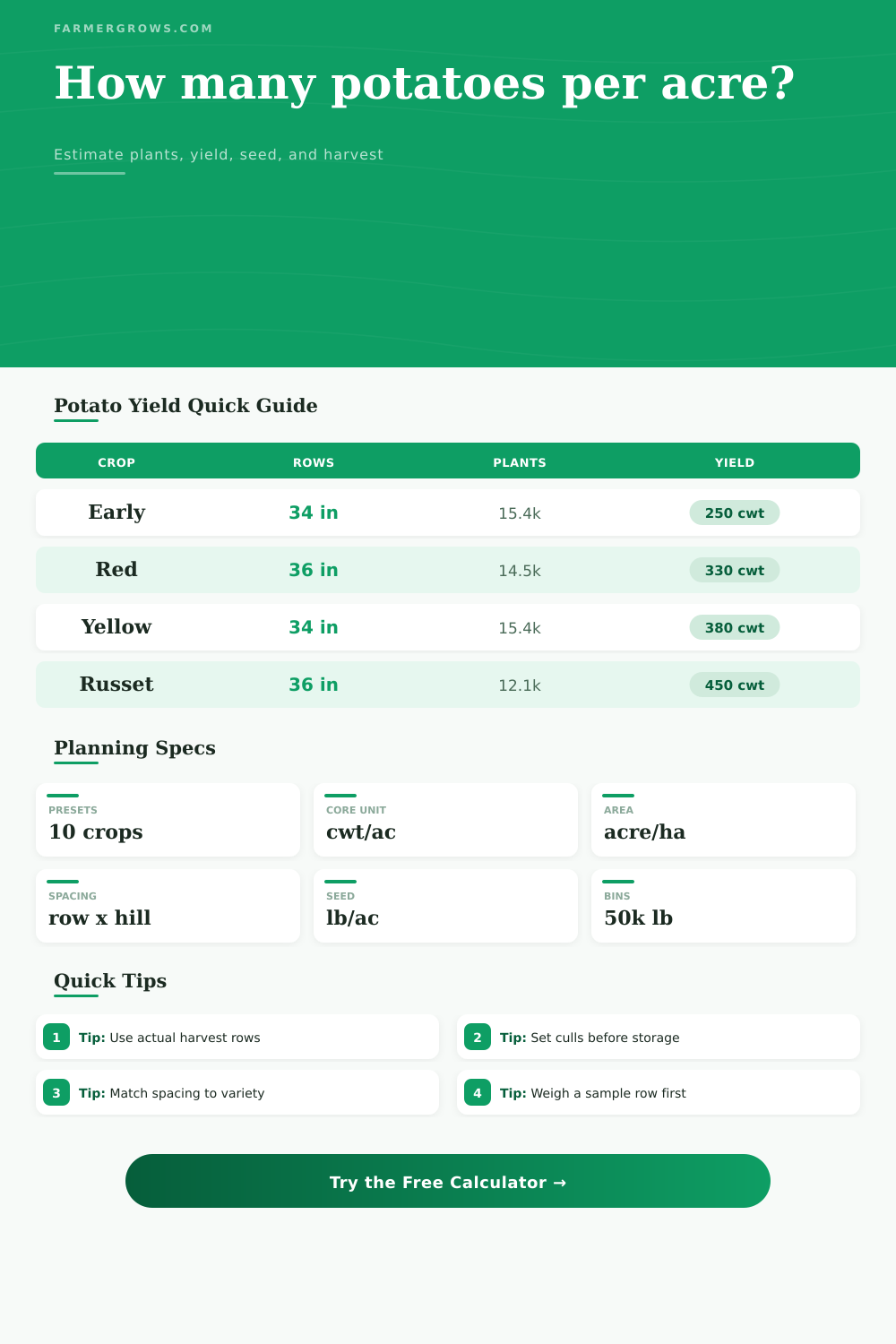
| Row x hill spacing | Seed pieces per acre | Plants at 92% stand | Best fit |
|---|---|---|---|
| 32 x 10 inches | 19,602 | 18,034 | Small potatoes, fingerlings, seed-size crop |
| 34 x 12 inches | 15,374 | 14,144 | Yellow, red, and fresh market table potatoes |
| 36 x 12 inches | 14,520 | 13,358 | Common maincrop and storage potato rows |
| 36 x 15 inches | 11,616 | 10,687 | Russets and larger size profile crops |
| 38 x 15 inches | 11,005 | 10,125 | Wide rows, larger hills, harvest equipment clearance |
| Yield measure | Equivalent | Per acre note | Metric equivalent |
|---|---|---|---|
| 1 cwt | 100 lb | Standard potato yield unit | 45.36 kg |
| 200 cwt/ac | 20,000 lb/ac | 10 short tons per acre | 22.4 t/ha |
| 350 cwt/ac | 35,000 lb/ac | 17.5 short tons per acre | 39.2 t/ha |
| 500 cwt/ac | 50,000 lb/ac | 25 short tons per acre | 56.0 t/ha |
| Planning item | Common value | Calculator use | Field note |
|---|---|---|---|
| Seed piece weight | 1.5 to 2.5 oz | Seed lb/ac | Smaller seed pieces raise piece count per pound |
| Bulk truck load | 45,000 to 50,000 lb | Loads needed | Use your legal and practical hauling capacity |
| Fresh market culls | 8% to 18% | Net yield | Scab, greening, cuts, size, shape, and bruising matter |
| Storage shrink | 3% to 10% | Stored packout | Depends on cure, ventilation, temperature, and duration |
Separate biological yield from packout. A field can bulk plenty of potatoes but still lose a large share to grading, bruising, green shoulders, or storage shrink.
Sample with row length. Dig a measured row, weigh marketable potatoes, count plants, then use this calculator to scale that sample to acres, bins, and seed rate.
Before we even get to planting, there’s some math to do: How many potatoes will be planted on each acre? To a crop expert, that’s arithmetic, how much time, weight and space is involved. Getting the real number of plants to match your desired number can mean the difference between a logistical nightmare and a profitable harvest.
This is one of those things you’d like to guess at, but don’t have any idea how to get it right. To manage it well, you must know exact number of plants. So how does this all begin? Most farmer begin with their row spacing. They choose 34 inches or 36 inches, based off what is easy to work around or how many beds they can fit into an acre.
How to Do the Math for Planting Potatoes
When you enter that dimension into our calculator, the rest of math is done for you so you don’t have to guess using conversions or coefficients. But that is not the whole story. Because from the time of planting until harvest, things happen to those plants. Some don’t emerge well, so you end up losing hill. Others die from nematodes or blight. And the digger misses some of the product, leaving it in soil.
Without anticipating that loss initially, you’re setting yourself up to simply wish for higher yields. Think about the stand survival rate. Ninety percent might seem like a high number and feel like a safe bet. But in a thousand plants, thats one hundred empty places where you’ve spent your money and your water. This variable can be adjusted in the tool, and doing so makes you face facts. It shifts the biology of what could happen with ideal conditions to the economics of what probably will happen.
Most people make this error: planning on perfect conditions. Then, when conditions don’t cooperate well, they freak out. It’s far more confident to plan for imperfection and account for conditions as they realy are in the field.
“Then that graded product hits the market. If a field yields fifty thousand pounds of raw product, maybe twelve percent will be culled from scab, cuts or greenings. That’s a lot of marketable tonnage right there. Combine that with cull rates and storage shrink (reference table) and you’ve got some big losses.” The bottom line is that you lose weight out in the field and you lose additional weight in the bin as moisture evaporates over the course of several months of storage. What you don’t have isn’t there… You can’t sell it; it’s like not accounting for tax liabilities. Don’t ignore shrink.”
Seed is another not-so-obvious cost center. More seed per hill equals fewer hills per pound of stock. Bigger seed results in fewer hills because there are fewer seeds per pound. Smaller seeds result in more hills, but also lower emergence rate (meaning more weaklings). The tool estimates your seed load based on piece weight. It then factors in some buffer for cut loss. This protects from waste that would otherwise force you to stretch the seed across an uneven field.
This could leave gaps, require multiple trips through the field, or leave product in the ground too long. Uniformity is key to harvesting at once; gaps mean going back or leaving something behind. All of this ties back into logistics.
How many trucks do you think it takes? How many storage bins will they fill? A typical bin size is fifty-thousand pounds. Your model predicted a yield of four point two bins; now you know you need five. You round up. You pay the rental expense. Or you round down. You pay the rush order price. Or you pay the delivery cost when you must make one. Planning well helps you avoid premium rates on last-minute repairs.
That’s not to say that this method eliminates anxiety; it transforms anxiety into information. It turns “Do I have room for the crop?” from a question mark to a set of knowable limits. And the principles are no different whether you’re raising fingerlings for the farmers market or russets for storage. Population is constrained by space, yield is constrained by population, and profit is constrained by yield.
So begin with the size of your field and the width of your rows. Subtract the known losses and adjust for the variety you planted. Then let the numbers tell you how much seed to order, when to plant and harvest it, and how to store it all. No magic here, just math applied to mud.
If you do the math correctly, then the mud produces exactly what you want it to produce. And that’s why we call it farming: because you go into that field with a plan. Not a hope. And that’s the difference between a good season and a great one.