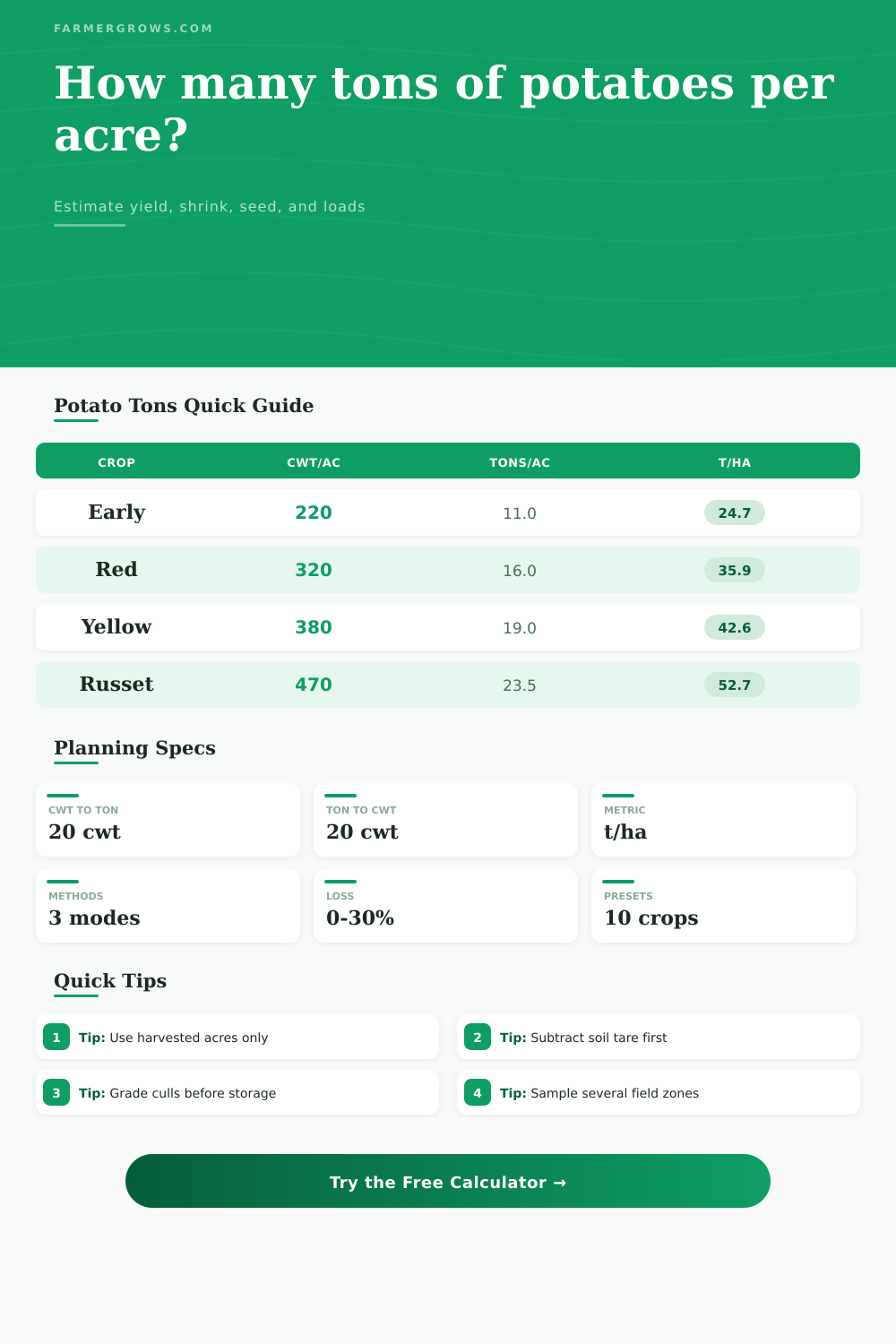
Tons Of Potatoes Per Acre Calculator
Estimate potato tons per acre from direct yield, row samples, or truck and bin weights, then adjust for harvested acres, soil tare, grade culls, shrink, seed rate, and load planning.
Choose a potato production pattern, then tune the area, yield method, recovery, tare, cull, shrink, seed piece size, and equipment capacity for your field.
Potato Tons Per Acre Result
Your result will appear here after calculation.
Typical potato yield ranges
| Potato crop | Common range | Metric equivalent | Calculator note |
|---|---|---|---|
| Early fresh market | 9 to 14 tons/ac | 20 to 31 t/ha | Short season harvest often trades tonnage for early market timing. |
| Red or yellow table crop | 14 to 21 tons/ac | 31 to 47 t/ha | Grade-out and skin finish can change marketable tons quickly. |
| Russet storage crop | 18 to 28 tons/ac | 40 to 63 t/ha | Storage shrink and cull sizing matter after field yield is known. |
| Processing potato | 22 to 34 tons/ac | 49 to 76 t/ha | Contract specs may separate usable tons from total field tons. |
Cwt, tons, and metric conversions
| Cwt per acre | Tons per acre | Metric tonnes per hectare | Use case |
|---|---|---|---|
| 200 cwt/ac | 10.0 tons/ac | 22.4 t/ha | Light crop, early digging, or dryland stress. |
| 300 cwt/ac | 15.0 tons/ac | 33.6 t/ha | Moderate fresh market or short-season field. |
| 400 cwt/ac | 20.0 tons/ac | 44.8 t/ha | Strong table-stock field with good stand and water. |
| 500 cwt/ac | 25.0 tons/ac | 56.0 t/ha | High-yield storage or processing field. |
Sample row length guide
| Row spacing | 1/1000 acre row length | Sample idea | Why it helps |
|---|---|---|---|
| 30 inches | 17 ft 5 in | 4 to 6 row samples | Useful for narrow potato rows and research plots. |
| 32 inches | 16 ft 4 in | 4 to 6 row samples | Balances easy digging with a meaningful sample area. |
| 34 inches | 15 ft 4 in | 6 row samples | Common for table potato stand and yield checks. |
| 36 inches | 14 ft 6 in | 6 to 8 row samples | Wide rows need representative zones across the field. |
Loss and shrink planning ranges
| Adjustment | Low range | High range | Calculator note |
|---|---|---|---|
| Digger recovery | 95% to 98% | 88% to 92% | Lower recovery for wet harvest, bruising, or rows left behind. |
| Soil and vine tare | 1% to 3% | 5% to 10% | Dirty bulk weights should be cleaned before yield is trusted. |
| Cull grade-out | 5% to 10% | 18% to 30% | Size, greening, rot, and damage reduce marketable tons. |
| Storage shrink | 3% to 6% | 10% to 14% | Long storage, sprouting, dehydration, and pile heating add loss. |
Keep total yield and marketable yield separate. Gross tons from a field sample or truck scale can look strong, but soil tare, undersize tubers, green tubers, rot, and bruising determine the saleable potato tons per acre.
Sample across real field zones. Dig short representative row lengths from good, average, and weak areas, then average the weights before using the sample method for storage, labor, or trucking plans.
All you need to do is plug in the number of samples, your area, and percentage of anticipated losses (or whatever factors you use). You won’t have to convert or calculate coefficients by hand anymore. Instead, it’s a matter of mathematics, the kind you learned in school instead of on farm.
To turn a profit, all you have to do is guess right on what’s below ground. What counts isn’t only weight of what comes out of the ground. What counts are how much survives transport to buyer unspoiled.
Why You Should Use the Calculator
The gross yield (the amount dug by the digger) is what most growers begins with. It’s a good starting point; it shows that your fertilizer and irrigation plans paid off. But it is also the most misleading of all your numbers. It contains rock that fell through screen, vines caught in haulm, and tubers covered in soil.
Folks frequently plan for truck capacity using the weight with dirt included. First use the tool to take out the tare, the weight of soil. There are thirty pounds of dirt for every one hundred pounds of potato. Seems like nothing. But you’re paying to haul it anyway. Your real money come down to clean weight.
Second, there is the grade. Misshapen, green, or shriveled potatoes aren’t paid on market, they can actualy cost money to dispose of. Enter your estimate of the percent cull. (This is where the vanity of the gross number gets knocked out.) It’s the number that puts food on table. And it becomes smaller if you’re storing any portion of crop.
Potato storage will reduce their margins. Potatoes are not just potatoes. They’re living things and they breathe, losing moisture in the process. Over the long growing season, there’s normal shrink of around six percent; bad ventilation (or temperature fluctuations) may increases that up to 10 percent or more. That weight dissapears from your scale. So no selling it!
To calculate your final inventory, the calculator adjust your sellable amount for shrink. It takes an educated guess and makes it real. Now you know exactly how much you have, how many truckload, etc. You’ll avoid missing any shipping window or causing chaos at the processor because you thought you had more then you did.
Seed planning is an area where intuition fails. How can you guess the seed rate from some scribbles on paper? It depends off spacing, of course, and size of the seed pieces. Enter that info into the seed-calculator: in-row spacing and average weight of seed piece to get a calculation. Then click “rejects” for a seed-cutting-loss buffer, and another buffer factor to account for gaps where seed might not be used (to avoid overspending on an excess of seed). Typically about 10 percent seems good; more or less depending on crop condition. It will output exactly how many pounds-per-acre to order. No guessing needed.
So what’s a processing or early red compared to a heavy russet storage crop? Those are the kinds of comparisons the reference tables gives us as standards. If your input wildly diverges from expected range, stop and see whether your assumption is correct. It’s a guide; it’s not an absolute truth. But these ranges let you confirm your inputs.
There’s a lot of faith involved in growing potatoes, and precise math in selling them. The weather is beyond your control, yet the math isn’t. Understanding begins by eliminating guesswork from the harvest and separating net marketable tonnage from gross yield. From the first dig through the final sale, you know exactly what you’re dealing with.